


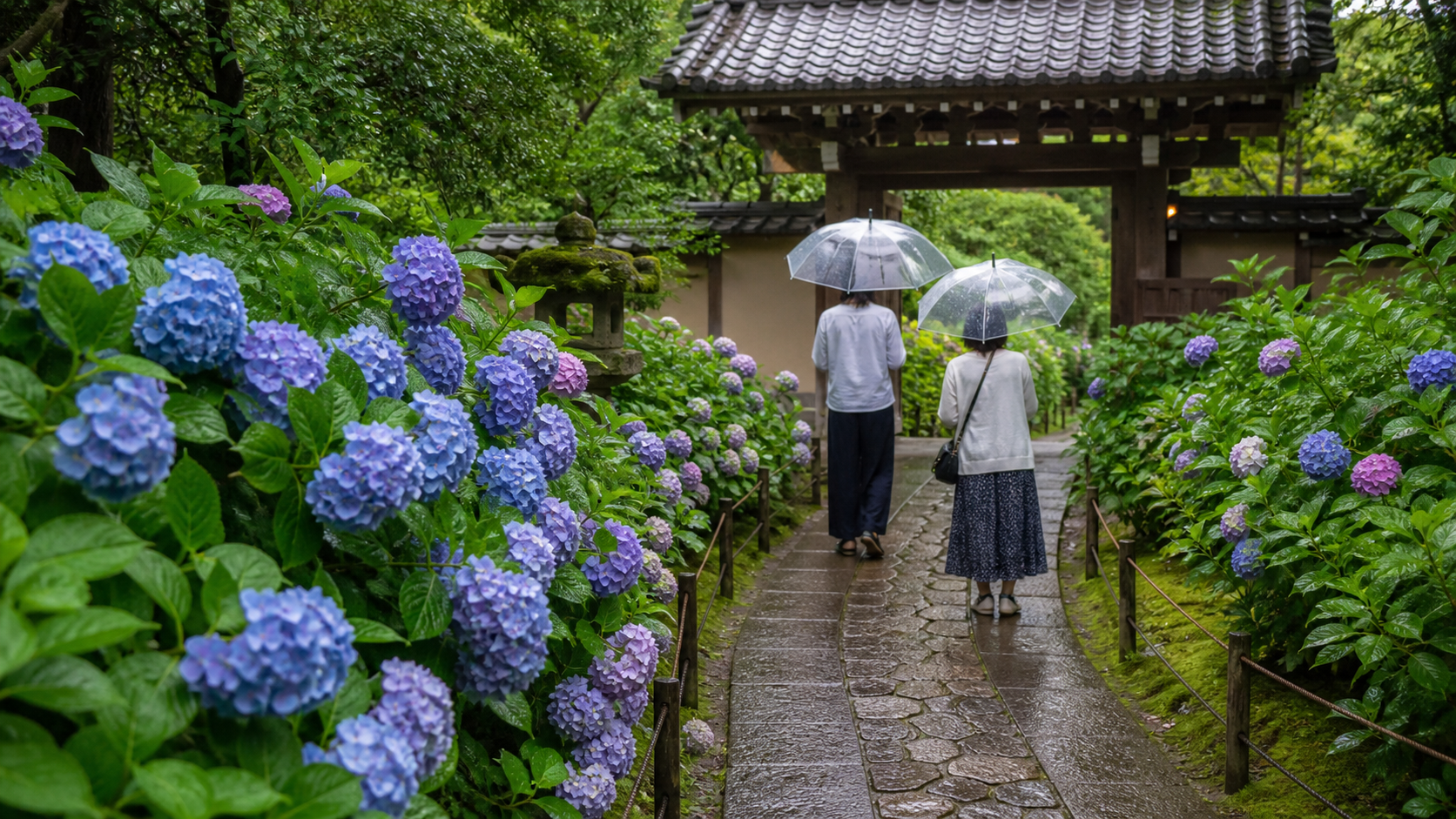
Japan’s rainy season is not a fixed nationwide block of dates. It advances by region, varies from year to year and may bring anything from humid cloud to dangerous downpours. For travelers who plan flexibly, however, early summer also brings ajisai—hydrangeas glowing beside temple paths and neighbourhood shrines.
Rainy-season dates are regional, not a promise
The Japan Meteorological Agency describes tsuyu as a seasonal transition with more rain and less sunshine. Entry and exit each span roughly five days, and final dates are reviewed after the season. Okinawa and Amami generally enter earlier than much of Honshu; Hokkaido is not included in the JMA’s regional rainy-season declaration list. A phrase such as “early June to mid-July” is therefore only a rough planning idea for parts of Japan, never a national guarantee.
Hydrangea flowering also shifts with temperature, rain and location. Official garden updates are more useful than a fixed annual date. Rain can deepen the atmosphere, but it does not guarantee fewer visitors or cheaper hotels—famous gardens can be busiest at peak bloom.
Which of these three places fits your trip?
| Place | Best for | Typical effort | 2026 reference |
|---|---|---|---|
| Meigetsu-in, Kamakura | Dense blue hydrangeas and Zen-temple context | Easy rail access; severe peak queues possible | June hours 8:30–17:00; last entry 16:30 |
| Mimurotoji, Uji | Large garden and many varieties | 15-minute walk; slopes and wet surfaces | Garden May 31–July 5; entry 8:30–15:10 |
| Hakusan Shrine, Tokyo | Free neighbourhood festival near the subway | Compact and convenient; weekend crowding | Festival June 6–14; free entry |
Dates, hours and prices below were checked on 26 August 2026 and describe the 2026 season. Use them as a reference for planning a later year, not as next year’s schedule.
Meigetsu-in: the blue hydrangea approach in Kamakura
Meigetsu-in is a Zen temple associated with the historic temple landscape of Kita-Kamakura. Around 2,500 hydrangeas, many of them the blue-flowering type popularly called “Meigetsu-in Blue,” frame its approach. The flowers are not a photo set: visitors are entering an active religious and historic place.
- Address: 189 Yamanouchi, Kamakura, Kanagawa.
- Access: about 10 minutes on foot from JR Kita-Kamakura Station.
- Admission: high-school age and above ¥500; elementary/junior-high students ¥300. A separately opened rear garden may require another ¥500.
- Hours: normally 9:00–16:00; in June 2026, 8:30–17:00 with last entry at 16:30.
- Closed days: no simple weekly closure is published; special closures may occur around hydrangea pruning or due to conditions. Check the Kamakura tourism notice before departure.
- Recommended visit: arrive near opening, allow 60–90 minutes, then continue on foot only if paths and weather are safe.
Mimurotoji: a large hydrangea garden in Uji
Mimurotoji is the tenth temple of the Saigoku Kannon pilgrimage and is known today as a flower temple. Its hydrangea garden opens for a defined season, so normal temple hours do not automatically mean the garden is open.
- Address: 21 Shigatani, Todo, Uji, Kyoto.
- Access: about 15 minutes on foot from Mimurodo Station on the Keihan Uji Line.
- 2026 hydrangea season: May 31–July 5; admission reception 8:30–15:10.
- Admission: adults ¥1,000; children ¥500 during the advertised hydrangea opening.
- Regular closures: August 11–17 and December 29–31; admission may stop when a weather warning is issued.
- Recommended visit: allow 90–120 minutes and wear shoes with grip. Mid- to late-June weekends bring heavy road and parking congestion, so use the train.
Hakusan Shrine: a neighbourhood festival in central Tokyo
Hakusan Shrine was invited from Kaga in 948 and is one of the Tokyo Ten Shrines. Hydrangeas spread through the shrine and adjoining Hakusan Park, turning a local religious space into a community early-summer gathering rather than a commercial flower park.
- Address: 5-31-26 Hakusan, Bunkyo City, Tokyo.
- Access: about 2 minutes from Hakusan Station Exit A3 on the Toei Mita Line, or 2 minutes from Hon-komagome Station Exit 1 on the Tokyo Metro Namboku Line.
- 2026 festival: June 6–14.
- Admission: free; some activities may charge.
- Closed days: the shrine and public park are not presented as a ticketed attraction with a weekly closure. Event stalls and special areas operate only at announced times.
- Recommended visit: allow 30–60 minutes, avoid blocking worshippers, and use public transport because there is no visitor parking.
A weather-smart half-day plan
- The night before: read the venue notice and JMA forecast/warnings; save an indoor alternative near the same rail line.
- Morning: wear quick-dry layers and non-slip closed shoes. A compact umbrella is useful, but a light rain jacket keeps hands free on crowded paths.
- At the entrance: confirm last admission and any one-way route. Do not assume an evening illumination is included in daytime admission.
- During the visit: shorten the route if water pools, wind strengthens or thunder is heard. Leave immediately when staff restrict an area.
- Afterward: fold and bag a wet umbrella before entering trains, museums or shops; never leave it open in a doorway.
Flowers, worship and photography
- Stay on the path. Do not bend stems, move ropes or enter planting beds for a portrait.
- Let worshippers approach the hall or offertory box before taking photographs.
- Tripods, drones, commercial shoots and portrait sessions may be restricted even when phone photography is allowed.
- Do not occupy a narrow viewpoint for repeated poses. Take a few frames, then yield.
- Keep voices low and do not present a temple or shrine as merely an “Instagram spot.”
Frequently asked questions
Must I visit in the rain?
No. Hydrangeas are attractive under cloud or after rain, and a dry morning is easier and safer. Heavy rain is a reason to postpone, not a premium experience.
Can I predict peak bloom months ahead?
Not precisely. Use the usual period only to choose travel dates, then follow the venue’s current bloom updates.
Are these three places a single itinerary?
No. They are in Tokyo, Kanagawa and Kyoto. Choose the one that fits your existing route; traveling between them wastes time and increases transport impact.
Official sources: Japan Meteorological Agency rainy-season data, Kanagawa Tourism: Meigetsu-in, Mimurotoji hydrangea garden, and Bunkyo Hydrangea Festival 2026. Checked 26 August 2026.