


Information checked: August 26, 2026. A typhoon is not a sightseeing theme and “typhoon season” is not a guarantee that a storm will—or will not—affect your dates. Tropical cyclones can approach Japan outside a simple July-to-October label, and yearly counts change. Base decisions on the Japan Meteorological Agency’s current track, warnings and local risk information, not a historical average.
A forecast track is not the same as a local warning
Use the JMA typhoon map for the storm’s current position, forecast track and intensity, then check the warning map for the exact municipality. A forecast cone describes uncertainty in the center’s future location; it is not the storm’s physical width or a safe/unsafe border. Hazard may extend far from the center and include strong wind, heavy rain, storm surge, high waves, river flooding and landslides.
Also check the municipality, hotel, airport, airline, railway and attraction directly. Social-media footage, a map screenshot from yesterday or the fact that a convenience store is open cannot prove that your route is safe.
Before arrival: protect flexibility, documents and medicine
- Save airline, railway, hotel and travel-insurance contacts and understand change, cancellation and additional-night rules.
- Keep passport details, reservations, prescriptions and emergency contacts available offline and backed up securely.
- Carry enough prescribed medicine for disruption, following storage requirements; do not replace medical planning with convenience-store supplies.
- Check the GSI hazard map and the municipality’s evacuation sites for the exact accommodation. The nearest building is not automatically appropriate for every hazard.
- If arrival is forecast near severe conditions, ask the carrier and hotel before traveling to the airport or station. Do not start an unnecessary transfer merely to “beat” the storm.
Flights, Shinkansen and local lines make separate decisions
A flight, one Shinkansen operator, a private railway, a city subway, a bus and a ferry can suspend service at different times. “Planned suspension” means an operator may announce in advance that service will stop; the timetable may then change again as the forecast evolves. Check the operating company, not only a route-planning app.
Do not go to a closed airport or station unless the operator instructs you to. Confirm rebooking, baggage, hotel extension and the last safe connection remotely. After service restarts, crowding and rolling-stock positioning can continue to cause delays. Never assume the first train is the easiest option.
At the hotel: ask which location is safest for this building
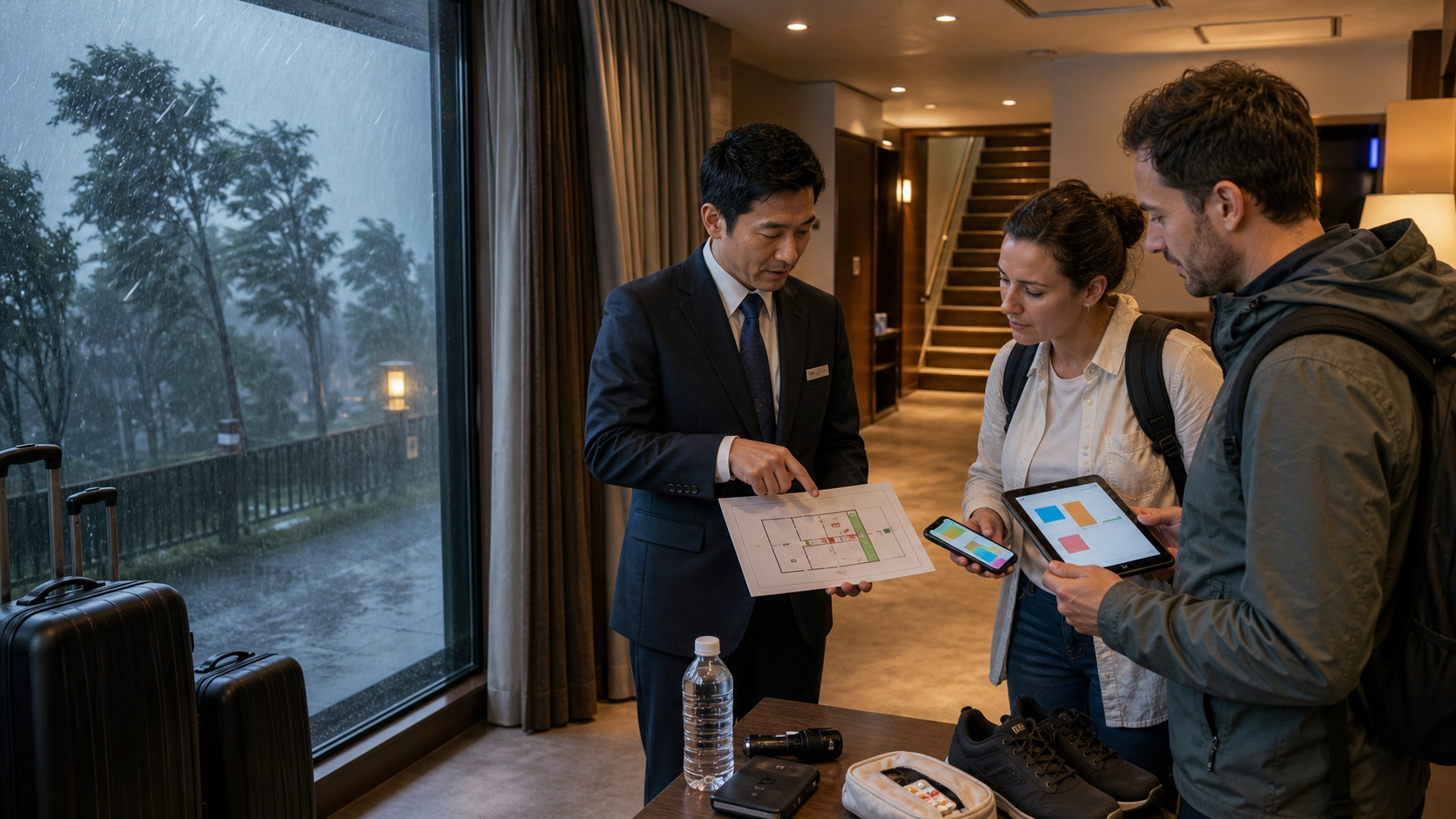
Tell reception if you need language, mobility, hearing, vision, medical or family assistance. Ask where the emergency stairs, assembly point and official evacuation site are; whether windows, shutters, elevators, restaurant, water and backup power have special procedures; and how staff will deliver instructions. A room, lobby, bath or upper floor is not universally safest—flood, landslide, wind and fire risks differ.
Stay away from windows and balconies, close curtains if instructed, bring loose balcony items inside only before conditions become dangerous, charge devices and keep shoes, flashlight and a small bag ready. Do not use an elevator during a fire, power failure or when staff says not to. A hotel bath or onsen may close, and bathing during an emergency can delay evacuation.
Prepare essentials without panic buying
Before conditions deteriorate, prepare drinking water, food that meets dietary needs and requires little preparation, a flashlight, charged power bank, phone cable, prescribed medicine, hygiene supplies, infant or disability items, closed shoes and some cash. Quantities depend on official guidance, household needs and the accommodation; do not empty shelves or travel through dangerous weather to shop.
Keep a battery light rather than an open flame. Store food safely during an outage and follow local notices about tap water. Never run a fuel-burning stove, grill or generator indoors or in an enclosed balcony because of carbon-monoxide risk.
“Stay indoors” is not a universal instruction
If the municipality or emergency staff issues an evacuation instruction, act early and follow the route they specify. Do not wait for water to rise, wind to peak or darkness to fall. Conversely, do not improvise an outdoor move during extreme conditions when authorities direct you to shelter in place. The correct action depends on location, timing and hazard.
Do not enter underground passages or basements during flood risk, approach rivers or coasts, stand near windows to film, or retrieve objects outside. People who may need more time should ask the hotel and municipality for help before conditions worsen.
The eye or a quiet morning does not prove the danger has ended
A temporary lull may be the eye of a typhoon, and rain can continue after the center passes. Wait for official clearance. Hazards include broken glass, unstable signs, downed power lines, flooded underpasses, contaminated water, landslides and rivers that continue rising upstream.
Recheck every segment before departure: local road, station entrance, line operator, airport access, flight and destination. Photograph damage only from a safe lawful place and never obstruct emergency crews or residents. Keep receipts and written cancellation notices if your insurer requires them.
Emergency numbers and useful Japanese
When should I call 119 or 110?
Call 119 for fire, ambulance or urgent rescue, and 110 for police emergencies. Give the address or landmark, what happened, number of people and your phone number. Do not use emergency lines for timetable questions.
What can I say?
- Taifū no saishin jōhō wa arimasu ka? — Do you have the latest typhoon information?
- Hinan basho wa doko desu ka? — Where is the evacuation site?
- Watashi wa aruku no ni tasuke ga hitsuyō desu. — I need help walking.
- Kyūkyūsha o onegai shimasu. — Please call an ambulance.
Should I go outside after an emergency alert appears on my phone?
Read or ask staff to interpret the alert. It may concern evacuation, weather, river, landslide or another hazard; the correct action is not always the same.
Official resources: JMA typhoon information / JMA warnings / GSI hazard map portal / Safety tips / JNTO emergencies