



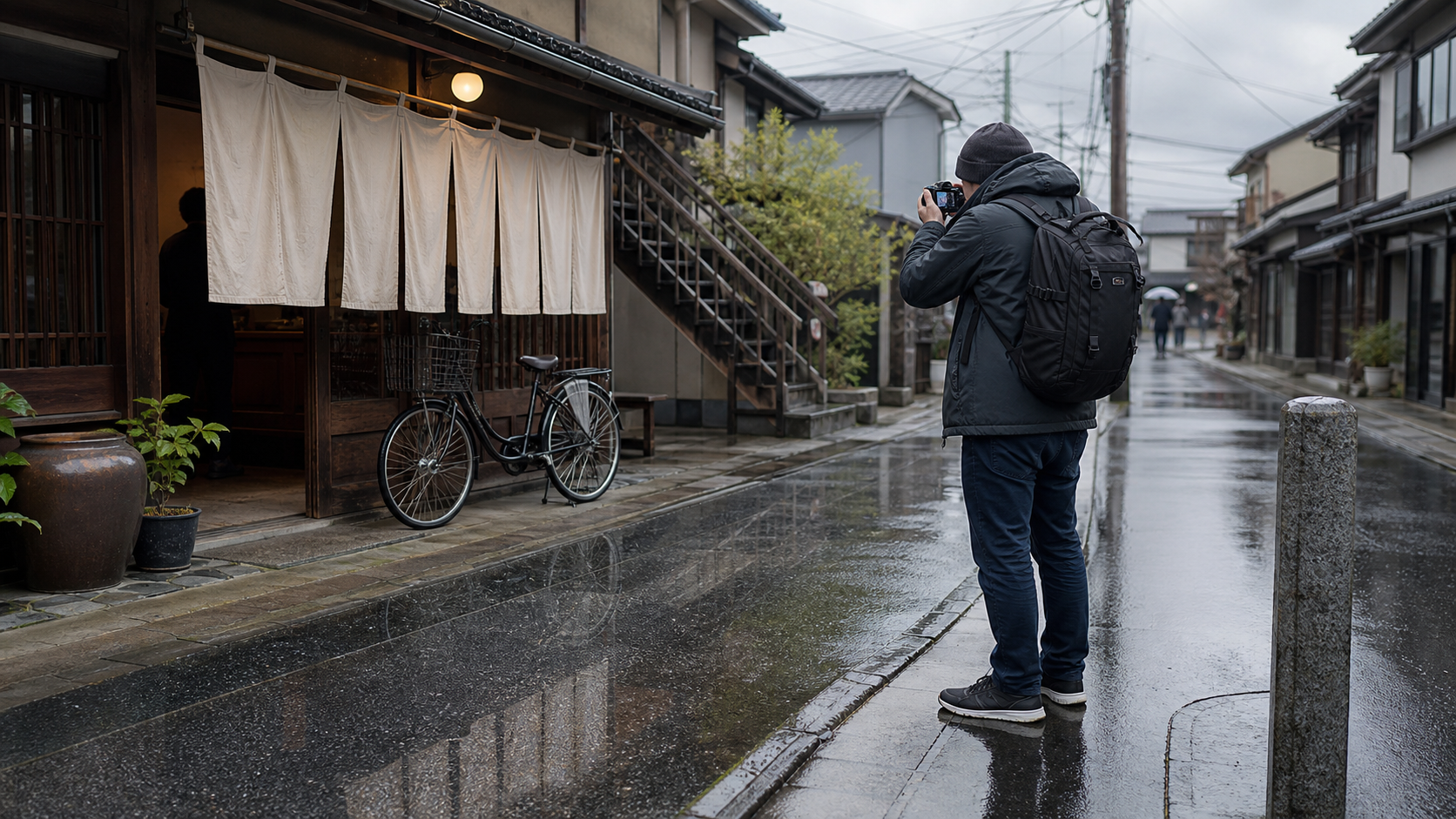
Cloud does not automatically make every photograph better. It acts like a broad diffuser: shadows soften and surface detail becomes easier to hold, while a bright blank sky and flat contrast become new challenges. In Japan’s lived-in streets, the best technique also includes permission, private-property boundaries and keeping daily routes open.
1. What clouds actually do to light
A cloud layer enlarges the apparent light source, reducing hard facial shadows and glare on wood, stone, food displays and plants. Color can look richer because highlights are less likely to clip. But heavy cloud reduces total light and can make scenes gray. Expose for the subject, not the sky, and avoid claiming that overcast conditions always produce “vivid” color.
2. Subjects that suit soft light
- Wooden facades, noren curtains, tiles and weathered metal.
- Temple garden moss and wet stone—only from permitted paths.
- Shopping-street awnings, bicycles and repeating signs without identifying residents.
- Seasonal flowers and food displays where the shop permits photography.
- Reflections after rain, framed safely from the pavement edge.
Details often say more about everyday Japan than forcing a famous landmark into every frame. Do not treat homes, laundry, schoolchildren or working people as free props.
3. Compose when the sky is blank
Reduce the amount of bright sky by using eaves, arcades, trees or a gate as a frame. Look for leading lines in drains, paving, rails and shopfronts; layer a foreground object, middle-distance subject and background street. A pale sky can work as negative space if it supports the subject, but it should not dominate by accident.
Black and white is a creative choice, not an automatic repair. Use it when texture, rhythm and tonal separation are stronger than color.
4. Practical camera and phone settings
| Situation | Starting point | Check |
|---|---|---|
| Static street detail | ISO 100–400, f/4–8, stabilization on | Shutter remains hand-holdable |
| Walking subject with permission | At least about 1/250 sec; raise ISO as needed | Face and hands are sharp |
| Wet reflection | Lower angle without stepping into traffic | Highlight warning and lens splash |
| Phone | Tap the main subject, lower exposure slightly if sky clips | Clean lens; avoid excessive HDR halos |
Shoot RAW+JPEG if you intend to edit, protect highlights, and use white balance consistently across a series. A small lens cloth is more useful than a large tripod on a narrow street.
5. Use after-rain reflections safely
Wait under a permitted shelter while rain is heavy, then use puddles and wet paving after it eases. Never step backward into a road, stand in a bicycle lane, or place equipment where someone can trip. A lens hood, cloth and simple rain cover help; change lenses under cover. Weather-sealed does not mean waterproof.
6. Build a respectful 60–90 minute walk
- Choose one public shopping street or historic district near a station.
- Check rain, closing times and photography restrictions.
- Begin with textures and architecture, then ask before including a person or shop interior.
- Pause for a legitimate café purchase rather than using a doorway as a free studio.
- Finish before light or weather deteriorates and review images away from the traffic flow.
Avoid publishing a fixed “secret alley” route through a residential block. Geotagging sensitive or overcrowded locations can intensify disturbance.
7. Photography etiquette in Japan
JNTO and GO TOKYO recommend asking before photographing people. A public street is not blanket consent for an identifiable portrait. Respect a refusal, delete an accidental close-up if reasonably requested, and be especially cautious with children. Ask before photographing artisans, vendors, shop interiors or other customers.
Follow no-photo, no-video and no-flash signs at temples, shrines, museums and stores. Stay behind barriers and off private land. In Kyoto’s Gion, never chase, stop, touch or photograph geiko or maiko without permission, and do not photograph private property or local children. Tripods and selfie sticks can obstruct narrow streets and are prohibited at some sites.
8. Checklist and FAQ
Carry: compact camera/phone, charged battery, cloth, small rain cover, non-slip shoes and a bag that leaves both hands free. Is a cloudy sky useless? No—use it deliberately as negative space or crop it. Can I photograph a shop from outside? Architecture may be visible, but people, interiors and displayed restrictions still require judgment and often permission. Can I use a tripod? Only where permitted and never where it blocks movement.
Official references: JNTO responsible photography, GO TOKYO sightseeing manners, and Kyoto City sightseeing guidelines. Venue rules override general advice.