


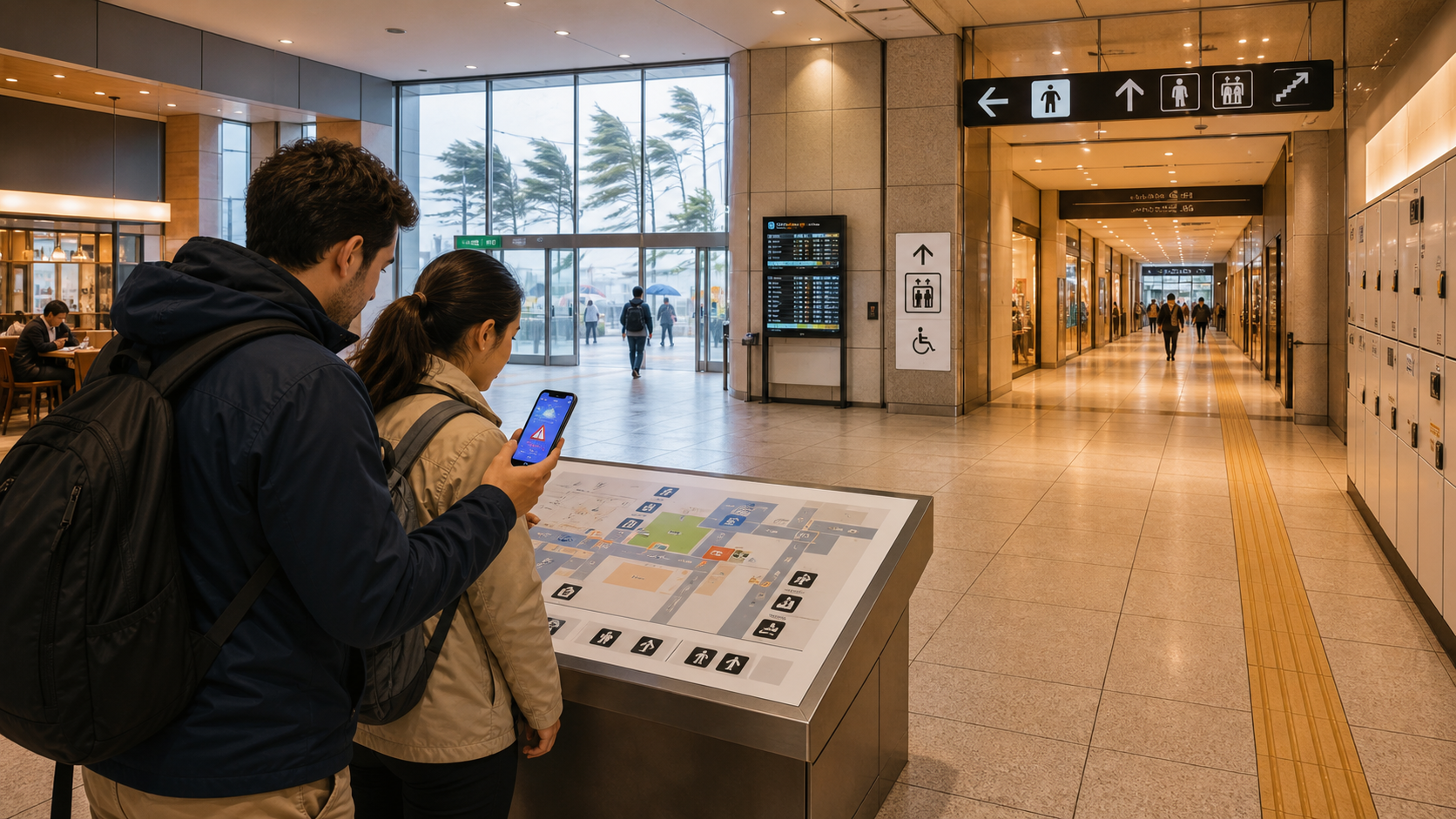
A station building or underground arcade can reduce exposure to ordinary strong wind, but it is not automatically a disaster shelter. During a typhoon, torrential rain, flooding, storm surge or evacuation notice, underground spaces may flood and trains may stop. Safety information comes before sightseeing.
1. First decide: change route or stop travel?
For a breezy day with normal train service, replace exposed bridges, waterfronts, rooftop decks and long street walks with connected station facilities. If the Japan Meteorological Agency issues warnings, transport operators announce suspensions, or local authorities give evacuation instructions, return to safe accommodation or follow staff directions. Do not descend underground simply to escape severe weather.
2. What strong wind changes
Wind accelerates around tower blocks, station exits and narrow gaps. Falling signs, branches and construction covers are hazards; umbrellas can turn inside out and become difficult to control. Observation decks, ropeways, ferries and outdoor attractions may close even when shops remain open. Check the exact operator, not yesterday’s timetable.
JMA specifically warns that underpasses and underground spaces can flood. Wind plus heavy rain is a different decision from wind alone.
3. Station and underground routes are networks, not one attraction
Ekinaka means commercial facilities inside a station, sometimes inside ticket gates. An underground mall may be outside the paid area and connected to several railways and buildings. A “connected” route can still contain an outdoor crossing, stairs or a locked after-hours door. Check the floor map, gate boundary, lift and opening time before committing.
Useful activities include an unhurried meal, regional food shopping, small exhibitions and route planning. Keep passageways clear; commuters still need to catch trains.
4. Tokyo Station First Avenue
| Address | 1-9-1 Marunouchi, Chiyoda City, Tokyo 100-0005 |
|---|---|
| Access | Immediately outside JR Tokyo Station’s Yaesu-side gates; the Yaesu Underground Central Gate is the clearest landmark |
| Hours | Vary by zone and shop; examples include Character Street 10:00–20:30 and Okashi Land 9:00–21:00 |
| Closed | Check facility and individual-shop notices, especially during disrupted transport |
| Price | No general admission; purchases and meals cost extra |
Recommended plan: confirm trains, store large luggage, choose one food or culture zone, then leave enough time to find the correct gate. First Avenue is outside the ticket gates; do not confuse it with paid-area shops.
5. Whity Umeda
| Address | Umeda Underground Mall 4-2, Komatsubara-cho, Kita-ku, Osaka 530-0018 |
|---|---|
| Access | Direct from Higashi-Umeda Exit 1 direction, Osaka Metro Umeda South Gate Exit 13 direction, and Hanshin Osaka-Umeda East Gate; about 3 minutes from JR Osaka Midosuji Exit |
| Typical hours | Shopping/services 10:00–21:00; restaurants/cafés 10:00–22:00; NOMOKA 11:00–23:00 |
| Closed | Facility notices and individual shops vary |
| Price | No general admission |
The Umeda underground network is extensive and easy to misread. Use zone names and exit numbers, not only “Osaka Station,” and expect some connections to close earlier than restaurants.
6. A practical strong-wind plan
- Check JMA/Safety tips, railway status and facility notices before leaving.
- Choose one connected complex near your hotel—not a cross-city checklist.
- Screenshot the floor map and mark ticket-gate boundaries, lift and hotel return exit.
- Carry a compact rain jacket; avoid opening an umbrella in a gust at the exit.
- Recheck conditions before going above ground. If alerts worsen, stop.
7. Accessibility, luggage and children
Accessible does not mean every shortcut is step-free. Record lift operating hours, tactile paving, accessible toilets, rest areas and the widest gate. Do not block tactile paths with suitcases. In crowds, hold children’s hands before escalators and arrange a meeting point. Travellers sensitive to noise or crowds should visit outside commuter peaks and identify a quiet café or rest area.
8. FAQ and official tools
Is underground always safer? No. It reduces ordinary wind exposure but can be dangerous during flooding. Can I stay after trains stop? Do not assume so; follow facility and railway staff. Are station shops all inside the gates? No. Check whether re-entry requires a fare. What should I monitor? JMA warnings, JNTO Safety tips, railway and local-government notices.
Official references: JNTO Safety tips, JMA natural-hazard guidance, First Avenue Tokyo Station, Whity Umeda. Conditions and hours change; confirm on the day.