


Information checked: August 26, 2026. Japan’s rainy season is not a fixed nationwide block from June to July. Timing and intensity differ by region and year, Hokkaido is not described by the same pattern as much of the archipelago, and heavy rain or a typhoon requires a different decision from ordinary drizzle. A useful rainy-day plan begins with the forecast, then matches gear and route to the actual conditions.
Ordinary rainy-season rain, heavy rain and typhoons are different plans
Check the exact municipality on the Japan Meteorological Agency map, including warnings, hourly rain, wind and transport notices. For ordinary rain, a shorter outdoor walk linked to indoor stops may work. During heavy rain, flooding, landslide risk, strong wind, evacuation information or suspended transport, stop sightseeing and follow authorities and facility staff. An underground passage is not automatically safe from flooding.
Do not rely on a month label or a weather-app icon. Conditions can change during a museum visit, and mountain trails, riverbanks, coastal paths, gardens, ropeways and boats may close even when urban shops remain open.
Long umbrella, folding umbrella or rain jacket?
| Gear | Works well for | Limits |
|---|---|---|
| Long umbrella | Steady city rain and good coverage | Awkward on crowded trains; easy to leave behind |
| Folding umbrella | Uncertain showers and compact luggage | Smaller canopy; dry and fold it after use |
| Rain jacket | Wind, luggage, stairs and hands-free movement | Can trap heat and sweat; ventilation matters |
| Water-resistant shoes or covers | Wet pavements and repeated walking | “Water-resistant” is not unlimited waterproofing; soles still need grip |
Transparent plastic umbrellas are common because they preserve visibility in crowded streets, not because they guarantee better photographs. Do not buy one unnecessarily for a single shower; hotels may lend umbrellas, while rental and return rules vary. Mark your own umbrella discreetly without damaging borrowed property.
“Directly connected to the station” may still include rain exposure
Record the line, ticket gate, exit number, elevator and whether each segment is inside or outside. A station complex may connect to one building underground while another entrance requires a street crossing. Gates, underground passages and department stores also have different opening hours, and the shortest stair route may not be step-free.
- Choose one station district rather than crossing the city repeatedly.
- Save the official floor map and mark the first covered entrance.
- Confirm the route is outside or inside the ticket gates; entering a paid area may require a fare.
- Keep one surface exit as an emergency reference, but never use a flooded underpass.
- Check the return line before the final activity; rain can disrupt service.
Build a cultural day, not a random list of roofs
Museums, galleries, aquariums, craft workshops, public libraries, department-store food halls, covered shopping arcades and sento can reveal Japanese design, food and neighborhood life. For every named venue, verify the exact address, nearest staffed station and exit, admission, reservation, closed day, last entry, temporary exhibition surcharge, bag policy, photography rules and accessibility. A lobby or cafe may not be free to use without admission or a purchase.
A practical half-day is one museum or workshop, lunch in the same connected district, then one covered shopping or food stop. Keep a genuinely nearby backup; do not advertise a “secret indoor spot” that is private property or lacks public access.
How to handle a wet umbrella in Japan
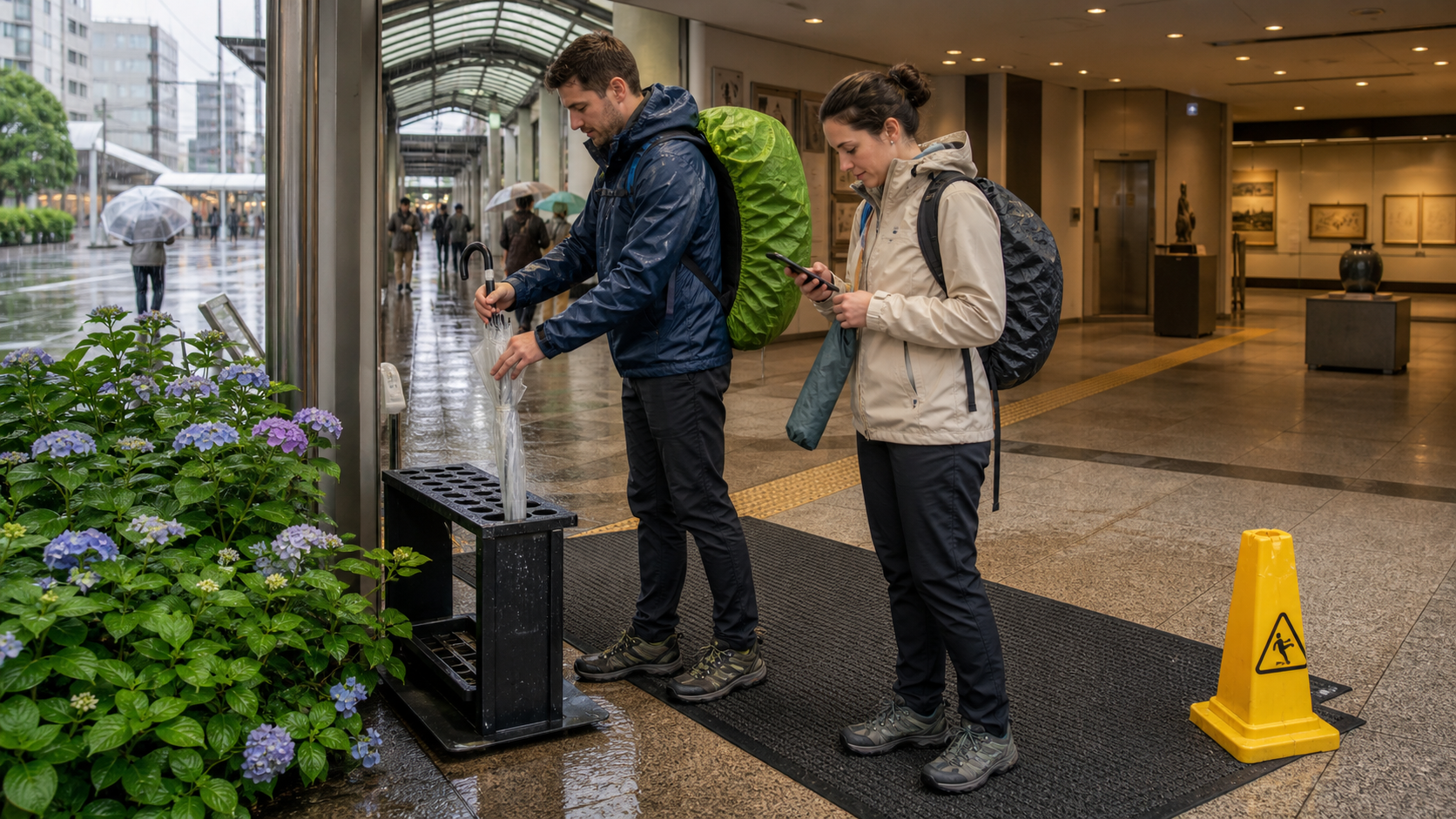
- Close the umbrella before entering the doorway and shake off water only where it cannot hit people.
- Use the umbrella stand, drip tray, reusable sleeve or facility-provided bag as instructed. Avoid taking single-use plastic if a reusable cover works.
- Carry a long umbrella vertically with the tip down; never swing it backward on stairs or escalators.
- Do not assume an umbrella in a communal stand is free to borrow. Similar transparent umbrellas still belong to someone.
- On trains, keep wet gear compact and away from seats, other passengers and tactile paving.
Wet tile, stairs and station crowds need a slower pace
Use shoes with familiar grip, shorten your stride and keep a hand free for rails. Entrance mats, painted road markings, metal covers, temple stone, station tile and fallen leaves can be slippery. Do not stop suddenly under a narrow awning to open an umbrella; move fully out of pedestrian and bicycle flow.
Children should not carry an umbrella with a sharp tip in a dense crowd. Travelers using wheelchairs or strollers should confirm covered step-free routes, elevator operating hours and drainage lips. If lightning, violent wind, inundation or an evacuation notice is present, rain gear is not a reason to continue.
Rain can reveal Japanese streets without turning residents into props
Wet stone, noren curtains, hydrangeas, arcade reflections and careful umbrella choreography can show how Japanese places adapt to rain. Photograph from a safe standing position and obtain permission for recognizable people, shop interiors, craftspeople and private property. Public access does not equal portrait consent.
Never step into a road, block a doorway, chase geisha or maiko, enter a residential lane marked private, or place a tripod in a busy station. Museums, temples and shops may prohibit photography, video, flash, tripods or umbrellas regardless of the weather.
Frequently asked questions
Can I take an umbrella onto a train?
Yes, but close it, contain drips and keep it from seats and other passengers. Facility-specific covers or stands should be used as directed.
Are station lockers safe for wet gear?
Do not place a dripping umbrella or soaked clothing into a locker unless the operator permits it. Moisture can damage your belongings and the compartment.
Does “underground route” mean safe during a downpour?
No. Underground spaces can flood. Follow warnings, barriers and staff; never enter water of unknown depth.
Official resources: JMA warnings / JMA forecast information / JNTO emergencies / JNTO June guide