



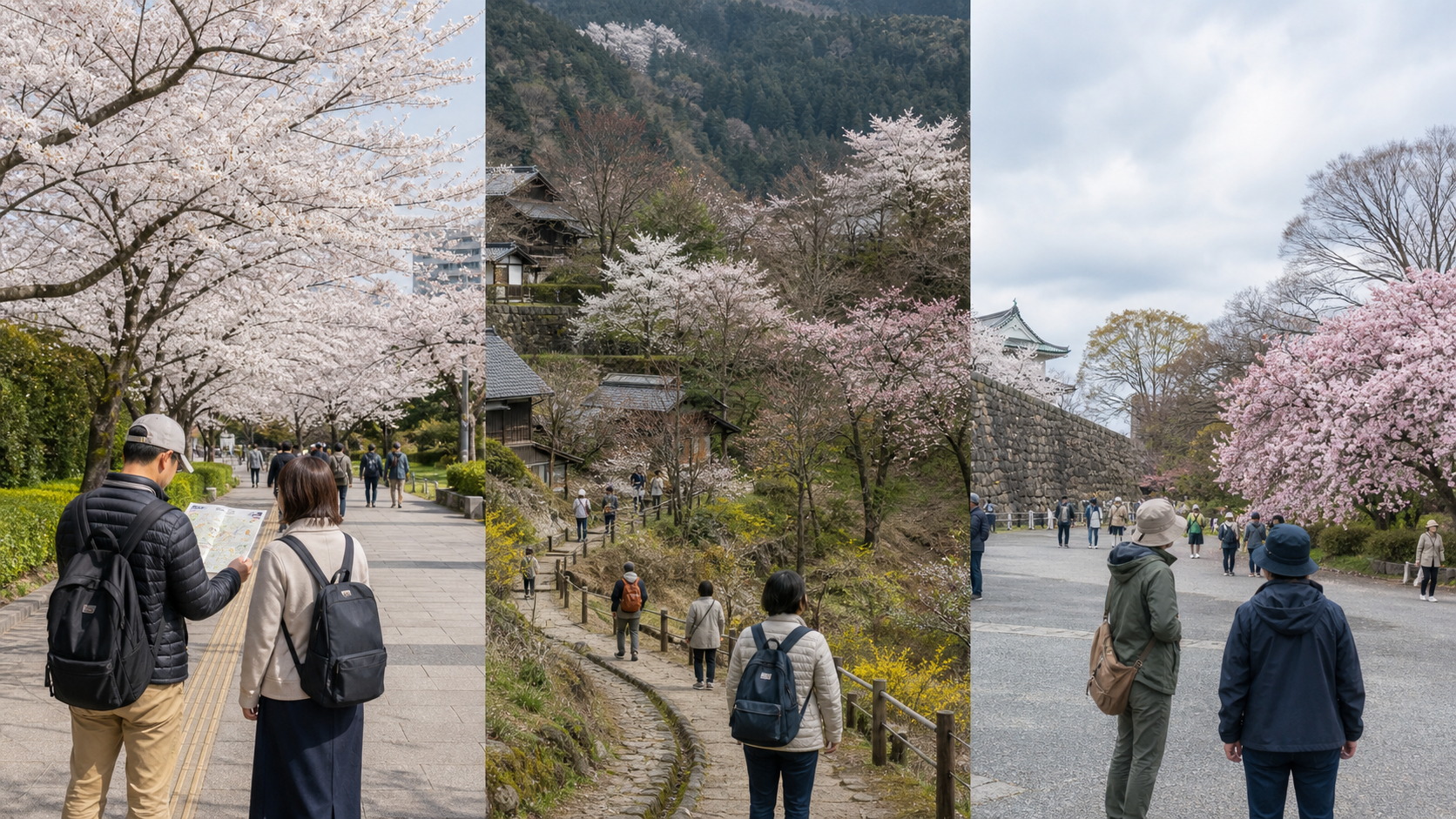
Information checked: August 26, 2026. Japan’s “sakura front” is useful for understanding the broad movement of spring, but it is not a railway line that arrives everywhere on schedule. Species, altitude, recent temperatures, rain and wind can shift the best viewing period. This guide uses the completed 2026 season as evidence and shows how to plan a future trip without treating an early forecast as a guarantee.
1. What the sakura front really means
The “sakura front” (sakura zensen) is an easy way to describe flowering progressing across Japan, generally from warmer areas toward cooler northern regions. It is a map-based planning image, not a single official line. The Japan Meteorological Agency (JMA) observes designated specimen trees and publishes actual flowering and full-bloom dates; private weather companies publish forecasts using their own methods.
“Flowering” normally means that the observed standard has been reached on a specimen tree, while “full bloom” is a separate observation. Neither tells you that every tree in the destination looks identical. A riverbank, mountain slope and city garden can differ on the same day. Okinawa is also not simply the first stop of a Somei-yoshino front: its winter display commonly involves the darker-pink Hikanzakura, while parts of Hokkaido are observed using other species.
2. The completed 2026 season: why normal dates are not promises
JMA’s completed full-bloom observations show how far one season can sit from the 1991–2020 normals. Tokyo reached full bloom on March 28, compared with a March 31 normal; Kyoto on March 30, compared with April 4; Aomori on April 16, compared with April 26; and Sapporo on April 24, compared with May 6. Fukuoka, however, reached full bloom on April 3, three days later than its March 31 normal. The pattern was not a perfectly even northward wave.
| JMA observation point | 2026 full bloom | 1991–2020 normal | Planning lesson |
|---|---|---|---|
| Tokyo | March 28 | March 31 | A city trip needs flexible days, not one “peak-day” booking. |
| Kyoto | March 30 | April 4 | Temple and garden trees still vary by species and exposure. |
| Fukuoka | April 3 | March 31 | “South always blooms first and early” is too simplistic. |
| Aomori | April 16 | April 26 | Northern destinations can run substantially earlier than normal. |
| Sapporo | April 24 | May 6 | A May-only Hokkaido plan can miss an early year. |
These are city observation dates, not a promise for every named park. Use them to understand uncertainty and compare seasons—not to retroactively label an entire prefecture “full bloom.”
3. A three-stage planning method
- Two to six months ahead: choose a region and a city base using normal ranges, flight and rail flexibility, and activities that remain worthwhile without blossoms. Avoid non-refundable travel that succeeds only on one date.
- Two to three weeks ahead: compare the latest forecast with the destination’s official park, city or tourism updates. Confirm reservation systems, festival dates, night lighting and temporary transport separately; they may not move with the flowers.
- Three days to the morning of your visit: check live images or official condition reports, JMA rain/wind warnings, closures, last transport and crowd controls. Strong rain or wind can shorten a peak quickly.
Do not confuse a forecast issue date, first-flowering date, full-bloom estimate and festival date. Save a screenshot of the current official page, but recheck it rather than relying on a social-media repost.
4. Choose a regional window, not one fixed date
For Somei-yoshino planning, late March to early April is a useful starting window for many large cities in Kyushu, Shikoku and central Honshu; mid- to late April often brings options in Tohoku; and late April into May is a normal starting assumption for Hokkaido. These are planning ranges, not forecasts. Higher ground may bloom later than a nearby station district, while early weeping cherries or late double-flowered varieties can extend a destination’s season.
A resilient itinerary pairs one famous place with a second landscape type: for example, a managed garden plus a riverside walk, or a castle park plus a museum. If one site is crowded or past peak, the day still reveals how spring changes urban life, gardens and local routines.
5. Three contrasting places and their practical details
| Place | Address and access | Admission / closure | Recommended use |
|---|---|---|---|
| Shinjuku Gyoen National Garden, Tokyo | 11 Naitomachi, Shinjuku-ku. Use Shinjuku Gate, Okido Gate or Sendagaya Gate according to your rail line. | Adults ¥500. Normally closed Mondays (or next weekday after a holiday) and Dec. 29–Jan. 3; open daily March 25–April 24. Seasonal hours apply, and busy blossom dates may require advance booking. | Allow 2–3 hours to compare about 70 varieties and different garden styles. Confirm the current reservation notice before departure. |
| Mt. Yoshino, Nara | Reach Kintetsu Yoshino Station, then walk about 20 minutes uphill to Shimo-senbon or use seasonal transport when operating. | The mountain landscape has no single admission ticket or closing day; temples, gardens, ropeway, buses and parking have separate fees and schedules. | Choose Shimo-, Naka-, Kami- or Oku-senbon according to current flowering, fitness and return transport. Wear walking shoes and expect substantial elevation. |
| Hirosaki Park, Aomori | 1 Shimoshiroganecho, Hirosaki. From JR Hirosaki Station, use a city bus to the park area and verify seasonal traffic controls. | Much of the park is free. The castle Honmaru/Kita-no-Kuruwa paid area is ordinarily ¥320 for adults from Apr. 1–Nov. 23, 9:00–17:00; festival hours can differ. The castle keep’s interior is closed for several years from Nov. 24, 2025. | Use the city’s species-by-species updates: later double-flowered cherries may remain after Somei-yoshino. Do not assume festival dates equal peak bloom. |
Prices, opening hours, paid zones and seasonal transport can change. The official page on the day of travel outranks this checked snapshot.
6. Hanami is more than “a picnic under pink trees”
Hanami means viewing flowers. Its present forms range from a quiet walk or lunch with family and colleagues to temple landscapes, castle parks and illuminated evening visits. Cherry blossoms have accumulated poetic associations with seasonal change, beauty and impermanence, but visitors do not need to perform a solemn interpretation. Careful observation—buds, falling petals, new leaves and the way a community uses its park—is already meaningful participation.
Some trees at Yoshino are tied to religious history and mountain worship rather than planted merely as a modern photo backdrop. Castle parks such as Hirosaki also combine horticultural care, historic space and civic festival culture. Read the local landscape before reducing every blossom site to the same “Japanese spring” image.
7. Picnic, tree and photography etiquette
- Confirm whether sheets, food and alcohol are permitted. Some gardens prohibit alcohol, sports equipment or specified picnic setups.
- Use only designated lawn or seating areas. Do not occupy paths, emergency routes, entrances or tactile paving.
- Never pull down, shake, climb or cut branches. Do not pick flowers, even for a photograph.
- Take rubbish to an authorized collection point or carry it away. Do not leave bags beside a full bin.
- Keep music and voices at a level that does not take over the shared space; follow closing and last-entry times.
- Ask before photographing recognizable individuals. Avoid tripods, long portrait sessions or group poses where they stop pedestrian flow.
- At temples and shrines, worship and ritual access take priority over blossom photography. Obey photography restrictions inside sacred areas.
8. Weather, crowds and accessibility
Spring can bring cold mornings, rapid warming, rain and strong wind on the same trip. Carry layers, a compact rain layer, water and any required medication. Wet petals, roots, stone steps and sloping mountain roads can become slippery. Night illumination requires warmer clothing than an afternoon visit.
For wheelchairs, strollers or limited stamina, verify the exact gate, gradients, surface, accessible toilet and lift—not just whether a site is marked “accessible.” Shinjuku Gyoen is a more controllable choice than a steep mountain route, while Yoshino requires careful area selection and seasonal transport checks. At peak times, arrive early but never queue before staff allow it; choose a meeting point outside the densest gate area.
9. A flexible blossom day that still works off-peak
07:30–09:00: check the official condition report, weather, booking and return route. Visit one outdoor riverside or neighborhood location before commuter and tour-group pressure grows.
09:00–12:00: enter one managed garden, temple area or castle park after confirming its rules. Spend time with different species and landscape details instead of rushing between identical photo angles.
12:00–14:00: eat at a restaurant or permitted picnic area. If lawns are saturated or crowded, do not force a picnic.
14:00–17:00: use a museum, craft center, historic district or café as a weather-safe cultural anchor. Add a second blossom site only if current conditions and energy justify it.
Evening: attend illumination only when the organizer confirms it is operating. Keep a rail-based return plan and skip the night visit if wind, cold or crowds make it uncomfortable.
10. Final checklist and official sources
- Have you distinguished forecast, actual flowering, full bloom and festival dates?
- Is your hotel or ticket flexible by at least one or two days?
- Have you checked the individual park rather than only the city forecast?
- Do you know the entry reservation, last admission, picnic and alcohol rules?
- Is there a worthwhile rain, crowd or post-bloom alternative nearby?
- Can you leave without a taxi if seasonal traffic controls or queues change?
Primary references: JMA phenological observations, JNTO cherry blossom overview, Shinjuku Gyoen admission information, Yoshino Town blossom information, and Hirosaki City blossom reports.