


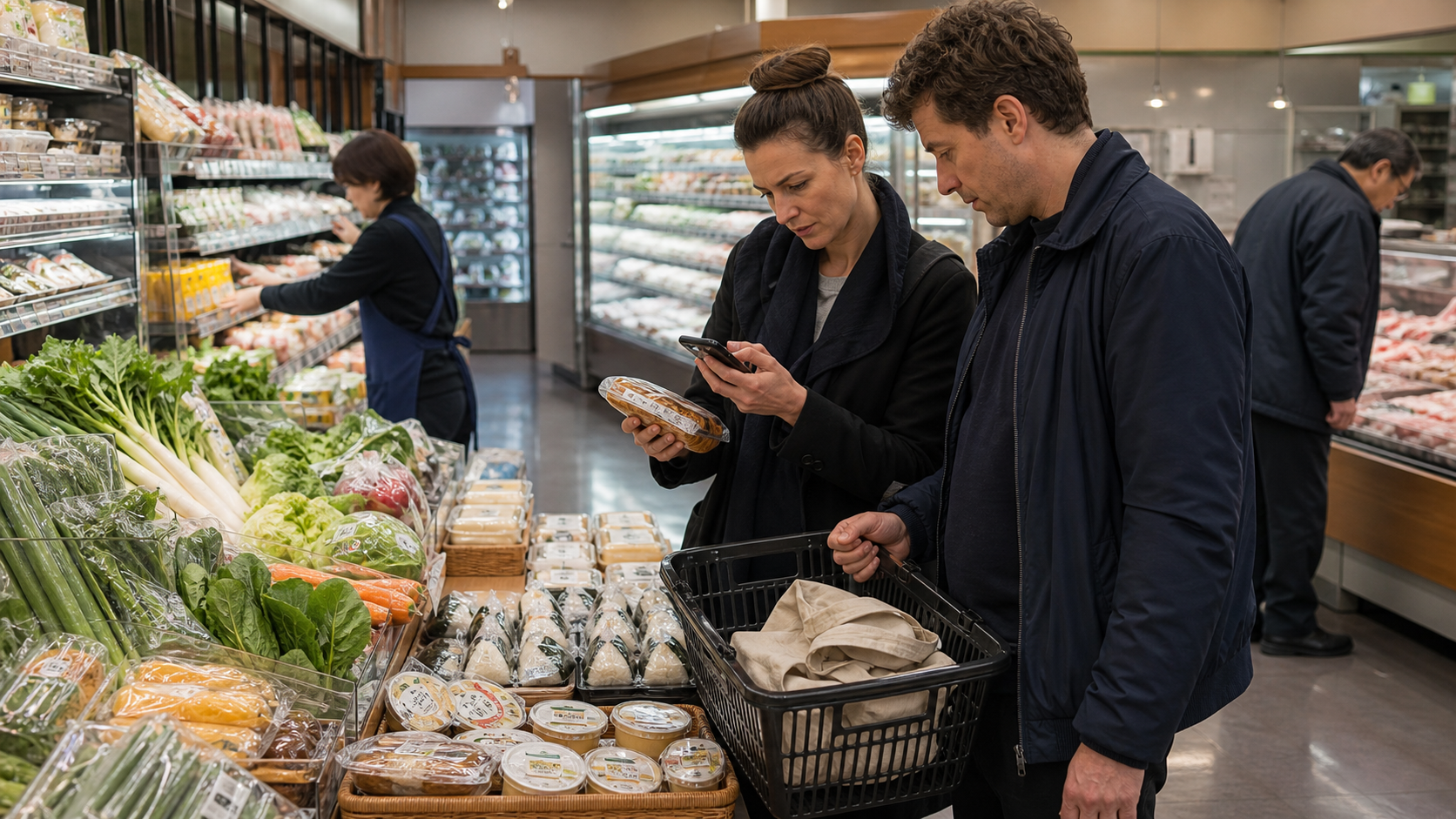
Information checked: August 26, 2026. A neighborhood supermarket is not a museum made for tourists; it is working infrastructure for residents. Visit at a quiet time, buy what you can use and you can still learn how region, season, household size and daily schedules shape Japanese food. This guide covers labels, prepared food, checkout, discounts, allergies and etiquette.
Look for regional supply, not cultural stereotypes
MAFF defines local production for local consumption as using agricultural, forestry and fishery products within the region where they are produced. A supermarket may therefore reveal nearby vegetables, fish landings, miso, soy sauce, pickles, rice varieties and local prepared dishes. But “local” on a promotional sign still needs a stated origin; it does not mean every item was produced nearby.
Package sizes, ready-to-eat foods and evening stock reflect household and work patterns, but one store cannot represent all Japanese people. Compare two seasons or regions rather than declaring one shelf “the real Japan.”
Five departments tell different stories
| Section | What to notice | What to check |
|---|---|---|
| Produce | Prefecture labels, season, loose versus small packs | Origin, price per pack/piece/weight, refrigeration |
| Fish | Local names, whole/cut/sashimi/cooked forms | Raw or heating required, bones, use-by date |
| Rice, miso, tofu | Regional staples and household sizes | Storage, soy, alcohol, dashi or mixed grains |
| Sōzai and bento | Daily side dishes, seasonal menus, portion choices | Use-by time, allergens, heating instructions |
| Local-product corner | Producer names, regional sauces, sweets and noodles | Actual origin, shelf life, destination customs |
Do not handle unpackaged produce excessively or open a package to inspect it. Use the provided tongs and bags only for their intended section.
賞味期限 and 消費期限 are not the same
| Japanese | Meaning | Action |
|---|---|---|
| 消費期限 (use-by) | Safety-related date for perishable food such as bento and sandwiches | Follow storage and do not eat after the stated limit |
| 賞味期限 (best-before) | Date through which unopened food should retain best quality under stated storage | Not automatically unsafe the next minute, but storage and condition matter |
| 要冷蔵 | Keep refrigerated | Count the whole journey; a hotel minibar may be inadequate |
| 加熱用 | Intended to be cooked | Do not eat raw; follow heating instructions |
| 原産地 / 原料原産地 | Origin of product or principal ingredient | Read which part the statement describes |
Japanese dates may be Western year or Japanese era and usually follow year/month/day. A discount sticker does not change storage instructions or extend the use-by time.
Prepared food is convenient, not room-temperature luggage
Choose bento, sushi and sōzai near the time you will eat them. Check use-by date and time, refrigeration and whether heating is required. Keep raw seafood chilled and separate from warm products. Do not leave food in a parked car or carry a seafood tray through a full sightseeing day.
Microwaves, chopsticks, sauces and eat-in areas vary by store. Ask before heating and remove any packet or lid the instructions identify. Eat only in a designated space or accommodation that permits it; do not open meals in the aisle or on a residential doorstep.
Observe the register before it is your turn
- Place your basket where indicated; do not abandon it in an aisle.
- Have payment ready. Cash, cards, transport IC and app support vary by store and checkout.
- State whether you need a bag. Plastic shopping bags generally cost extra; bring a clean reusable bag.
- At semi-self or self-checkout, scan/pay only as instructed and call staff for age-restricted items or errors.
- Pack at the designated table, keeping raw, chilled, hot and fragile goods separate.
- Take the receipt; it helps identify the store, product and tax if a problem occurs.
Japan does not normally use bargaining at supermarkets. Discount times are not guaranteed, and blocking the shelf while waiting for stickers is discourteous.
Japanese labels help, but do not cover every overseas allergen
The Consumer Affairs Agency requires packaged-food labels in Japanese. Mandatory and recommended allergen lists differ from other countries; items important to you may not be highlighted. Read the complete ingredient and allergen statements, not only a front icon. Alcoholic drinks have different allergen-labelling treatment.
Prepared foods may involve shared fryers, knives, trays and tongs. Dashi can contain fish; sauces may contain wheat and soy; salads may contain egg or dairy; “vegetable” does not prove vegan, halal or allergy-safe. For severe allergy, use the CAA communication sheet and ask staff; if they cannot confirm, do not buy.
Residents need the aisle more than visitors need a photograph
Visit outside the busiest dinner period when possible, move in a small group and keep carts, luggage and bodies to one side. Do not photograph shoppers, staff, price systems or back-room work without permission. Translation by phone is useful, but step aside before scanning a label so others can reach the shelf.
Do not consume outside food in the store, sample products without permission, return chilled goods to a warm shelf or leave unwanted items at checkout. Put refrigerated and frozen items back promptly or hand them to staff. Buy discounted food only if you can eat or store it; food-loss awareness is not an excuse to overbuy.
A respectful 30-minute visit
- Before: verify exact address, nearest station/bus stop, hours, irregular closure, payment and parking; supermarkets have no universal schedule or admission fee.
- 0–8 min: compare seasonal produce and origin labels.
- 8–15 min: see rice, miso, tofu and one regional shelf-stable product.
- 15–22 min: choose one prepared meal only after checking date, allergens and eating place.
- 22–30 min: pay, pack by temperature and return to the route without occupying the entrance.
Are supermarkets always cheaper than convenience stores?
Not every item. Compare size, tax, promotion and waste risk, not the shelf number alone.
Can I take local food home overseas?
Check destination customs, animal and plant quarantine before buying. A sealed supermarket package is not an import permit.
When are discounts applied?
It varies by store, product, stock and day. Never promise a fixed hour.
Official references: Consumer Affairs Agency food labelling / multilingual label guide / MAFF local production/local consumption / MAFF food loss / METI shopping-bag policy / JNTO shopping etiquette