



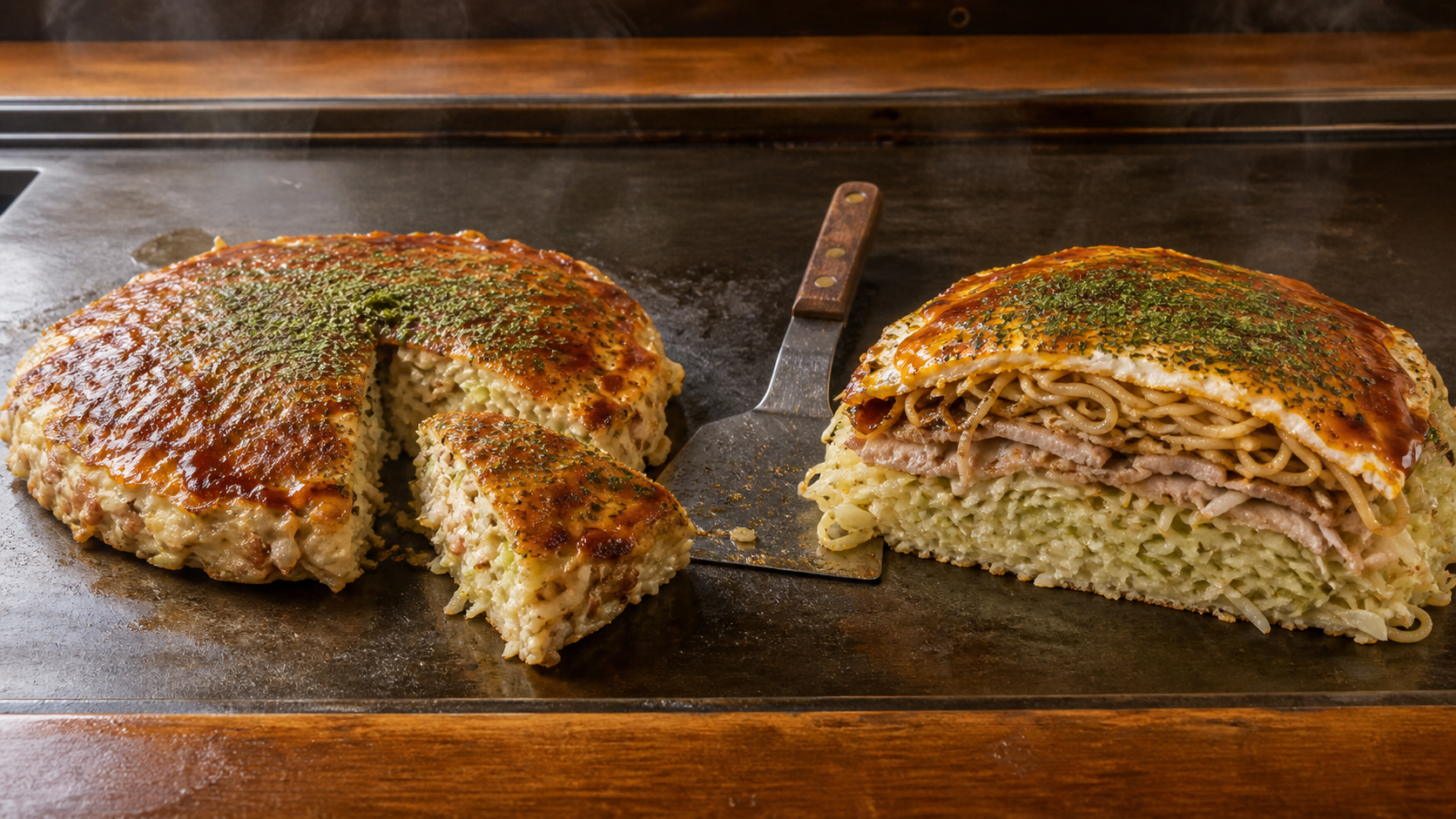
Information checked: August 26, 2026. Calling okonomiyaki a “Japanese pancake” is convenient but incomplete. It is a savoury griddle meal built around batter, cabbage and chosen fillings, and two famous regional traditions use those elements very differently. Osaka-style mixes the ingredients; Hiroshima-style builds distinct layers and commonly adds noodles. Neither is the national original or the “correct” version.
Osaka-style and Hiroshima-style at a glance
| Osaka style | Hiroshima style | |
|---|---|---|
| Construction | Chopped cabbage and fillings are mixed into dashi-seasoned batter | A thin crepe-like base supports separate layers |
| Typical layers | Mixed body, often pork on one surface | Cabbage, bean sprouts, pork, noodles and egg assembled in stages |
| Noodles | Not standard; a noodle combination is usually called modan-yaki | Soba (Chinese-style wheat noodles) or udon is commonly included |
| Texture | Cohesive, tender and often fluffy | Layered contrast: steamed vegetables, seared noodles and egg |
| Watching the cook | Mixing and the flip are highlights | Compression, steaming and moving several components are highlights |
Individual shops vary. Mayonnaise is common in Osaka but not compulsory; Hiroshima toppings and noodle seasoning also differ. Judge the plate in front of you, not a rigid internet checklist.
Two postwar meals with deeper roots
Both styles have precursors in older flour-and-water foods, including issen yōshoku, but their familiar forms developed strongly after World War II. Osaka’s version used abundant cabbage to turn a snack into a meal, and specialty restaurants began spreading in the 1950s. In Hiroshima, stalls serving layered, filling food became associated with the city’s reconstruction; noodles made the dish more substantial.
This history deserves care. Hiroshima okonomiyaki is a living everyday food, not a novelty created solely for visitors, while Osaka style is not simply “the Kansai default.” Regional pride is part of the pleasure, but ranking one as authentic and the other as imitation misses the point.
Decode the menu before ordering
| 豚玉 / butatama | Pork and egg; a common first choice, not a pork-free dish |
|---|---|
| ミックス / mix | Shop-defined combination that may contain pork, squid and shrimp |
| モダン焼き / modan-yaki | Osaka-style okonomiyaki combined with noodles; recipes vary |
| 肉玉そば / nikutama-soba | Common Hiroshima order with pork, egg and Chinese-style noodles |
| 肉玉うどん / nikutama-udon | Hiroshima version using udon instead of soba |
| トッピング | Extra green onion, cheese, mochi, seafood or other additions; normally charged |
In Hiroshima, soba on an okonomiyaki menu usually means Chinese-style wheat noodles, not buckwheat noodles. Anyone avoiding buckwheat or wheat should still ask rather than infer from the word.
Do not assume it is self-cook
Many Osaka specialists cook the dish completely, even when the hot plate is built into your table. Hiroshima counter shops usually let the cook manage several components on a large griddle. Ask “Do I cook it?” or watch staff instructions before touching the spatulas. Pressing a mixed Osaka pancake can force out air; disturbing Hiroshima layers can break the steaming process.
- Order the base style and fillings.
- Confirm noodle type and quantity where relevant.
- Leave the food untouched while the cook works.
- Wait for the explicit “ready” signal.
- Use the small spatula only for serving or eating, according to the shop.
Spatula, plate and sauce etiquette
At some Hiroshima counters, locals cut and eat small pieces directly from the griddle with a spatula; using a plate and chopsticks is also acceptable when provided. Cut from the edge so the remainder stays warm. The iron plate is extremely hot, so keep sleeves, bags and children away.
Taste before adding more sauce or mayonnaise. Shared bottles should not touch the food. A whole Hiroshima portion with noodles can be large; ask whether sharing is permitted and whether each seated guest has a minimum order.
Okonomi-mura: practical visitor information
| What it is | A building housing 23 independently operated okonomiyaki shops |
|---|---|
| Address | Shintenchi Plaza 2F–4F, 5-13 Shintenchi, Naka-ku, Hiroshima 730-0034 |
| Access | About 3 minutes on foot from Hatchobori streetcar stop |
| Hours | Vary by shop |
| Closed | Varies by shop; check the chosen shop directly |
| Admission | No general admission ticket; pay for food at the individual restaurant |
| Parking | No dedicated visitor parking stated; use nearby paid parking or public transport |
| Recommended | Walk the floors once, compare open seats and menus, then choose one counter rather than blocking narrow passages |
It can be busy at meal times and each shop has its own character. Twenty-three shops in one building does not mean one queue, one menu or identical opening hours.
Allergens, vegetarian requests and cross-contact
Wheat, egg, soy, pork, squid, shrimp, milk, sesame and fish-derived dashi are common. Sauce can contain wheat, soy, fruit or other ingredients; tenkasu may contain wheat and be fried in shared oil. A vegetable appearance does not prove vegetarian or vegan preparation, and the shared griddle makes cross-contact difficult to eliminate.
For a serious allergy, use the Consumer Affairs Agency communication sheet and ask about batter, dashi, sauce, noodles and shared tools. “No pork” does not automatically mean halal; ask about seasoning and the cooking surface. A shop that cannot confirm safely is not a suitable choice.
Which style should a first-time visitor choose?
- Choose Osaka style if you want an integrated cabbage texture, a softer cohesive bite and a broad topping culture.
- Choose Hiroshima style if you enjoy watching layered construction, want noodles as part of the meal and prefer contrasting textures.
- Try both on different days if your itinerary reaches both cities; back-to-back full portions hide rather than reveal the differences.
Is “Hiroshima-yaki” polite?
“Hiroshima okonomiyaki” or simply “okonomiyaki” is safer in Hiroshima; some residents dislike treating it as a derivative “-yaki.”
Is okonomiyaki cheap?
Prices depend on seafood, toppings, location and portion. Check the current tax-inclusive menu.
Can I take leftovers away?
Only if the shop permits and can pack them safely. Do not assume because the dish is cooked.
Official references: OSAKA-INFO: Osaka okonomiyaki / Dive! Hiroshima: Hiroshima okonomiyaki / Dive! Hiroshima: Okonomi-mura / Consumer Affairs Agency: allergy communication sheet