


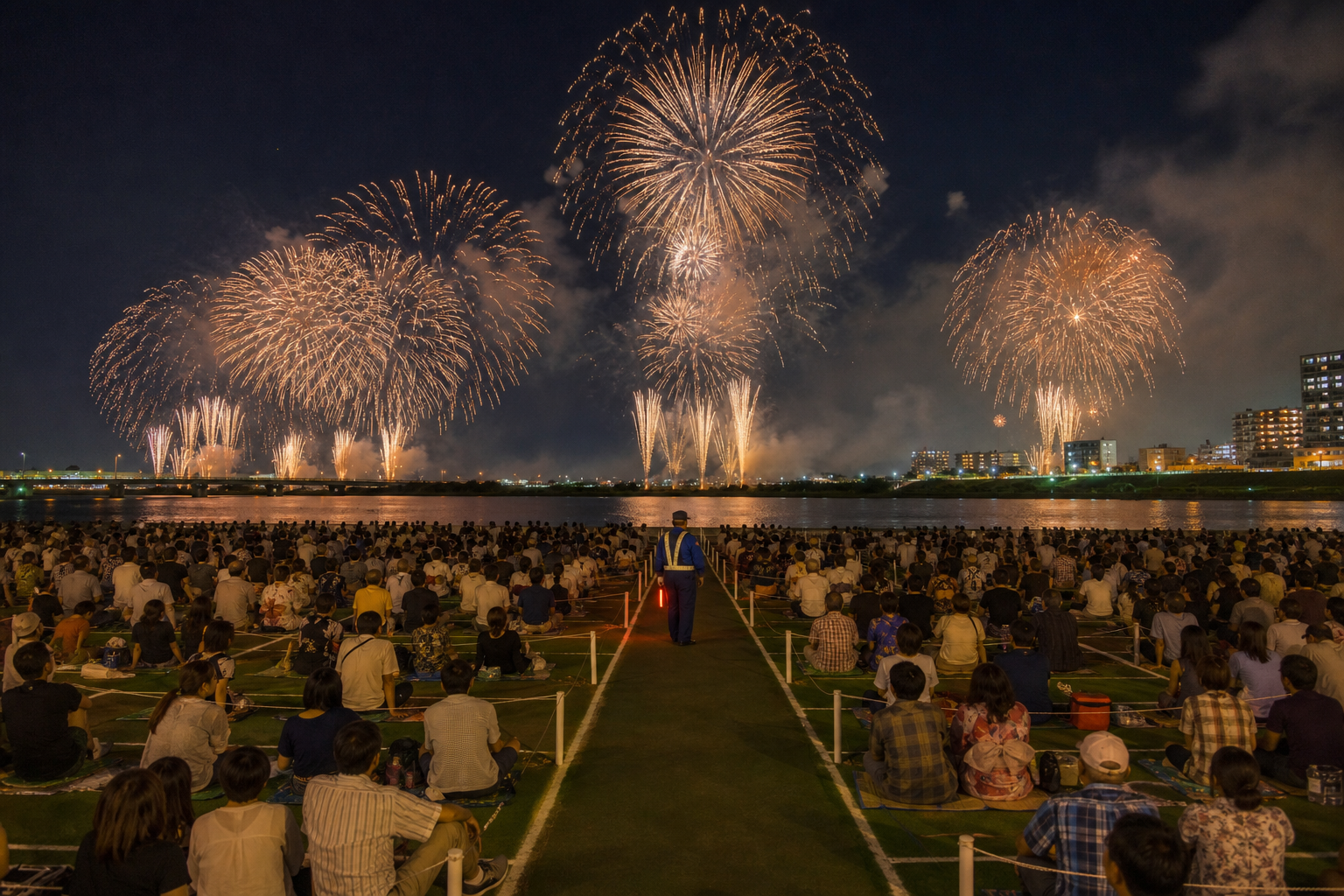
Japanese fireworks are not merely a summer backdrop. A large hanabi taikai is a timed public performance shaped by pyrotechnicians, river geography, local memory, transport control and thousands of spectators. This guide explains how to choose an event, reserve a legitimate seat, read the program and return safely, using Sumida, Nagaoka and Omagari as three very different models. Event details were checked in August 2026; always reconfirm the year you attend.
Hanabi is performance, craft and community memory
The word 花火 literally combines “flower” and “fire,” but the art is not only a round burst. Designers control shell construction, timing, colour changes, symmetry, scale and musical sequence. Some events are competitions; others commemorate disaster, war, recovery or local history. Food stalls and yukata can be enjoyable, but neither is guaranteed and neither defines the cultural value of the display.
Watch the opening, development and fading light
| Program term | What to notice |
|---|---|
| Shakudama / large shell | Expansion, circular balance and how evenly stars fade; size names refer to shell standards, not a promise of viewing distance. |
| Starmine | Rapid sequences combining many shells and effects; follow rhythm rather than one outline. |
| Creative fireworks | Original form, colour and timing judged as a designed work; read the official program before assuming the intended motif. |
| Daytime fireworks | Coloured smoke and sound form the composition; Omagari is especially known for a daytime competition. |
Respect the maker’s name when it appears in the program. A technically quiet interval may be preparation, wind assessment or part of the composition—not automatically a failure.
Choose by viewing system, not by an online “top 10”
- Urban moving-view event: convenient rail access but extreme one-way crowd control and little or no free seated space.
- Ticketed riverbank production: wide views and a defined seat, but advance purchase, long walks and difficult departure.
- Competition: program literacy and craftsmanship matter as much as spectacle; accommodation may sell out months ahead.
- Small local display: potentially more intimate, but transport, toilets and multilingual help may be limited.
Check the organizer—not a ranking site—for the launch area, paid/free zones, chair or mat rules, accessibility, cancellation policy and last train.
Sumida, Nagaoka and Omagari: three different experiences
| Event | Access, ticket model and recommended use |
|---|---|
| Sumida River Fireworks, Tokyo | Two launch areas along the Sumida; stations include Asakusa, Oshiage, Tokyo Skytree, Hikifune, Kuramae, Ryogoku and Asakusabashi depending on zone. The 2026 event was July 25, 19:00–20:30. Ordinary visitors largely watched while moving on controlled streets; there was no general place to sit outside designated supporter seating. Best for experienced city visitors who accept dense crowds and flexible station choice. |
| Nagaoka Festival Grand Fireworks, Niigata | Shinano River banks, about 30 minutes on foot from JR Nagaoka Station for the station-side area. Held every August 2 and 3, normally from about 19:20. Official viewing tickets are essential; categories and prices change and 2026 general sales used lotteries, named tickets and an official resale route. Best with a local overnight stay and a preselected river side. |
| Omagari National Fireworks Competition, Akita | Omono River fireworks park, roughly 30 minutes on foot from JR Omagari Station under event routing. The 98th competition is August 29, 2026. It combines daytime and night competition; official tickets, seat rules and transport plans must be checked for that edition. Best for visitors interested in comparing pyrotechnicians, not merely photographing a finale. |
Official sources: Sumida, Nagaoka, Omagari. Dates, gates, prices and traffic plans are annual information, not permanent facts.
Buy only through the organizer’s route
Paid seats may be lottery-based, first-come, resident-priority, sponsor-based or sold through named agencies. “Free event” does not mean every riverbank or rooftop is open. Never enter private land, a paid zone or a firework exclusion area. Avoid screenshots and unofficial resale; tickets may be named or restricted under anti-scalping rules. Confirm whether one ticket covers one person or a group space, whether children need tickets, and whether chairs, tents or large mats are prohibited.
A workable fireworks day begins before noon
- Weeks or months ahead: book official seats and refundable accommodation; choose the correct river side.
- Previous day: save the current map, program, gate, toilet, first-aid point and alternative station offline.
- Morning: check organizer, JMA and railway announcements.
- Three or more hours before launch: eat, hydrate, charge phones and enter before crowd controls tighten.
- After the finale: remain seated or follow the assigned flow; do not race for the nearest station.
Do not assume food stalls, convenience stores, lockers, ATMs or mobile data will be usable. Carry water, some cash, a small towel, power bank, rubbish bag and any medicine.
Prepare for heat, sudden rain, wind and cancellation
Summer heat continues after sunset. Hydrate before thirst, use shade and cooling items, and limit alcohol. A yukata is optional; if worn, choose footwear you have already tested. Check JMA hazard information. Wind, lightning, river conditions and fire risk can delay or cancel a display even if rain is light. Never shelter under an isolated tree during lightning, and follow staff toward official evacuation routes. Refund and postponement rules differ by event.
Your viewing space is not private property
Lay out a mat only where and when permitted, and keep aisles, tactile paving, levees and emergency access clear. Do not reserve excessive space or abandon a mat. Keep umbrellas down during the performance; use a raincoat where organizers advise. Take rubbish home or use designated sorting points. Ask before photographing identifiable people, especially children and people wearing yukata. Flying drones, launching personal fireworks and smoking outside designated places can endanger the event.
Photograph without blocking the performance
A phone in night mode is often enough. Lower screen brightness and hold it below others’ sightlines. Tripods, stools and large lenses may be prohibited by seat type; never extend equipment into an aisle. For a camera, use manual focus near infinity as a starting point, low ISO and bulb exposures only if your position is stable and permitted. Watch several sequences with your eyes—the official program and maker names provide more meaning than hundreds of nearly identical frames.
The return journey is part of the event
Choose two possible stations, agree on a reunion point before networks become congested, and screenshot accommodation details. Children should carry contact information that does not expose a full passport. Follow one-way routes even if maps suggest a shortcut. Never walk on the carriageway, riverbank darkness or railway land. If the last train is critical, leave early; otherwise allow the crowd to thin and stay overnight. The most respectful fireworks visit ends without burdening residents, emergency teams or the next morning’s cleanup.