


Information checked: August 26, 2026. Alcohol is only for people aged 20 or over in Japan. “Sake” abroad often means Japanese rice alcohol; in Japan, sake can mean alcohol generally, while nihonshu identifies the brewed drink. Beginners do not need a famous brand or an unverified “master” to choose well. Learn five label clues, compare small pours and describe what you actually enjoy.
Nihonshu turns rice starch into alcohol through koji
Sake is brewed from rice, water and rice inoculated with koji mould; yeast converts sugar to alcohol. Because rice begins as starch, koji enzymes create sugar while yeast ferments it in the same tank—a process called multiple parallel fermentation. Water, rice variety, yeast, polishing, fermentation and the brewer’s decisions shape the result.
Nihonshu is produced across Japan and can express a brewery and region, but avoid rigid stereotypes. Modern producers source materials and exchange techniques widely. Local sake (jizake) is most meaningful when you connect it with the brewery’s water, climate, food and history rather than treating prefecture as a guaranteed flavour.
Classification tells you production method, not a quality score
| Label | Legal / practical clue | Do not assume |
|---|---|---|
| Junmai | Rice and koji rice; no brewers’ alcohol added | Not automatically sweet, heavy or warm-only |
| Honjozo | Rice, koji and a limited addition of brewers’ alcohol; polishing ratio 70% or less | Added alcohol does not mean cheap dilution |
| Ginjo | Ginjo brewing; polishing ratio 60% or less; often aromatic | Not every bottle smells strongly fruity |
| Daiginjo | Ginjo brewing; polishing ratio 50% or less | Lower polishing ratio is not automatically “better” with food |
| Junmai ginjo / daiginjo | Junmai ingredients plus the relevant ginjo polishing and method | “Junmai” and “ginjo” are not competing categories |
| Futsushu | Sake outside the specific-designation rules | Ordinary classification does not prove poor craftsmanship |
Seimai-buai is the percentage of each rice grain remaining after polishing: 60% means 40% was removed. It describes manufacture, not your guaranteed enjoyment or the amount of alcohol.
Use aroma, sweetness, acidity and body together
Amakuchi means sweeter and karakuchi drier, but perceived sweetness changes with acidity, aroma, umami, temperature and food. Nihonshu-do (sake meter value) is based on specific gravity; a higher positive number often suggests drier, but it is not a universal taste score. Acidity can make a sake feel sharper or richer.
Ask for descriptors you understand: apple/pear/banana-like aroma, rice and cereal, floral, lactic, earthy, clean, rich, light, sparkling or aged. “Fruity” is aroma, not proof that fruit was added. Most sake is around 15–16% alcohol, so a clear, delicate taste is not the same as a low-alcohol drink.
Cold, room temperature and warm reveal different aspects
| Japanese term | Approximate temperature | What to observe |
|---|---|---|
| Yuki-hie | 5°C | Very cool; aroma can seem restrained |
| Hana-hie | 10°C | Common cool range for aromatic ginjo and namazake |
| Suzu-hie | 15°C | Cool but aroma opens more |
| Hitohada-kan | About 35°C | Gentle warmth near body temperature |
| Nuru-kan | About 40°C | May broaden rice, umami and acidity |
| Atsu-kan | About 50°C | Hot; suitable only when the sake works at this intensity |
These National Tax Agency names are useful vocabulary, not mandatory pairings. Ginjo is often served cool and richer junmai or honjozo may work warm, but each bottle and palate differs. Ask the brewery’s recommendation, then compare one sake at two temperatures rather than declaring all daiginjo cold-only or all junmai warm-only.
Start with a flight and compare one variable
- Tell staff whether you prefer aromatic or quiet, light or rich, sweeter or drier.
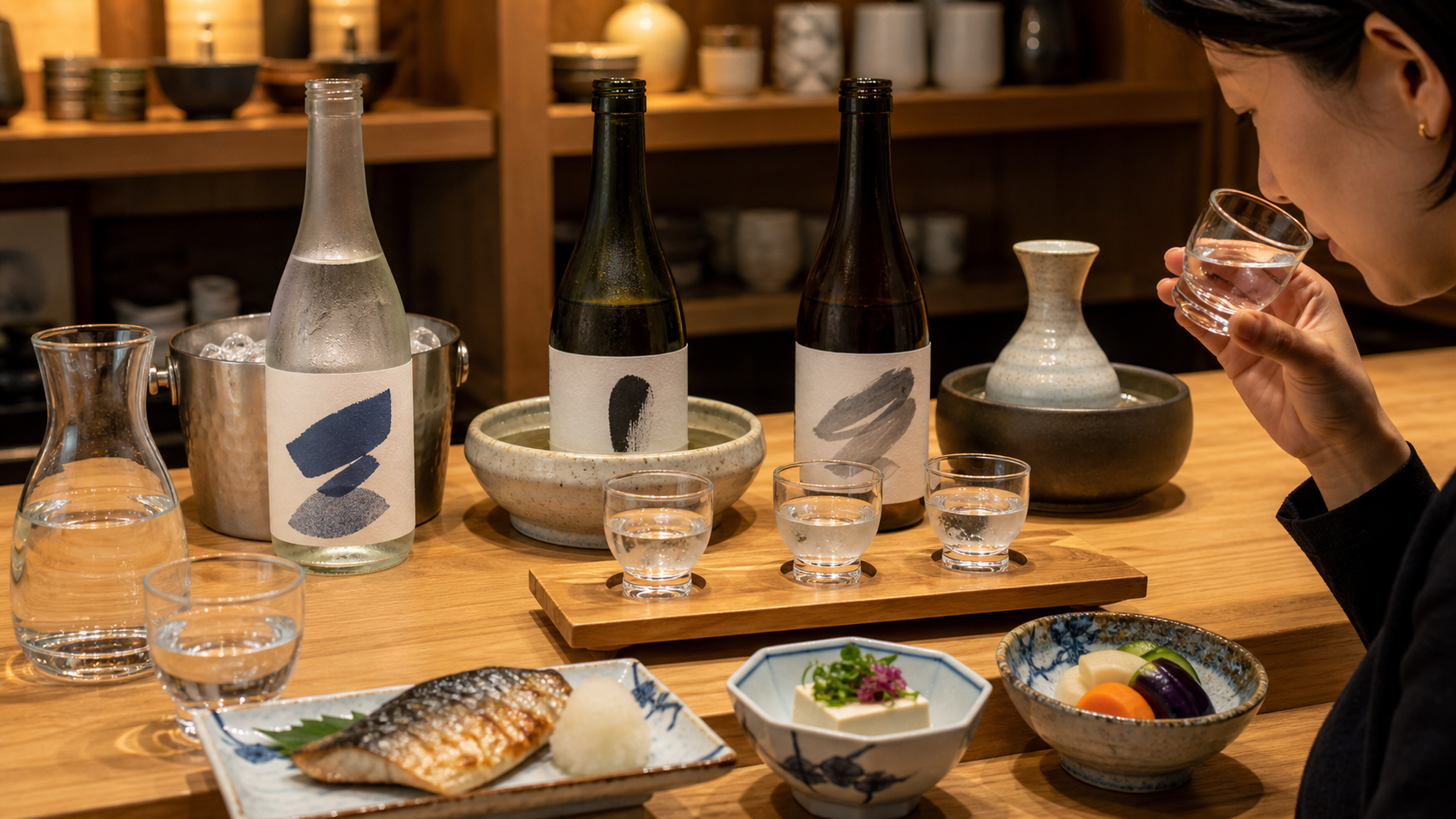
- Order a three-sake flight with a clear theme: one brewery, three classifications; one sake at temperatures; or three local breweries.
- Compare colour, then smell gently. Sip a small amount and notice entry, mid-palate, finish and aftertaste.
- Drink water and eat between samples. Do not rinse the cup with drinking water unless staff instruct you.
- Record brewery, product, classification, temperature and your own words—not only a numeric rating.
A glass, ochoko, wine glass, ceramic cup or a glass inside a wooden masu may be used. Overflowing a glass into a masu is a service style, not a nationwide ritual. In casual settings you may pour your own drink; pouring for companions can be courteous, but never keep someone’s cup full against their wishes.
Pair by intensity, aroma and local context
| Sake direction | Starting food idea | Why it may work |
|---|---|---|
| Light, clean | Chilled tofu, white fish, delicate vegetables | Does not overwhelm subtle flavours |
| Aromatic ginjo | Lightly seasoned seafood, fruit-accented dish | Connects aroma while limiting heavy sauce |
| Rich junmai | Grilled fish, mushrooms, miso, simmered dishes | Umami and acidity can meet browned or fermented notes |
| Warm honjozo / junmai | Oden, yakitori, hotpot | Warmth and savoury food can soften the finish |
| Aged / koshu | Cheese, nuts, soy-rich or caramelised dishes | Matches deeper oxidative and nutty notes |
These are experiments, not rules. Ask for local sake with local seasonal food to understand place, then test contrast as well as similarity. Sake may contain trace process-derived substances and food dishes have allergens; communicate medical restrictions separately from flavour pairing.
Plan a brewery visit or purchase with practical checks
For a brewery, record its exact address, nearest station and exit, walking surface, tour entrance, hours, closed days, tour fee, tasting fee, reservation, language, minimum age, photography, shoes and accessibility. Production areas may be wet, cold, narrow or stair-only. Strong perfume can interfere with aroma; follow the brewery’s hygiene instructions and do not touch equipment.
At retail, compare bottle size, storage instruction, pasteurisation and best-consumption guidance. Namazake is unpasteurised and normally requires refrigeration; do not leave it in a hotel room or warm luggage. Ask for insulated packing, check airline liquid/baggage rules and your destination’s duty-free allowance and import restrictions. A regional-only claim should be confirmed, not assumed.
| Experience | Planning range |
|---|---|
| Small glass | Often about ¥500–¥1,500+ |
| Three-sake tasting flight | Often about ¥900–¥2,500+ |
| One-go carafe (about 180 ml) | Often about ¥800–¥2,500+ |
| Brewery tour / tasting | Free to several thousand yen depending on programme |
These are planning ranges, not quotes. Premium bottles, rare aged sake, cover charges and food are extra.
Taste culture without turning it into a drinking challenge
Drinking and alcohol purchase are prohibited for anyone under 20 in Japan, even though the civil age of adulthood is 18. Carry identification. Never pressure another person to drink. The Ministry of Health recommends deciding your amount in advance, eating before or while drinking, and alternating alcohol with water. Avoid rapid heavy drinking.
Do not drive or cycle after drinking. Avoid exercise, sauna, onsen or bathing during and after alcohol; dehydration, heat and impaired judgement raise risk. People who are pregnant or breastfeeding, taking medication, receiving treatment, unable to metabolise alcohol well or choosing not to drink should avoid alcohol as appropriate and can participate through brewery history, food and non-alcoholic drinks.
Is daiginjo always the best beginner bottle?
No. It can be refined and aromatic, but a simpler junmai, honjozo or futsushu may pair better with your meal and preference.
Does “dry” mean no sugar or low calories?
No. Karakuchi is sensory shorthand, not a nutrition claim.
Should I finish a tasting I dislike?
No. Use a discard vessel if provided or ask staff. Responsible tasting is not disrespectful.
May I take the ochoko or masu home?
Only if explicitly included or sold. Serving vessels remain the venue’s property.
Official references: National Tax Agency: sake components and classifications / Tokyo Regional Taxation Bureau: sake temperature terms / JNTO Sake 101 / National Tax Agency: preventing under-20 drinking / Ministry of Health: alcohol guidance