



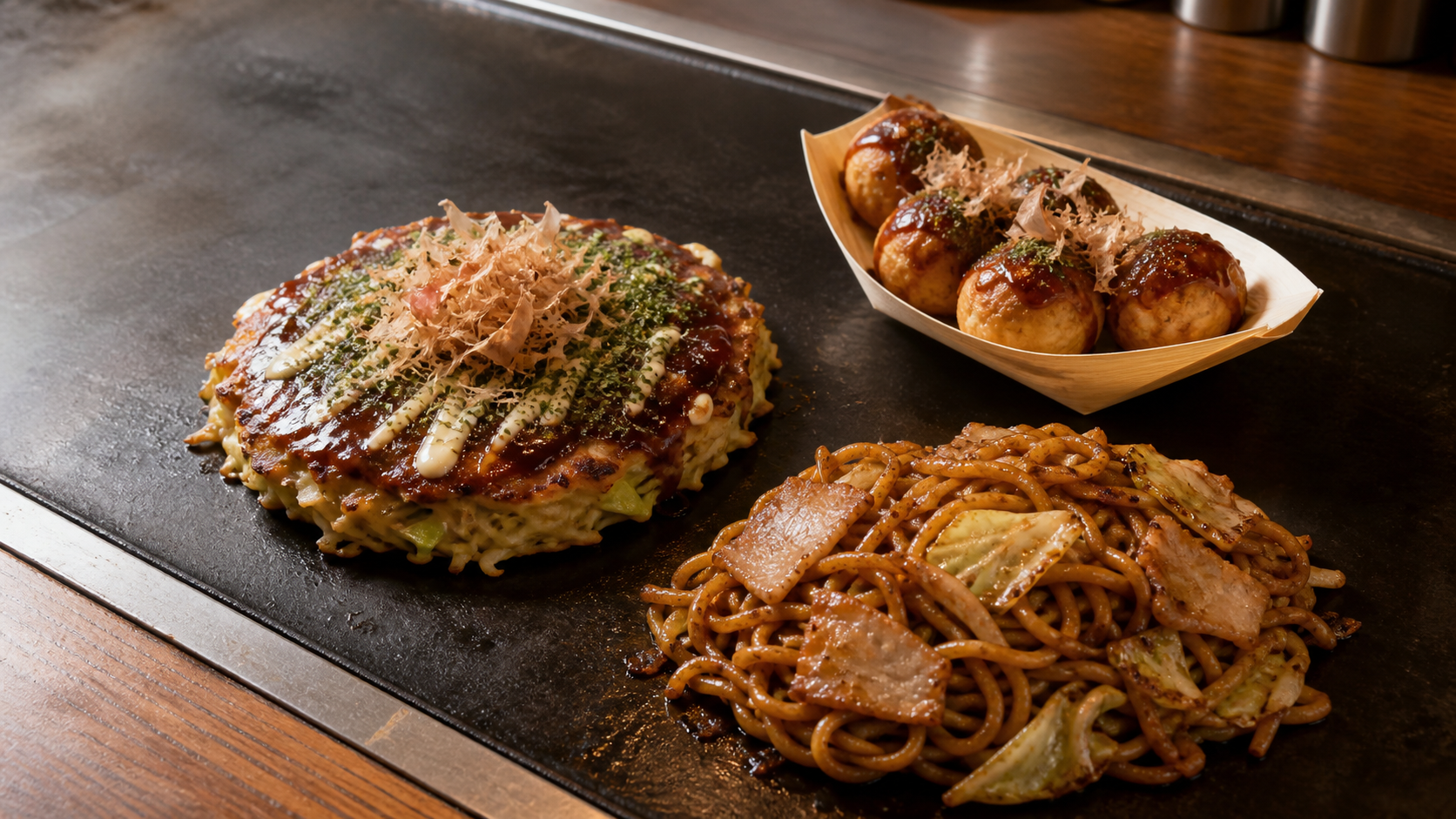
Information checked: August 26, 2026. Osaka’s konamon culture is often translated as “flour-based food,” but flour alone does not explain its character. Dashi, cabbage, sauce, a well-seasoned iron griddle and the cook’s timing turn modest ingredients into takoyaki, Osaka-style okonomiyaki and yakisoba. This guide helps you compare the three, order confidently and build a practical tasting walk in Namba and Dotonbori.
Konamon is broader than “things made from flour”
Kona means powder or flour and mon is the Kansai form of “thing.” Wheat-based batter or noodles are central, but Osaka cooks also layer kelp and bonito dashi, sauce, cabbage, seafood or pork. Udon and other flour foods can belong to the broader family. Yakisoba is included culturally even though the noodles are manufactured before reaching the griddle.
The term does not mean every dish is a snack. Okonomiyaki and yakisoba can be full meals, while a small takoyaki tray works well as a shared tasting portion.
Takoyaki, okonomiyaki and yakisoba
| Dish | Texture and method | Useful ordering point |
|---|---|---|
| Takoyaki | Dashi-seasoned batter cooked in a mould around octopus; Osaka versions are often soft and creamy inside | Let the steam escape before the first bite; the centre can be much hotter than the surface |
| Osaka okonomiyaki | Cabbage and fillings mixed into batter, cooked as one round on a griddle | Staff often cook it; do not flip or press it unless invited |
| Yakisoba | Wheat noodles stir-fried with cabbage, meat or seafood and savoury sauce | Ask what “mixed” contains; it can include pork, squid and shrimp |
Hiroshima-style okonomiyaki is assembled in layers and commonly includes noodles; it is not simply a larger Osaka version. Modan-yaki in Osaka combines okonomiyaki with noodles but remains its own menu item.
Why the griddle became part of Osaka’s identity
Osaka prospered as a commercial city known as the nation’s kitchen. Its dashi culture, sauce manufacturers, busy shopping streets and customer feedback helped cooks refine inexpensive griddle foods. The familiar postwar Osaka okonomiyaki gained volume from cabbage and developed into a meal; specialty shops spread during the 1950s, according to the Osaka Convention & Tourism Bureau.
Kuidaore—often rendered as “eat until you drop”—is better understood as pride in spending generously on good food, not a command to overeat. Comparing small portions and noticing the cook’s technique is more rewarding than racing through a checklist.
Ordering at a stall or teppan restaurant
- Check whether the queue is for takeaway, seating or both.
- Confirm the number of takoyaki pieces or okonomiyaki size before ordering.
- Choose fillings, then sauce, mayonnaise and toppings; “everything” is not automatically free.
- Ask whether staff cook the okonomiyaki. If they do, leave it untouched until they say it is ready.
- Use the small spatula to cut a bite-sized piece; do not scrape the shared griddle aggressively.
Prices, opening hours and cashless payment differ by shop. Read the current menu rather than relying on an old online price. At a standing stall, decide where eating is permitted before buying.
A 2½-hour Namba–Dotonbori tasting route
- Start near Osaka Metro Namba Station outside the lunch or dinner peak.
- Share one small takoyaki order and wait before biting into the hot centre.
- Visit the Dotonbori Konamon Museum for the compact history display or a booked sample-making activity.
- Walk the Tombori Riverwalk or side streets for 20–30 minutes instead of ordering immediately again.
- Finish with one okonomiyaki or yakisoba shared at a seated teppan restaurant.
Dotonbori is a dining and entertainment district, not a theme park with one gate. It lies immediately around Namba stations served by Osaka Metro, Nankai and Kintetsu/Hanshin services. Store hours and holidays vary. Avoid stopping in the centre of the busy promenade for photos or food.
Dotonbori Konamon Museum: practical information
| Address | Chuwa Daiichi Building, 1-6-12 Dotonbori, Chuo-ku, Osaka 542-0077 |
|---|---|
| Access | About 4 minutes on foot from Exit 14 of Osaka Metro Namba Station |
| Hours | 11:00–22:00; food-replica activity weekdays 11:30–19:15, weekends/holidays 10:30–19:15 |
| Closed | Planned to open year-round; verify on the official page before visiting |
| Admission | Free; food and activities cost extra. Osaka’s official listing gives ¥2,000 for the wax-sample activity |
| Time | Approximately 45 minutes for sample making |
| Recommended | Watch takoyaki technique, read the history display, then compare it with the real dish; reserve or check activity reception in advance |
Hours and fees can change. Treat the values above as a checked planning reference, then reconfirm on your visit date.
Wheat, dashi and cross-contact
Konamon is generally unsuitable for a wheat allergy unless a specialist shop explicitly manages ingredients and equipment. Common concerns include egg, milk, soy, pork, octopus, squid, shrimp, sesame and fish-derived dashi. Sauce may contain wheat, soy, fruit or other ingredients; mayonnaise contains egg. A “vegetable” version can still contain bonito stock, and removing visible meat does not make a shared griddle vegan, halal or allergy-safe.
Restaurant food is not always covered by the same mandatory allergen display as packaged products. For a serious allergy, show the Consumer Affairs Agency communication sheet, ask about stock, sauce and shared tools, and leave if the answer is uncertain.
Eating etiquette and FAQ
- Do not eat while blocking a shopfront, bridge or narrow shopping street.
- Use the shop’s eating area and return trays or rubbish where instructed.
- Ask before photographing staff at close range or filming the griddle.
- Bonito flakes move because of heat and steam, not because they are alive.
Must I cook okonomiyaki myself?
No. In many Osaka shops the staff cook it. Follow the shop’s system.
Is takoyaki always topped with mayonnaise?
No. Toppings vary and can often be adjusted when ordering.
Can one person order?
Usually, but minimum orders and seating rules vary. A counter shop or small takoyaki portion is easiest for a solo visitor.
Official references: OSAKA-INFO: okonomiyaki history and style / OSAKA-INFO: Dotonbori Konamon Museum / Consumer Affairs Agency: allergy communication sheet