



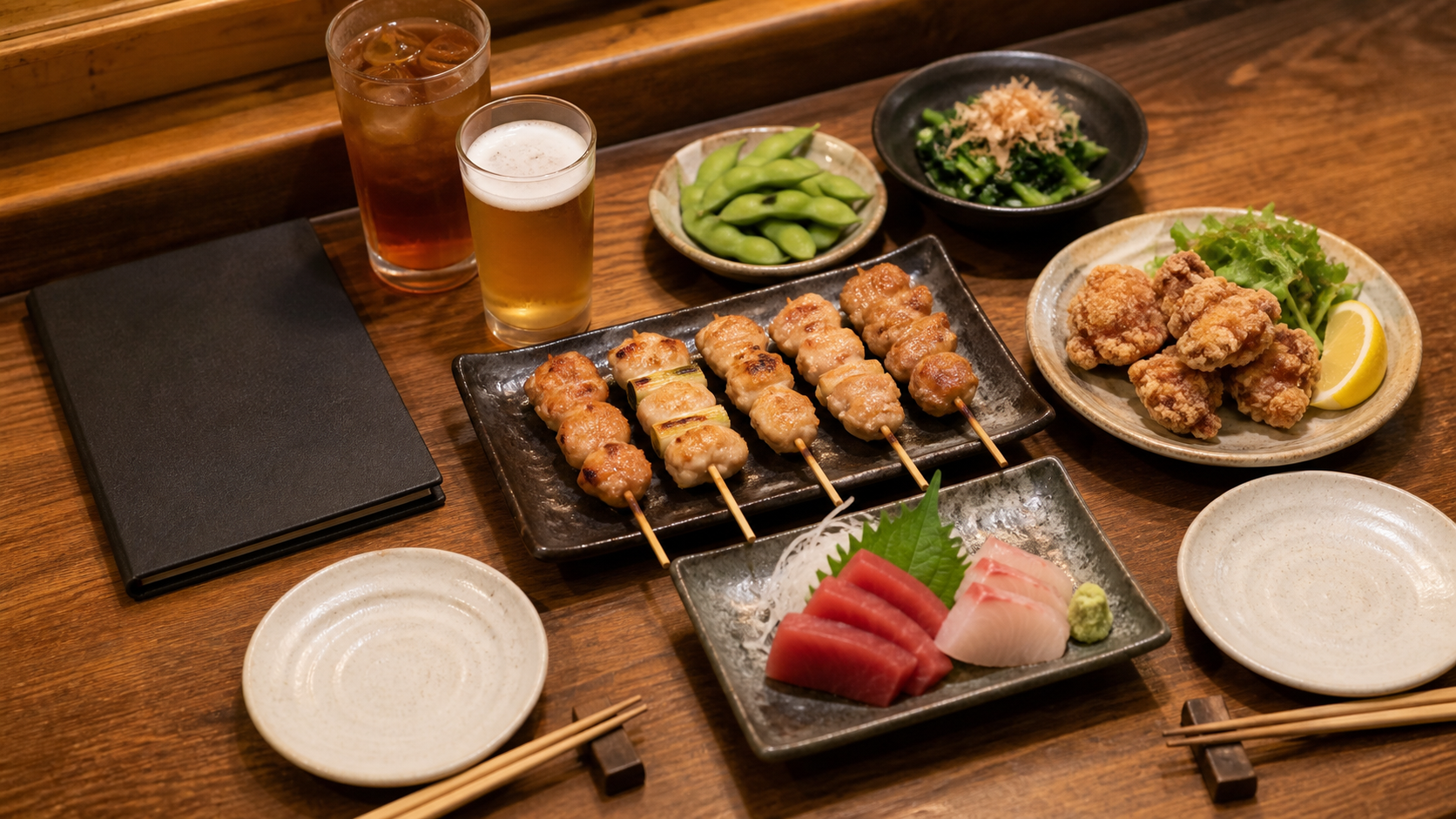
Information checked: August 26, 2026. An izakaya is a casual place for drinks and food, usually built around several dishes rather than one set meal. You do not have to start with beer, and “two or three dishes per person” is not a universal rule. The safest first order is small, balanced and easy to expand after you see the actual portions.
Before you sit: check the restaurant’s system
Izakaya range from standing counters to seafood specialists and private-room chains. A picture menu is useful, but the practical questions matter more. Check whether smoking is allowed, whether children can enter, if each guest must order a drink, whether seating is timed, and when food and drink last orders occur.
| Menu wording | Meaning |
|---|---|
| 一人前 | One serving, not necessarily one full meal |
| 二人前より | Minimum order of two servings |
| 一本/一皿 | Per skewer / per plate |
| お通し・席料 | Starter linked to a cover or seat charge |
| 税込/税別 | Tax included / tax excluded |
How an izakaya meal usually unfolds
JNTO describes izakaya food as shared dishes served with individual torizara side plates. That does not mean every plate must be shared or that everyone must eat equally. Use serving chopsticks when provided, and give people with allergies a clean portion before shared utensils touch it.
- Order drinks—soft drinks are completely normal.
- Check whether an otoshi arrives and whether it is charged.
- Choose two or three small/shared plates for the whole table, not automatically per person.
- See the portion size before adding hot dishes.
- Finish with rice or noodles only if still hungry.
A reliable first round for two people
| Role | Example | Why it works |
|---|---|---|
| Quick dish | Edamame, chilled tofu or pickles | Usually arrives while hot food cooks |
| Vegetable | Seasonal greens, tomato or salad | Balances fried and grilled dishes |
| Protein | One karaage plate or 4–6 yakitori skewers | Shareable; confirm whether skewers are priced singly |
| Optional local item | Today’s fish or regional specialty | Gives the restaurant’s identity without over-ordering |
For one diner, halve this idea: one quick dish plus one main dish, then add rice or another plate. For four people, start with three or four plates and reorder. Pot dishes and platters may require two servings.
Ten approachable dishes—and what the names do not tell you
| Dish | What to expect | Check |
|---|---|---|
| 枝豆 edamame | Salted soybeans in pods | Soy; eat beans, not pods |
| 冷奴 hiyayakko | Chilled tofu with toppings | Soy, fish flakes, sauce |
| だし巻き卵 | Rolled egg seasoned with dashi | Egg; fish-based stock common |
| 唐揚げ karaage | Marinated fried chicken | Wheat/soy; shared fryer |
| 焼き鳥 yakitori | Grilled chicken cuts | Salt or tare; order unit; cook fully |
| 刺身 sashimi | Raw sliced seafood | Species, freshness, allergy, raw-food risk |
| 焼き魚 yakizakana | Grilled fish, often whole or filleted | Bones and seasonal price |
| ポテトサラダ | Japanese-style potato salad | Egg/mayo, ham, dairy possible |
| お茶漬け ochazuke | Rice with tea or dashi and toppings | Often fish stock, not always vegetarian |
| 焼きそば yakisoba | Stir-fried noodles and sauce | Wheat, soy, meat/seafood |
Order by function, not by a checklist of famous foods
A satisfying table normally needs contrast: something quick, something fresh or vegetable-based, one grilled or fried protein, then a carbohydrate if wanted. Ordering sashimi, karaage, yakitori, noodles and rice all at once can be too much for two people.
Look for the handwritten or seasonal menu. A small regional dish can teach more than ordering the same national staples everywhere. Ask kyō no osusume wa nan desu ka? (“What do you recommend today?”), then confirm the price and serving size before agreeing. “Recommended” does not mean free or inexpensive.
Allergies, vegetarian choices and raw food
Restaurant dishes are not covered by exactly the same ingredient-display system as packaged foods. Dashi may contain bonito, sauces often contain soy and wheat, mayonnaise contains egg, and shared grills or fryers create cross-contact. Vegetable names do not automatically mean vegan, halal or allergen-free.
For a serious allergy, show the ingredient in Japanese before the otoshi arrives and ask whether the kitchen can safely accommodate it. If the answer is uncertain, do not “test” the dish. Pregnant, elderly, very young or immunocompromised diners should consider avoiding raw or undercooked foods; ask for chicken to be fully cooked.
Budget, cover charges and payment
| Style | Planning range per adult |
|---|---|
| Light meal with soft drink | About ¥2,000–¥3,500 |
| Several dishes and drinks | About ¥3,000–¥5,500 |
| Seafood specialist or premium sake | ¥5,000 and above |
These are planning ranges, not fixed prices. Add tax where excluded, the stated seat/otoshi charge, and any late-night surcharge. Some tablet menus show a running total, but it may exclude fees. Check accepted payment before ordering; small venues may be cash-only. Tipping is not customary.
Etiquette and first-visit FAQ
Must everyone order alcohol?
No. Oolong tea, soda water and other soft drinks are normal. A venue may require one drink per guest, but it need not be alcoholic unless the stated plan has special conditions. Japan prohibits drinking under age 20.
Can I refuse the otoshi?
Practices vary. It often forms part of the cover charge, so refusing the food may not remove the fee. Ask before sitting if this matters, and flag allergies immediately.
Should I order everything at once?
No. Gradual ordering is central to the format. Order enough to begin, then add food before last order. Avoid placing a large late order just as the kitchen closes.
Who pays?
Many restaurants issue one bill per table and may not split it. Agree within the group and settle among yourselves afterward. Pay at the register unless staff directs table payment.
May I photograph the food?
Usually, discreet food photos are acceptable, but ask before filming staff, the kitchen or other guests. Keep phones and bags out of service aisles.
Official references: JNTO Izakaya Dining Guide / Consumer Affairs Agency: food labelling / National Tax Agency: underage drinking prevention