



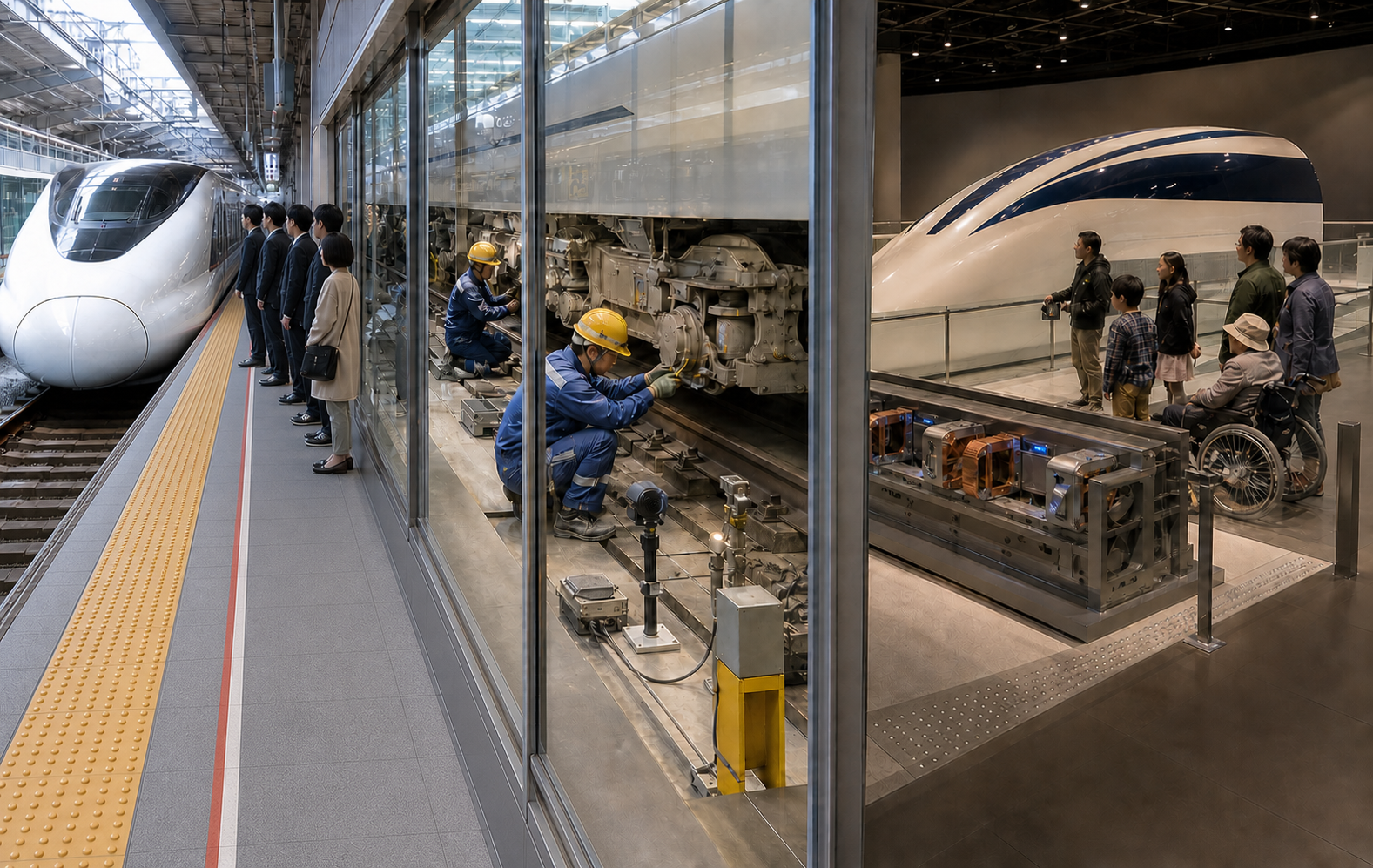
Information checked: August 26, 2026. Japan’s railway technology is more than a pointed train nose or a speed record. Safe high-frequency service depends on track, power, signalling, earthquake detection, inspection, maintenance, station work and passengers following shared rules. This guide separates today’s Shinkansen from the still-under-construction Chuo Shinkansen maglev and gives two practical museums for examining the system.
Railway technology is an operating culture, not one machine
| Layer | Question to ask |
|---|---|
| Vehicle | How do braking, aerodynamics, bogies, weight and passenger space interact? |
| Infrastructure | What track, structures, power and platform geometry are required? |
| Control | How do signalling, central traffic control and driver procedures prevent conflict? |
| Resilience | How are earthquakes, wind, rain, snow, fire and evacuation handled? |
| People | How do maintenance, cleaning, station teams and passenger behaviour sustain frequency? |
Japanese precision is not an innate national trait. It is produced by standards, training, reporting, maintenance windows, investment and repeated human work—and delays and disruptions still occur.
The Shinkansen is a family of lines and operators
Commercial Shinkansen began with the Tokaido line in 1964. Today different JR companies operate routes with different rolling stock, maximum speeds, stopping patterns, reservation rules, baggage systems and disruption risks. Some Tohoku services are scheduled up to 320 km/h; that figure must not be applied to every line. A ticket may combine basic fare and limited-express components, and a train name such as Nozomi describes a stopping/service pattern, not a vehicle model.
Maximum speed is not the same as journey time
Tokyo–Shin-Osaka is measured in hours, not “2 minutes 12 seconds.” Published times change by timetable and stopping pattern, and a peak vehicle speed does not include acceleration, braking, curves, stops or recovery margin. Door discipline, turnarounds and reliable transfers can matter as much as headline speed. Check the official timetable for the exact date and never build an airport connection around the theoretical fastest run.
Superconducting maglev uses a different guideway and support system
JR Central’s L0-series test vehicles are developed for a planned commercial maximum of 500 km/h. Superconducting magnets interact with coils in the guideway for levitation, guidance and propulsion at high speed; wheels are used at low speed before levitation. This is not the same technology as every urban “linear motor” railway. Questions about energy, tunnels, ventilation, emergency evacuation, construction impacts, noise and whole-life maintenance belong beside speed.
The Chuo Shinkansen is not a bookable 2027 train
The planned first phase links Shinagawa and Nagoya, later extending to Osaka. JR Central stated in March 2024 that opening to Nagoya in 2027 was not feasible and that a new opening date was difficult to determine because there was no prospect then for starting excavation of the Shizuoka section of the Southern Alps Tunnel. Construction and testing continue, but planned 500 km/h operation and roughly 40-minute Tokyo–Nagoya travel are project specifications, not a current service. Do not buy tours, property or connections on an invented opening date. JR Central status statement
SCMAGLEV and Railway Park: compare real vehicles in Nagoya
Address: 3-2-2 Kinjofuto, Minato-ku, Nagoya, Aichi 455-0848. Access: about 24 minutes from Nagoya Station on the Aonami Line, then about two minutes on foot from Kinjofuto Station. The museum has no parking lot; use nearby public parking if driving. Hours: 10:00–17:30, last entry 30 minutes before closing. Closed: Tuesdays (following day when Tuesday is a national holiday), December 28–January 1; calendar exceptions and weather closures apply. Admission: adult ¥1,200, school child ¥500, age three+ preschool child ¥200. Official visitor information
Allow about two hours. Compare historic rolling stock, Shinkansen development, railway systems and the superconducting-maglev room. The Shinkansen driving simulator costs ¥500 for 15 minutes and is first come, first served; the day’s admission ticket is required, times cannot be chosen and availability is not guaranteed. A CG “ride” is interpretation, not travel on the Yamanashi test line.
The Railway Museum: technology inside social history
Address: 3-47 Onari-cho, Omiya-ku, Saitama 330-0852. Access: take the New Shuttle from JR Omiya to Tetsudo-Hakubutsukan Station, then walk about one minute. Hours: 10:00–17:00. Closed: normally Tuesdays and New Year holidays; check the date calendar. Admission: adult ¥1,600, elementary/junior-high/high-school ¥600, preschool age three+ ¥300. Official museum information
The collection connects Japan’s first railway era, steam and electric traction, commuter life and Shinkansen. Do not promise a simulator from an old blog: programmes, prices, lotteries or app procedures can change. Use the current experience page on the visit date.
A five-step engineering reading method
| Step | Observe |
|---|---|
| 1. Mission | Speed, capacity, terrain, accessibility or resilience? |
| 2. Trade-off | Energy, noise, weight, cost, maintainability or comfort? |
| 3. Interface | Vehicle–track, train–signal, staff–passenger or city–station? |
| 4. Evidence | Operational record, test result, model, proposal or future rendering? |
| 5. Boundary | What weather, failure, disability or evacuation condition remains? |
This prevents a test record, simulator or concept image from being mistaken for daily service.
Passenger cooperation is part of capacity and safety
Queue at marked positions, let passengers exit, keep tactile paving and doors clear, silence calls in seating areas, use luggage spaces according to the train’s rules and never cross barriers for a photograph. At museums, do not climb, hang from or roughly handle preserved vehicles. SCMAGLEV and Railway Park prohibits tripods, selfie sticks and drones; flash and video restrictions apply in specified areas. Follow object-specific signs and protect other visitors’ privacy.
Choose one museum by the question you want answered
Choose Nagoya for the progression from conventional high-speed rail to superconducting maglev and a practical Aonami Line half day. Choose Omiya for the broader relationship between rolling stock, work, cities and everyday passenger culture near Tokyo. At either museum, select three vehicles, one control/safety exhibit and one human-work exhibit instead of racing through every display. The most meaningful lesson is that speed becomes public transport only when an entire system can operate, maintain and evacuate it safely.