


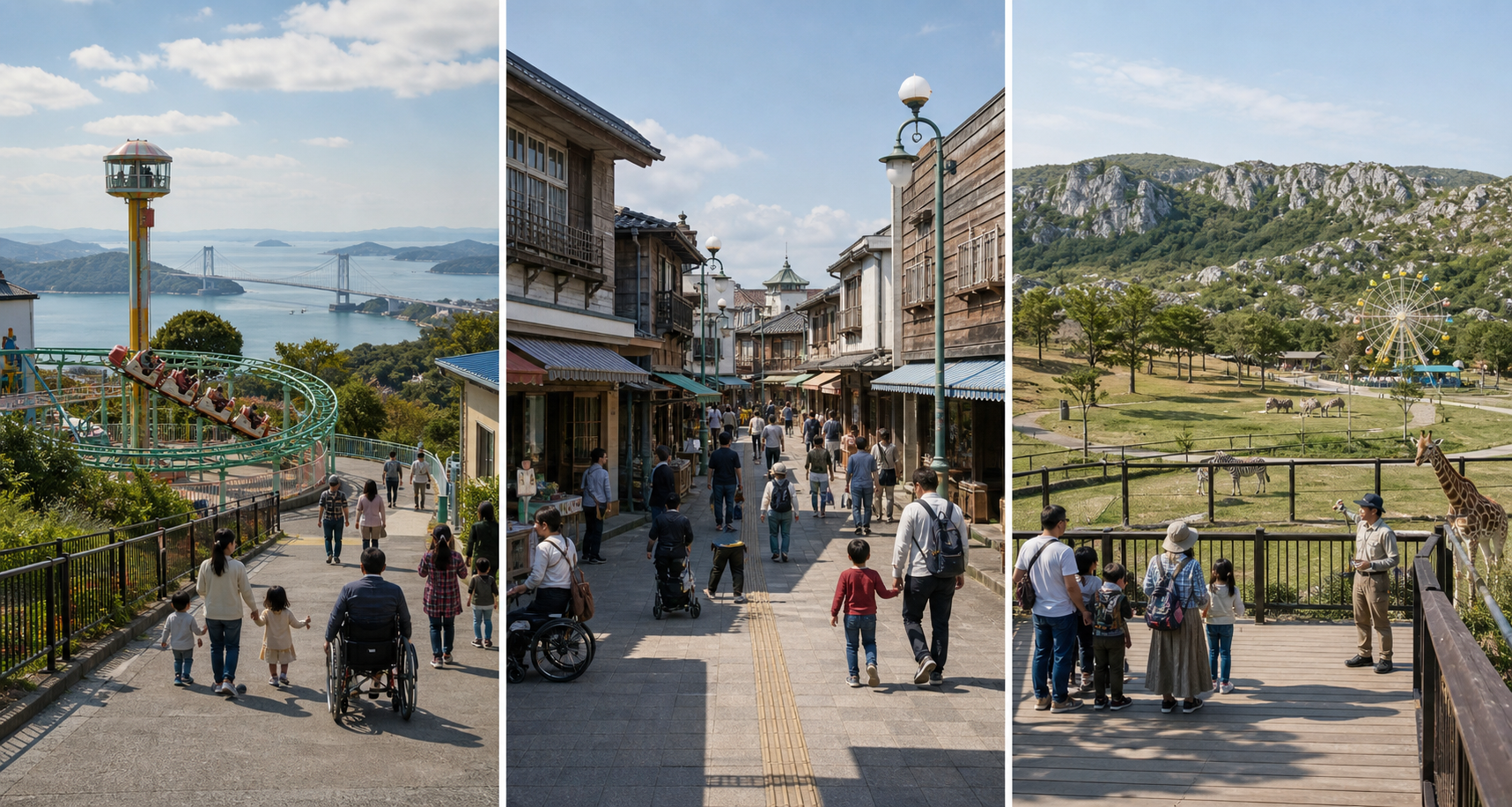
Information checked: August 26, 2026. The Chugoku region does not have one interchangeable “best amusement park.” Brazilian Park Washuzan Highland combines Seto Inland Sea views with thrill rides; Miroku no Sato mixes family attractions with a reconstructed Showa-era street; Akiyoshidai Safari Land is primarily an animal park with a smaller ride area. Choose by transport, child height, heat and the ticket components you will actually use.
Choose the experience before choosing the prefecture
| Park | Best fit | Main planning constraint |
|---|---|---|
| Washuzan Highland, Okayama | Thrill rides, sea-and-bridge views, summer pool | Hillside walking, ride restrictions, date-specific hours |
| Miroku no Sato, Hiroshima | Mixed-age families, rides, Showa streets, seasonal pool | Variable-price ticket and limited bus schedule |
| Akiyoshidai Safari Land, Yamaguchi | Animals first, gentle rides second | Car/bus choice, separate safari and ride charges |
“Chugoku” here means western Honshu, not China the country. These parks are far apart: do not try to combine them in one day.
Brazilian Park Washuzan Highland: rides above the Seto Inland Sea
Address: 303-1 Shimotsui Fukiage, Kurashiki, Okayama 711-0926. Access: from JR Kojima Station, take the Shimotsui loop bus to Washuzan Highland Yuenchi-mae; the ride is roughly 10 minutes, but verify the day’s timetable and last return. Kojima IC is close by car. Admission: as checked, admission plus free pass is ¥3,800 for junior-high age and above, ¥3,200 for primary pupils, ¥2,500 for ages three to preschool and ¥2,500 for ages 55+; bungee jumping costs extra. Hours change by date—August 2026 ranges from daytime closing to selected 23:00 nights—so there is no safe universal opening time. The summer pool is seasonal. Official calendar and prices
The cultural feature is not an “authentic Brazil” claim but a Japanese regional park’s long-running Brazilian-themed entertainment. Treat performers as professionals, follow photography announcements and do not reduce people to costumes. The famous elevated cycle and thrill rides require calm weather and individual eligibility; views never override staff instructions.
Miroku no Sato: family rides and a designed Showa memory
Address: 638-1 Fujie-cho, Fukuyama, Hiroshima 720-0543. Access: direct Tomotetsu buses operate from Fukuyama Station and a separate route serves Matsunaga Station, but services are not metro-frequency; match both outbound and return timetables before buying a ticket. Hours/closures: date-specific calendar; temporary closure and shortened-operation notices occur. 2026 prices: period A/B/C admission is ¥1,500/1,800/2,000 for junior-high age and above and ¥1,200/1,500/1,700 for ages three through primary school; ride free passes are ¥3,600/4,100/4,300 and ¥3,300/3,800/4,000 respectively. Web tickets are ¥100 less but still require exchange. Official tickets / Official access
Itsuka Kita Michi is a curated reconstruction of streets associated with Japan from the 1950s onward, not an untouched town. Use advertisements, household objects and shop layouts to ask how postwar consumption and family leisure changed. Some areas may be partly closed, so check notices rather than promising every scene.
Akiyoshidai Safari Land: plan the animal route first
Address: 1212 Aka, Mito-cho, Mine, Yamaguchi 754-0302. Access: about three minutes by car from Edo IC, about 50 minutes by car or roughly one hour by route bus from Shin-Yamaguchi Station. Confirm the rural bus connections in both directions. Hours: safari/contact area 9:30–16:45 from April–September and to 16:15 from October–March; amusement area to 17:00 or 16:30. Generally open daily, but inspection, construction and severe weather can close it. Safari admission: own-car route adult ¥2,600, age three+ child ¥1,600, age 70+ ¥2,300, plus mandatory first-lap tablet guide ¥600 per car. Feeding-bus totals are ¥3,700/¥2,700/¥3,400. Official operating information
The amusement area itself has free entry, but rides are charged separately. Walking-zone admission to the contact area is ¥1,500 adult and ¥1,000 child. Motorcycles, open cars and soft-top vehicles cannot enter the safari course; pets cannot accompany visitors inside. Animals may withdraw and programmes can change for welfare or weather.
A park name does not tell you what the ticket includes
| Check | Why it matters |
|---|---|
| Entry versus ride pass | Entry-only can leave every ride charge separate. |
| Pool entitlement | At Miroku, ordinary admission/free pass does not include the pool; even accompanying adults need the correct pool ticket. |
| Exceptions | Bungee, games, food, animal feed and some once-only attractions may be extra. |
| Age and height | Ticket age does not equal permission for every attraction. |
| Refund rule | Weather or ride suspension may not produce a ticket refund. |
Measure children before travel and ask about transfer needs
Check each ride’s minimum height, age, accompanying-adult rule, posture, restraint and emergency-evacuation requirement. A child tall enough may still decline; never pressure them because a pass was expensive. Ask whether a wheelchair user must transfer, whether stairs are part of evacuation, and where strollers can be parked. Carry prescribed medicine and a quiet recovery plan for sensory overload.
Heat, wind, lightning and rain change the usable park
Outdoor rides may stop for wind, lightning, rain or inspection while the gate remains open. In summer, arrive early, schedule indoor/shaded rest, drink regularly and do not use pool time as proof that heat illness is impossible. In a typhoon or severe-warning situation, check JMA, rail/bus operators and the park before departing; an open attraction does not make the journey safe.
Build one realistic day, not an attraction checklist
For Washuzan, reserve the cooler first hours for priority rides and the middle of the day for views and rest. At Miroku, choose either a ride-heavy plan or a pool plan, then spend a slower hour reading the reconstructed Showa street. At Safari Land, take the animal course early, eat and rest, then use only age-appropriate rides. Keep at least one return service in reserve when travelling by bus.
Safety and considerate photography
Obey queues, restraints, loose-item storage and staff instructions. Never extend a phone or camera beyond a ride vehicle, feed animals outside approved programmes, tap glass, imitate calls or block accessible routes. Ask before photographing performers or identifiable families. Dispose of rubbish correctly and return rented mobility or locker equipment on time.
The five checks that prevent a wasted trip
- Open the park’s calendar for the exact date, not a search-result snippet.
- Confirm every priority attraction and pool/animal programme is operating.
- Match ticket inclusions to every visitor’s age, height and needs.
- Save the last two return connections and a taxi number offline.
- Recheck weather, service notices and closures on the morning of travel.
The best regional park is the one your group can reach, use safely and leave without a last-bus crisis.