



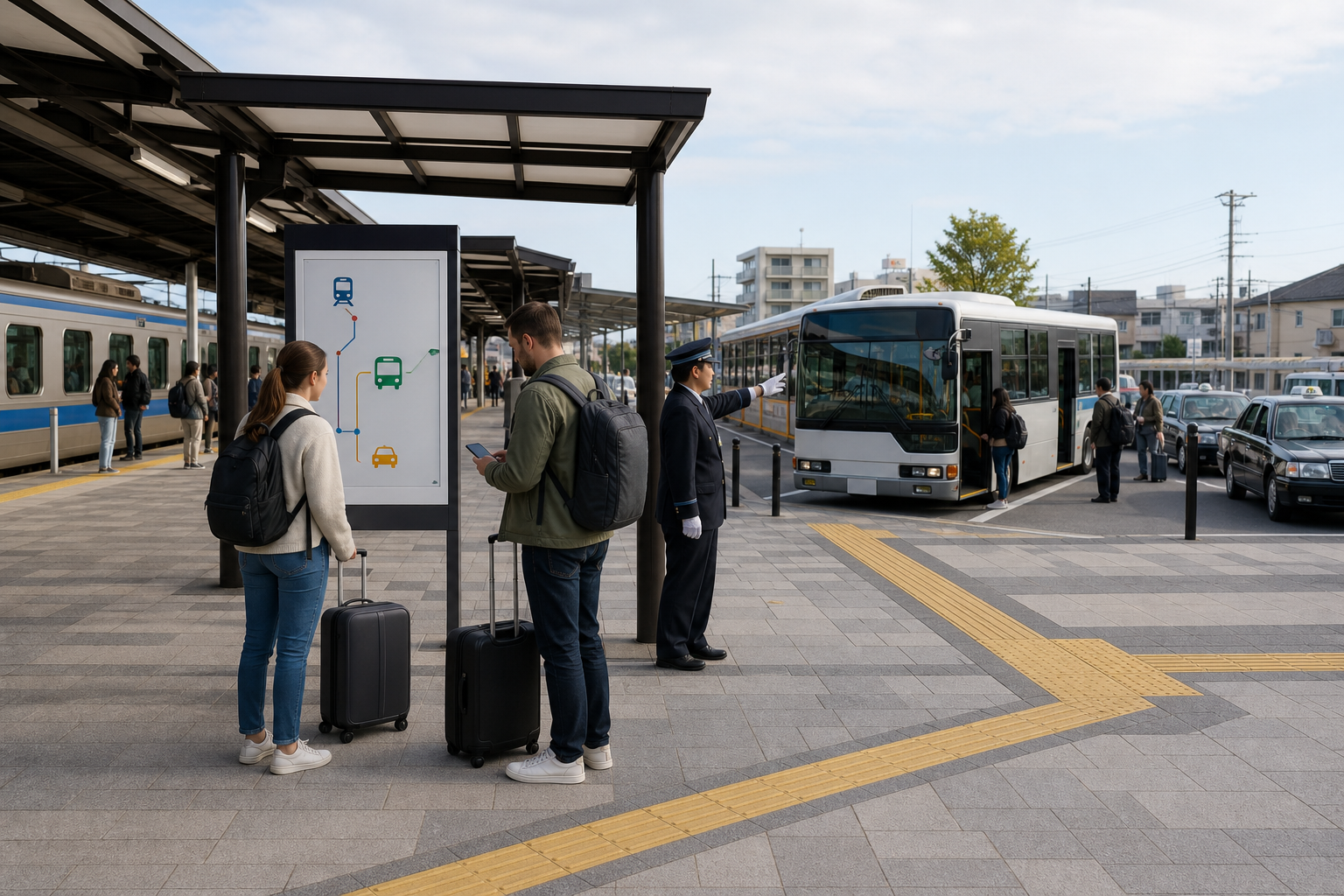
Japan has many transport choices, and JR, private railways, subways, local buses, highway buses and taxis at one station may use separate companies and fares. Rather than assuming everything is punctual and nationwide, verify the segment, service type, reservation, IC-card boundary, final departure and baggage. That prevents more mistakes than a “fastest route” screenshot.
Choose by distance, baggage and time
| Situation | First candidate | Verify |
|---|---|---|
| Within a major city | Rail/subway + walking | Exit, transfer distance, last service |
| Regional station to attraction | Local bus | Frequency, IC acceptance, final return |
| Fast intercity | Shinkansen/limited express | Fare layers, reservation, baggage |
| Lower-cost/night intercity | Highway/overnight bus | Terminal, seat, rest stops, delay |
| Early/late, group, heavy bags | Taxi | Meter, dispatch, surcharge, toll |
Do not add movement merely to collect destinations. A complicated transfer that saves ten timetable minutes can add station walking, confusion and delay risk. Check official times, platform/bus-stop name and gradients, not only an app’s fastest line.
Rail tickets are layered
On many JR journeys a basic-fare ticket is combined with a limited-express/Shinkansen ticket and, where relevant, reserved-seat or Green-class charges. They may print as one ticket or several. Confirm which pieces enter the gate together and do not discard a ticket mid-journey.
- Local/rapid: often basic fare or IC balance; liner and other exceptions can need another ticket.
- Limited express: basic fare plus limited-express ticket; some trains are entirely reserved.
- Shinkansen: basic fare plus Shinkansen express charge; bundled products, online pickup and IC links vary.
- Private rail/subway: normally outside JR tickets/passes. Through-running can add a non-JR fare.
The same service name can have reserved/unreserved and seasonal conditions. Compare the exact train, seat, change/refund rule and pickup—not merely the smallest search-result price.
IC cards: widely useful, not universal
Major cards such as Suica, PASMO and ICOCA are mutually accepted on many trains, buses and shops. They do not cover every route. Crossing between IC regions, some rural transport, reserved services and Shinkansen use have separate limits. Entering one gate does not prove the entire trip can be settled by IC.
- Check the IC logo and permitted segment before boarding.
- Use the same card/device at entry and exit; do not stack cards.
- For low balance, missed touch or region crossing, do not force the gate—ask staff.
- Deposit, refund, expiry, mobile version and foreign-card top-up differ by product.
- Carry small cash and another payment method for outages or a flat phone.
An IC card does not automatically calculate every travel pass or reserved surcharge. Compare day passes, limited-express tickets and promotions separately.
Shinkansen, national JR Pass and oversized baggage
In 2026, ordinary-class national JAPAN RAIL PASS prices are ¥50,000 for seven consecutive days, ¥80,000 for 14 and ¥100,000 for 21. Eligibility includes Temporary Visitor conditions. Subways, most private rail and JR highway buses are generally outside coverage. It is not automatically a bargain after “a few Shinkansen rides.” Total actual segments and compare regional passes and flights.
The pass does not guarantee a seat. Reserve all-reserved services and busy dates, and cancel unused reservations before departure. Tokaido/Sanyo/Kyushu Shinkansen Nozomi and Mizuho are not included by the ordinary pass alone; current use requires the dedicated additional pass-holder ticket or another valid fare arrangement.
- Three dimensions up to 160 cm: suitable overhead, footwell or designated deck storage
- 161–250 cm: advance reservation of a seat with oversized-baggage area/compartment is required on Tokaido–Sanyo–Kyushu Shinkansen
- No reservation: an applicable ¥1,000 onboard baggage fee and staff-directed storage
- Over 250 cm: cannot be carried aboard
Space behind the last row is reserved/shared baggage area, not automatically owned by that passenger. Strollers, instruments and sports equipment have exceptions, but reserve the storage you need. Read JR Central’s official oversized-baggage guide.
Local, limited-express and private rail
Local, rapid and limited-express trains can share a platform; another company may run through on the same track. Match Japanese/romanised station name, destination, service category and stops, not only an alphanumeric station code. Beware similarly named JR/private stations and bus stops far across a north/south exit.
Regional services may be over an hour apart and finish early. Unstaffed lines can use numbered tickets, onboard settlement, one-person boarding and door buttons. Save the return before boarding and keep information offline where reception is weak.
Local buses: front/back and pre/post-payment differ
- Check route number, via point and platform—not destination alone.
- Follow the marked/front-or-rear entrance and passenger flow.
- For distance fares, take a numbered ticket; for IC, touch the specified reader.
- Press the stop button after your stop is announced.
- For post-payment, match the ticket number to the display and pay by accepted IC/cash. Change machines may reject large notes.
Do not confuse a city’s flat fare with regional distance fare. Some buses lack IC, require cash or sell a ticket before boarding. Keep suitcases out of aisles and wheelchair space; if full, consider both the next bus and the final return.
Highway and overnight buses: compare conditions, not a fixed price
Tokyo–Osaka does not have one permanent fare. Day, season, seat, changeability, advance discount, operator and terminal alter the price. Compare with rail for the same date and flexibility.
- Verify terminal building, floor, bay and check-in cut-off—not merely “Shinjuku” or “Osaka.”
- Seat width, toilet, stops, charging and women-focused arrangements are service-specific.
- Check hold-baggage number/dimensions, fragile items, bicycle/instrument rules, valuables and no mid-route retrieval.
- An overnight bus is not a complete hotel substitute; plan sleep, changing and a safe early-arrival rest place.
- Road and weather delay make a tight flight or timed booking immediately after arrival unsafe.
Taxis: not one national ¥500/1 km fare
Initial distance/fare, distance/time increments, late-night, dispatch, reservation, toll, winter and area charges vary by operating district and company. Expect the meter; a quote remains approximate because traffic changes the total. Use an official rank, accommodation booking or a licensed regional dispatch service—never an unlicensed private ride.
- Show facility name, entrance, phone and map pin—not address alone.
- Rear doors are often driver-operated; do not force them.
- Wear seatbelts; request child seat, wheelchair vehicle and luggage capacity in advance.
- Cash, card, IC and QR acceptance vary by vehicle. Ask before departure and carry a backup.
- Check whether app estimates include dispatch, reservation and toll charges.
Baggage, children and accessibility
Do not place suitcases on tactile paving, gates, escalators or bus aisles. Use station/hotel storage or delivery in crowded cities while keeping passport, medicine and valuables. On escalators, follow signs and safety rather than regional standing folklore; do not walk and hold the rail.
For a stroller, wheelchair, large baggage or visual/hearing support, confirm the lift exit, staff-assistance meeting time, train–platform gap, wheelchair seat, bus ramp and universal-design taxi by the previous day. “Accessible station” does not mean every exit is step-free.
Disruption, last service and FAQ
- Save the final service and one earlier option, plus whether taxis operate afterward.
- Check operator status in the morning; do not rely only on prediction apps.
- Add lift and baggage time, not only the nominal shortest transfer.
- For delay, ask whether alternative transport, ticket treatment or reservation change applies.
- During disaster, reach a safe station/accommodation instead of completing sights. A pass does not necessarily reimburse extra lodging.
Should I buy a JR Pass?
Calculate your itinerary. It can suit concentrated eligible long-distance JR travel. City-only, private-rail-heavy or Nozomi-priority trips may favour individual tickets or a regional pass.
Can one IC card take me everywhere?
No. Mutual acceptance is broad but region crossings, rural transport, reserved trains and Shinkansen can require another process.
What if I miss the last train?
Check licensed taxis, nearby accommodation and safe late facilities. Do not sleep rough around a station or accept an unlicensed car.
Official references: JAPAN RAIL PASS; conditions current April 2026; JR Central oversized baggage. Verify individual fares, schedules, IC and taxis with the local operator on the date.