



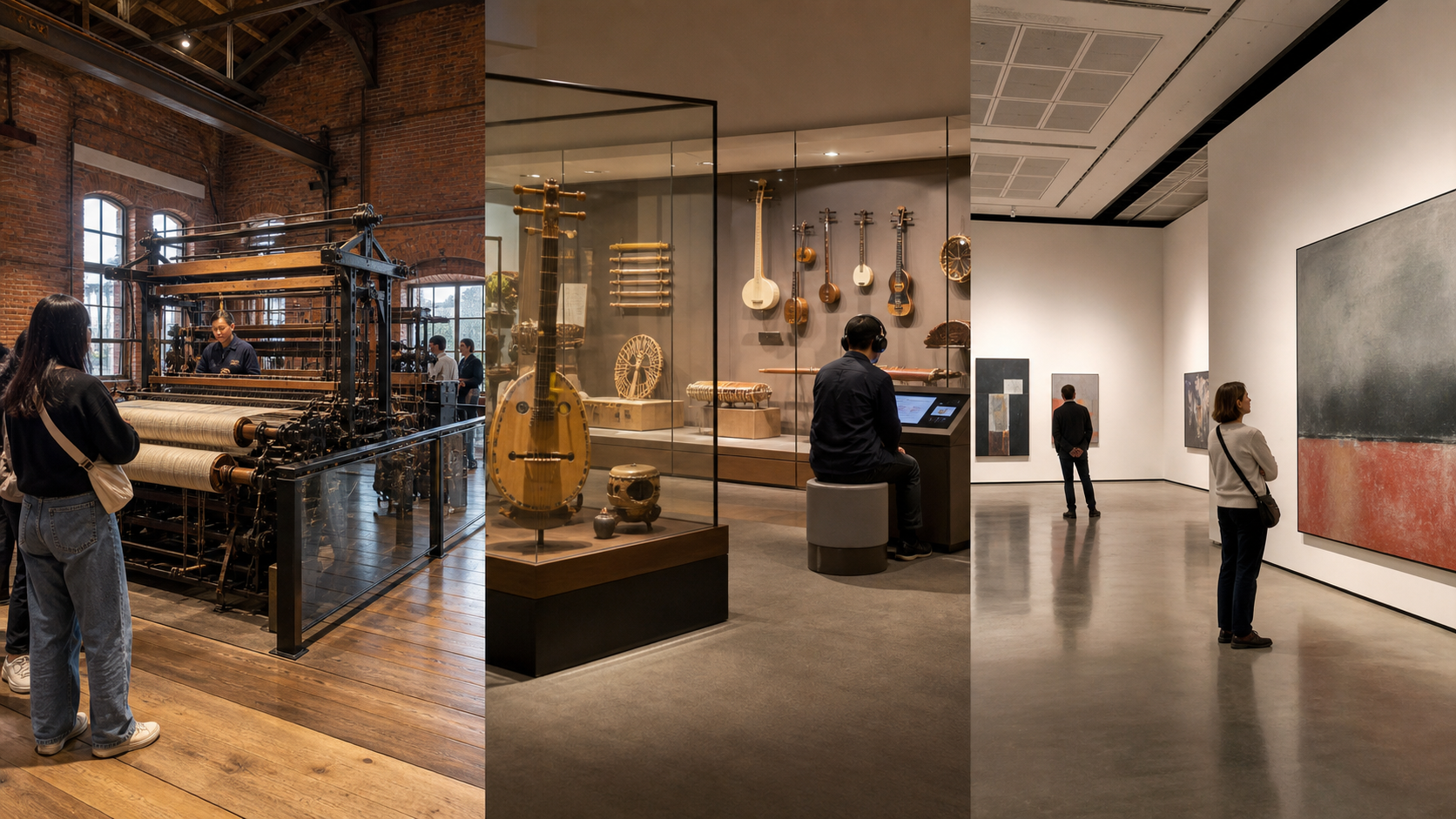
Information checked: August 26, 2026. A useful Tokai museum trip is not a random list of famous objects. It can connect three regional strengths: Nagoya’s history of textile and automobile manufacturing, Hamamatsu’s international musical-instrument culture, and modern art in central Nagoya. This guide corrects outdated prices and mistranslated collection claims, then shows how to visit without rushing demonstrations, exhibitions or the people who work there.
1. What “Tokai” means for this route
The boundaries of Tokai vary by context, but travel planning commonly brings together Aichi, Gifu, Mie and Shizuoka. This article does not claim to catalogue every museum in four prefectures. It uses two rail-connected cities—Nagoya in Aichi and Hamamatsu in Shizuoka—to build a focused route around manufacturing, sound and art.
Nagoya is the practical base. The Toyota Commemorative Museum of Industry and Technology is close to Nagoya Station, while Nagoya City Art Museum sits in Shirakawa Park near Fushimi. Hamamatsu is roughly 35 minutes from Nagoya by some Hikari services or about 50 minutes by Kodama, before a ten-minute walk to its musical-instrument museum. Train patterns and fares vary, so confirm your actual departure rather than planning from these example times alone.
2. Quick comparison: choose by interest and energy
| Museum | Main theme | Realistic visit | Best for |
|---|---|---|---|
| Toyota Commemorative Museum of Industry and Technology | Textile machinery, automobile production and industrial heritage | 2.5–4 hours | Visitors who learn through operating machinery and demonstrations |
| Hamamatsu Museum of Musical Instruments | Instruments and sound cultures from Japan and around the world | 2–3 hours | Music, craft, acoustics and cross-cultural comparison |
| Nagoya City Art Museum | Collection exhibitions, regional art and changing special exhibitions | 1.5–2.5 hours | Modern and contemporary art, architecture and a central-city visit |
Do not force all three into a single day. Toyota’s live demonstrations and Hamamatsu’s mini-concerts or gallery talks are schedule-dependent; racing between cities can turn the most valuable parts into missed appointments.
3. Toyota Commemorative Museum: from looms to automobiles
The correct English name is the Toyota Commemorative Museum of Industry and Technology. It stands on the birthplace of the Toyota Group and preserves an early-20th-century factory as industrial heritage. Its core story begins with textile machinery rather than automobiles: improvements in spinning and weaving, including Sakichi Toyoda’s inventions, created skills, capital and a culture of practical experimentation that later supported automobile development.
The Textile Machinery Pavilion and Automobile Pavilion use actual machines and staff demonstrations to explain motion, materials and production. This is more than a display of famous cars. Watch how a mechanism solves a problem, compare manual and automated work, and notice how monozukuri here means an evolving combination of design, trial, skill, safety and production—not a mystical national trait.
Practical visit: 1-35, Noritake Shinmachi 4-chome, Nishi-ku, Nagoya. It is about three minutes on foot from Meitetsu Sako Station; the Me~guru sightseeing bus also stops at the entrance. Open 9:30–17:00, last admission 16:30. Adults aged 18 or over pay ¥1,000. Closed Mondays, or Tuesday when Monday is a holiday, plus year-end/New Year holidays. Ordinary individual entry does not require a reservation, but Technoland uses same-day numbered tickets and demonstrations or tours can be cancelled.
4. Hamamatsu Museum of Musical Instruments: compare sound, not “rarity”
The Hamamatsu Museum of Musical Instruments is a public museum devoted to musical instruments, not a pottery or “wares” museum. Its permanent galleries display about 1,500 materials selected from a wider collection, arranged across regions, types and periods. Japanese instruments sit within a global sound history rather than being isolated as exotic objects.
Move beyond a checklist of “oldest,” “largest” or “rare.” Compare how material, climate, belief, ceremony, court culture, popular entertainment and available technology shape instruments. Listening stations, demonstrations, mini-concerts and workshops may reveal more than photographing cases, but their schedules change and some programs have limited capacity.
Practical visit: 3-9-1 Chuo, Chuo-ku, Hamamatsu, Shizuoka. Walk about ten minutes from the north exit of JR Hamamatsu Station. Open 9:30–17:00. Adults ¥800; high-school students ¥400; elementary and junior-high students are free. Closed on the second and fourth Wednesday (or following day if it is a holiday), except that August is normally open daily, as well as year-end/New Year and inspection days. There is no dedicated car park; surrounding parking is paid.
5. Nagoya City Art Museum: collections change, so check the calendar
Nagoya City Art Museum is in Shirakawa Park, in a building designed by Kisho Kurokawa. It presents collection exhibitions and separate special exhibitions; it is inaccurate to describe the entire museum as a permanent display of another museum’s collection. Collection rotations may include École de Paris, Mexican Renaissance, contemporary art, local artists and photography, but what is visible depends on the exhibition period.
Practical visit: 2-17-25 Sakae, Naka-ku, Nagoya. From Fushimi Station, use Exit 5 and walk through the Shirakawa Park area. Open 9:30–17:00, with Friday opening to 20:00 except on public holidays; last admission is 30 minutes before closing. The collection exhibition is generally ¥300 for adults and ¥200 for high-school/university students; special exhibitions have separate prices. Closed Mondays (or the following weekday when Monday is a holiday), year-end/New Year and exhibition-change periods. In 2026, several multiweek changeovers appear on the official calendar, so checking only “Monday closed” is not enough.
6. Recommended routes: depth before quantity
| Plan | Morning | Afternoon | Why it works |
|---|---|---|---|
| Nagoya industry day | 09:30–13:00 Toyota museum, aligned with demonstrations | Lunch, Noritake area or one nearby cultural stop | Leaves time to understand textile-to-automobile development |
| Nagoya art + industry | 09:30–12:00 Toyota museum selected route | 14:00–16:30 Nagoya City Art Museum | Contrasts production technology with visual culture; skip if a changeover closes the art museum |
| Hamamatsu sound day | Arrive after checking the event schedule; permanent galleries | Listening, mini-concert/workshop if offered, then city walk | Avoids treating Hamamatsu as a rushed stop between trains |
| Two-city, two-day route | Day 1 Nagoya: Toyota or art museum | Day 2 Hamamatsu: musical-instrument museum | Best balance for demonstrations, meals, luggage and delays |
On a through trip between Tokyo and Kyoto/Osaka, Hamamatsu can be a stopover only if luggage storage and the exact train pattern are confirmed. Do not assume every Hikari stops there, and allow time to retrieve bags before the reserved train.
7. Tickets, closures and reservations
Prices in older articles can be misleading. Toyota’s current general adult admission is ¥1,000, not the former ¥500 quoted in the old page. Hamamatsu remains ¥800 for an adult permanent-exhibition ticket at the checked date. Nagoya City Art Museum’s ¥300 fee covers the collection exhibition; a special exhibition is not automatically included.
Check four separate items: the building calendar, the exhibition calendar, the event/demonstration schedule and the ticket page. A museum can be open while a gallery is changing exhibitions, and a demonstration can be cancelled while the permanent galleries remain open. Discount passes can save money only when your chosen facilities, valid weekdays, sales period and normal admission total make sense; never buy a pass solely from an advertised maximum saving.
8. Museum, demonstration and photography etiquette
- Follow gallery-specific photography symbols. Permission in one room does not extend to every loan, artwork or special exhibition.
- At Toyota, personal photography is generally allowed, but tripods and auxiliary equipment are not; do not record guided-tour audio/video or photograph staff and visitors without permission.
- Keep behind barriers and never touch, sit on or climb machinery. A stopped demonstration is not permission to approach moving parts.
- At an instrument museum, do not play displayed instruments unless staff explicitly identify a hands-on object. Sound is part of the collection, and uncontrolled playing affects every visitor.
- Switch the phone to silent, keep calls outside galleries, and use headphones at listening stations at the level provided.
- Eat and drink only in designated places. Large luggage belongs in an approved locker or staffed facility, not beside cases or emergency routes.
- Sketching materials, flash, video, live streaming and commercial use have separate rules; ask before setting up.
9. Accessibility, families and language support
Toyota publishes detailed information on slopes, lifts, handrails, nine multipurpose toilets, assistance dogs, loan wheelchairs/canes, strollers, a nursing room and a prayer room. Availability of loan equipment is limited. Its maps and audio guidance cover several languages; same-day English tours may be offered but can be cancelled, so the self-guided route must still work.
For every museum, verify the specific entrance, lift location, accessible toilet and seating rather than relying on a generic icon. Families should choose fewer galleries, schedule a break and explain that interactive buttons are different from touch-prohibited exhibits. Visitors sensitive to sound should check demonstration and mini-concert times; visitors with visual impairments can ask which tactile or audio resources are currently available.
10. Final checklist and official links
- Is the museum open, and is the gallery you want between changeovers?
- Have you checked last admission as well as closing time?
- Do demonstrations, tours or workshops require a same-day ticket?
- Does your train actually stop at Hamamatsu, and where will luggage go?
- Have you budgeted for special exhibitions separately?
- Do you know the photography, food, sound and accessibility rules?
Primary sources: Toyota Commemorative Museum of Industry and Technology, Hamamatsu Museum of Musical Instruments visitor information, and Nagoya City Art Museum calendar. Recheck each site on the morning of travel, especially for typhoons, inspection days, exhibition changes and demonstration cancellations.