



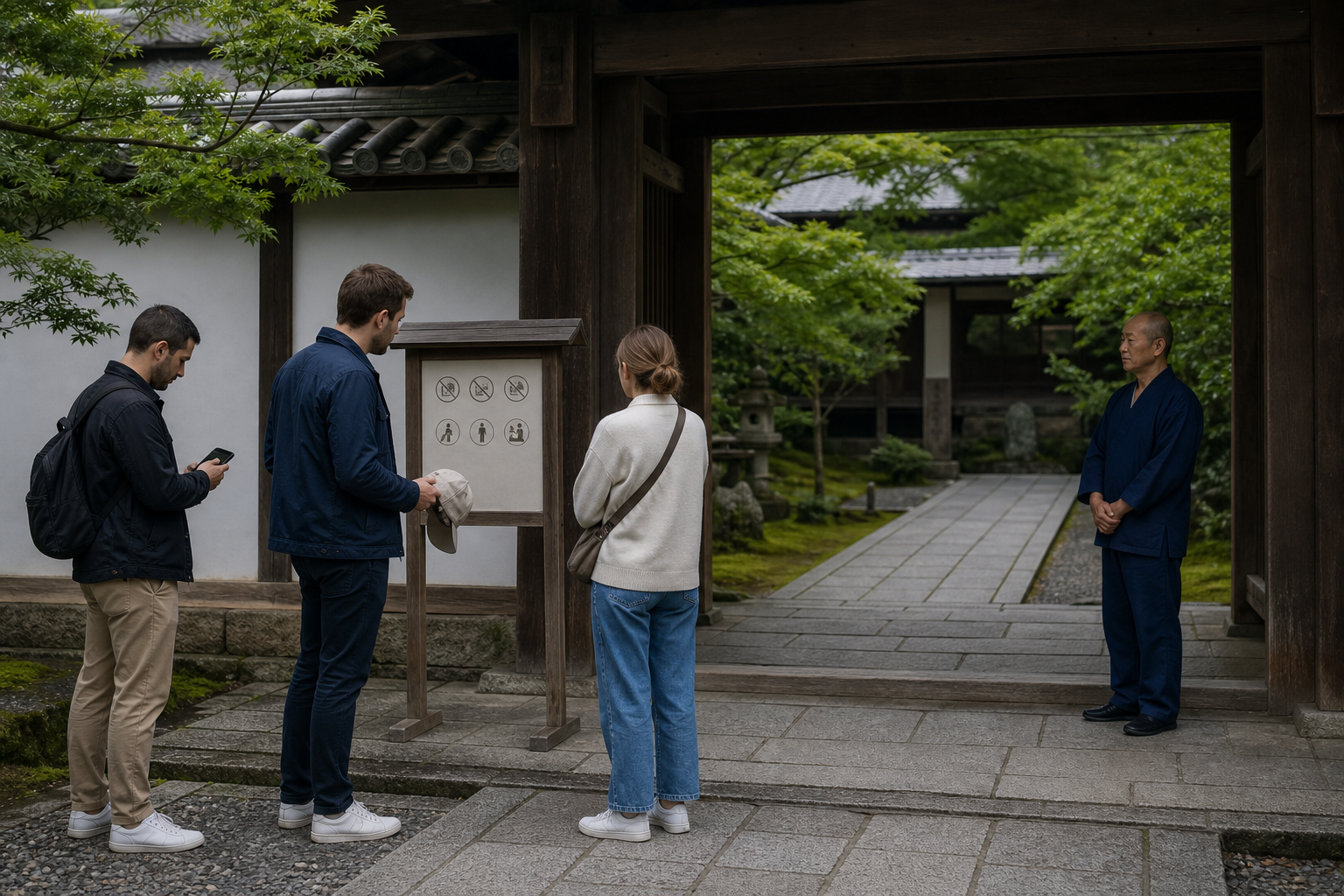
Kyoto’s shrines and temples are not merely old buildings to photograph. Worship, ceremonies, training and community life continue there today. Perfectly memorising a ritual matters less than reading the notice, staying quiet and protecting the routes of worshippers and residents. This guide separates shrine and temple customs so that a general habit is never mistaken for one site’s rule.
Rule priority: the site beats a generic ritual
- Restricted areas, law and staff: never cross a rope, fence, closed gate or conservation boundary.
- Same-day notices: photography, shoes, food, ceremonies, queues, one-way routes and special entry.
- Official site/booking terms: gates, fees, closure, group size, baggage and disability arrangements.
- General custom: a useful default only where no instruction exists; sect and history can create exceptions.
“I photographed it at the last temple” and “everyone on social media does it” are not permission. A free precinct may still contain a paid, no-photo hall or garden. Admission contributes to operation and conservation; it does not purchase unrestricted access to a sacred place.
Shrine and temple: do not copy the same movement
| Shinto shrine | Buddhist temple | |
|---|---|---|
| Tradition | Shinto; enshrined kami | Buddhism; buddhas, bodhisattvas, founders |
| Common entrance clue | Torii | Sanmon or other temple gate |
| Common prayer | Often two bows, two claps, one bow | Join palms and pray quietly; normally no clapping |
| Exceptions | Some shrines use another clap count | Sect, hall and ceremony practices differ |
Precinct shrines inside temples and mixed historical landscapes are not always identified by architecture alone. Read the name, enshrined figure and official guide. If mistaken, do not panic: become quiet, read the notice and adjust.
Basic shrine worship
- Pause clear of traffic before the torii and make a small bow.
- Avoiding the centre is a common custom, but safety and the site’s circulation come first; do not squeeze dangerously to an edge.
- Purify at the water basin if it is open. Do not improvise if ladles are removed or use is suspended.
- At the worship hall, place an offering gently and use a bell only when installed and available.
- A common sequence is two bows, two claps, prayer and one bow; posted or ceremony-specific practice overrides it.
- On leaving, bow if appropriate without stopping the flow outside the gate.
The centre is sometimes explained as the kami’s route, but custom should never make a road, crowd or accessible route less safe. Pushing another worshipper aside to preserve an empty centre is worse etiquette.
Basic temple worship
- Bow lightly at the gate, avoid stepping deliberately on a threshold and use only an open passage.
- Use incense and purification facilities only where offered; obey fire and smoke restrictions.
- At the main hall, offer gently, join the palms and pray. Do not normally clap as at a shrine.
- Do not turn priests, chanting, funerals, memorial services or ceremonies into a tourist performance.
- A final bow must not block a queue, vehicle or wheelchair route.
Not every main hall requires shoes to be removed. Some are worshipped from outside; others supply a shoe bag for entry. Follow the floor, tatami, veranda signs and staff rather than a universal claim.
Purification, incense and candles: only when provided
At a ladle basin, a common sequence uses one scoop to rinse the left hand, right hand and then the mouth via water poured into the left hand; never touch the ladle to the mouth, and rinse the handle last. Many sites now use flowing water, no ladles or temporary closure. Do not drink the water or search for equipment against a notice merely to reproduce a ritual.
Buy and light incense/candles only at the designated place; do not wave fire and obey fire bans and quantity limits. Incense smoke may have devotional or folk associations, but it cannot be presented as medically curing disease. Never direct smoke at children, people with respiratory conditions or anyone who moves away.
Shoes, clothes and interiors
- Respect the exact shoes-off boundary and use the bag provided. Never set shoes on tatami or a cultural-property floor.
- Corridor slippers may also need removal before tatami; the sign wins.
- Removing a hat inside can be courteous, but religious or medical headwear need not be forced off; ask staff.
- There is no single Kyoto-wide shoulder/knee law. Choose quiet, practical worship clothing and follow special-entry conditions.
- Wet umbrellas, suitcases and food must not obstruct entrances or tactile paving. Store large baggage at a station or accommodation.
Photos, video, tripods and drones
| Notice | Action |
|---|---|
| No photography | Includes phones and video; comply if asked to stop or delete |
| No flash | Does not prove every other photo is permitted; read all signs |
| No tripod/selfie stick | A circulation, safety and conservation rule even when quiet |
| Partial permission | Only the named area, direction or object |
Do not make worshippers, priests, shrine staff, ceremonies, counter workers or children the subject without consent. Shutter sound, live streaming, lights, costume/commercial shoots can require separate approval. Drone use involves aviation rules plus landowner, municipal and site permission; never fly in a precinct without explicit authority.
Offerings, goshuin and amulets
There is no nationally correct offering coin. Wordplay about denominations is optional; place money gently. Never stick coins or notes to buildings/statues or throw them into a pond unless a site expressly provides for it.
A goshuin records worship; it is not a souvenir stamp. Worship first, then check reception time, prewritten sheets, fee and accepted book. Do not demand service after closing, hurry the writer, photograph without consent or acquire marks for resale. Treat omamori and ofuda as devotional items, not packaging to open for content photography.
Residents, geiko/maiko, groups and children
Homes, schools, cemeteries and workplaces surround Kyoto sacred sites. Never use a private lane, doorway, garden or closed cemetery section as a shortcut or set. Gion residents explicitly prohibit stopping, following, touching or taking unauthorised photos/videos of geiko and maiko. Do not block roads or pavements for a composition.
- Groups: do not form a wall at an entrance; explain in a permitted place using a low voice or receivers.
- Children: adults prevent running, playing with gravel/stones/bells and climbing rails.
- Food: use designated areas; do not picnic in halls, cemeteries or gardens, eat while obstructing, or leave waste.
- Early/late: a route open 24 hours does not permit loud conversation, lighting or suitcase noise beside sleeping residents.
Planning, accessibility and FAQ
For each site verify its official name, address, station/bus stop, gradient/steps, gate and last admission, fee, closure, photography, luggage, toilets and wheelchair route. Never generalise that Kyoto temples open early or shrines are free. Ceremonies, works and blossom/foliage seasons can override normal information.
Accessibility must be checked section by section: approach, reception, worship hall, garden, goshuin counter and toilet. Gravel, gradients, thresholds and shoe removal matter. Ask directly about companions, loan wheelchairs, alternative gates and lifts during special access.
Will I be punished for walking in the centre of a torii path?
There is no need for fear. Know the general custom, but prioritise safety, crowds and accessible circulation; quietly adjust next time.
Does temple incense smoke cure illness?
It has devotional and folk associations, but no medical cure can be guaranteed. Do not direct smoke at others and avoid it if health requires.
Can I worship if I make a ritual mistake?
Yes. Respect, quiet behaviour and compliance with entry/photo rules matter more than perfect choreography. When uncertain, bow or join palms simply and ask staff briefly.
Official reference: Kyoto City Tourism Association, Gion resident guidance, plus each shrine/temple’s official page and signs. Use same-day primary information, not an unverified “all-site app” or social post.