


One night at an onsen ryokan is more than a bath and a bed. Arrival, meals, yukata, futon, regional ingredients and the character of the water form one connected stay. Yet dinner cut-offs, baths, tattoos, children, dietary requests and shuttles differ by property. Confirming them before booking is the first step toward receiving hospitality without creating impossible expectations.
Ryokan and onsen are not synonyms
A ryokan is Japanese-style accommodation that may feature tatami rooms, meals and personal service, but not every ryokan has natural hot-spring water. Under Japan’s Hot Springs Act, an onsen is underground water, vapour or gas that is at least 25°C at source, or contains at least one listed substance above its threshold. Cooler source water may therefore legally be onsen and require heating.
Terms such as free-flowing source, recirculation, filtration, added water, heating and disinfection describe management methods; one word alone does not determine quality. Read the bath notice for spring type and treatment, then match it to your health and preference. A private open-air room bath is not automatically natural onsen.
The 12-point booking check
- Price unit: often per person, per night and meal plan—not one room total.
- Meals: dinner/breakfast, breakfast only or room only; dining hall, private room or in-room service.
- Dinner cut-off: the last check-in and last dinner start may differ.
- Room: tatami, hybrid or Western; bed/futon, toilet, shower and room bath.
- Baths: public indoor/outdoor, reservable, room bath, gender switch and cleaning hours.
- Tattoos: covering size, public-bath rule and private alternative—ask directly.
- Diet: name allergens, religious/vegan needs, pregnancy foods and cross-contact limits at booking.
- Access: last bus, reserved shuttle, snow, gradients and next-morning service.
- Children: age pricing, meal, bedding, bed-sharing and guardian rules.
- Accessibility: entrance, route, tub edge, rails, room and dining measurements.
- Cancellation: food preparation can trigger earlier charges than at a room-only hotel.
- Tax/payment: bathing tax, local accommodation tax, pay-at-property items, cards and cash.
Do not rely on “onsen included,” “private bath” or “diet available.” Save the reply that names your date, party and requested arrangement.
Day 1: arrival before dinner
| Reference time | Activity | Check |
|---|---|---|
| 15:00 | Arrival/check-in | Meals, baths, curfew, exits, keys |
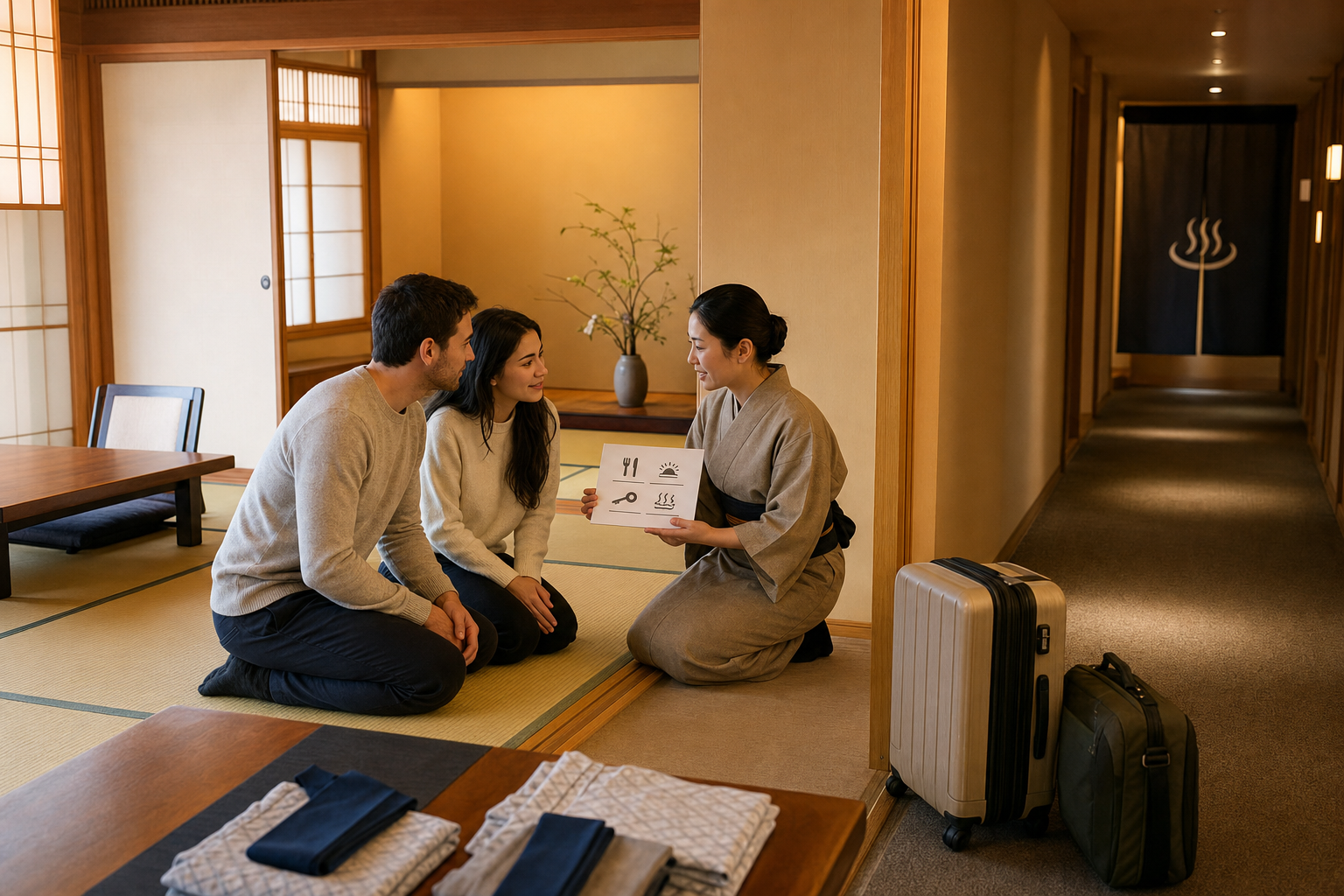
| 15:20 | Room orientation/tea | Footwear, minibar charges, futon |
| 16:00 | First short bath | Health, cleaning, gender switch |
| 17:15 | Rest and yukata | Hydrate; locate dining room |
| 18:00–19:30 | Dinner | Arrive at assigned start |
Many half-board ryokan prepare dinner to a set schedule. If delayed, contact the property as soon as you know—not after reaching the station. Do not assume a missed meal can be held safely or refunded. Shuttles may also be timed and reservation-only.
Follow the property’s boundary for removing outdoor shoes, using corridor slippers and entering tatami. Locate evacuation routes, nighttime contact and key policy immediately. Keep passports and medicine secured.
How to use a public bath safely
- Check the curtain/sign and any gender-switch time before entering.
- Undress in the changing room. Swimwear is normally not used. Leave phones and cameras outside.
- Wash at a shower station before entering and rinse away all soap.
- Tie long hair; never place the small towel in the water; do not swim.
- Use kakeyu to acclimatise, begin briefly and do not force shoulder-deep immersion.
- Hydrate afterward. Sit down and alert staff for dizziness, palpitations or nausea.
Japan’s Ministry of the Environment advises avoiding bathing immediately before/after a meal and after drinking alcohol, resting after strenuous exercise, and avoiding solitary bathing for older people, children and people who need physical assistance. It gives roughly 3–10 minutes for an initial bath and, after adaptation, around 15–20 minutes as a broad maximum—but temperature and your condition override any number.
Acute illness and some serious active heart, lung or kidney conditions can make hot-spring bathing unsuitable. If pregnant, under treatment, prone to fainting or managing blood pressure, ask your clinician and the property rather than self-diagnosing through a travel article. Drink spring water only where it is explicitly approved, and only in the stated quantity.
Kaiseki and dietary needs
A ryokan dinner may express place through local fish, mountain vegetables, fermentation, vessels and seasonality. Banquet-style kaiseki is not exactly the same concept as tea-ceremony kaiseki. Some properties present several dishes together; others serve courses.
- State the causal allergen, stock/sauce risk, cross-contact tolerance and emergency medicine—not merely “I dislike fish.”
- Seafood stock, soy/wheat, egg, dairy, buckwheat and sesame may be invisible in washoku.
- One substitute dish does not prove full vegan, halal or kosher handling.
- Ask in writing when booking; many kitchens cannot redesign a menu on arrival. Respect an honest inability to handle a life-threatening risk.
- Ask before photographing service or staff, and do not let hot dishes go cold for a photo session.
Yukata, tatami, futon and room
A yukata may be worn to the dining room or around the onsen town, but confirm the property’s boundary. Conventionally place the right panel against the body first and overlap the left panel on top. Keep the obi comfortable and add a haori or padded tanzen in cold weather. Ask for another size.
Do not take corridor slippers onto tatami or put wet towels and suitcase wheels directly on it. Staff may lay futons during dinner, the room may be pre-set, or guests may arrange bedding. Gather valuables and expect the stated room-entry service. If you need a bed, book a hybrid or Western room rather than assuming a tatami room includes one.
Night bathing and sleep
“Bath open 24 hours” can still exclude cleaning, gender switching and maintenance. If dinner includes alcohol, skip the night bath and use the morning slot. Voices at outdoor baths carry to guestrooms and residents. Never take a phone into a bathing area to photograph stars.
Hydrate and let body temperature settle before sleep. Note tatami steps, low chairs and the night route to the toilet; use a footlight. Contact the property for illness, and call 119 for urgent impaired consciousness or breathing difficulty.
Day 2: morning bath to departure
| Reference | Activity | Check |
|---|---|---|
| 06:30 | Morning bath or walk | Cleaning/switch, darkness, snow |
| 07:30–08:30 | Breakfast | Assigned time and room |
| 09:00 | Pack and review bill | Minibar, key, tax, shuttle |
| Around 10:00 | Checkout | Property’s stated time wins |
Prefer bathing before breakfast or leave sufficient time after it. The entrance may change after a gender switch. Review bathing/accommodation tax, drinks and private-bath charges before leaving, and reach the shuttle meeting point early.
Tattoos, families, gender and accessibility
Tattoos: there is no single nationwide guest rule. Policies range from small covers to no public-bath entry or private-bath alternatives. Send size or a photo and obtain written approval rather than hiding it.
Families: the maximum age for children to enter an opposite-gender bath varies by ordinance and property. Ask about nappies, toilet training, floats and baby baths; never leave a child alone in the tub or changing room.
Gender: discuss the actual bath category and private option before booking. Choose a property that can explain in writing how you can use facilities without requiring an unsafe or humiliating assumption.
Accessibility: look beyond “accessible room.” Ask about shuttle entry, front step, dining route, changing room, washing station, tub-edge height, rails, bathing chair, assistant access and reservable time. A private bath is not automatically wheelchair accessible.
Price, tax, model stay and FAQ
There is no national standard ryokan price. Compare the same headcount, room, dinner/breakfast, drinks, private bath, shuttle, service, consumption tax, bathing tax and local accommodation tax. Bathing tax is set by the municipality, so amount and exemptions differ. Distinguish “paid online” from “local taxes excluded.”
Low-stress model: reconfirm shuttle and dinner → arrive in the 15:00 hour → orientation → short pre-dinner bath → rest → dinner → skip bathing after alcohol → choose either a morning walk or bath according to health → breakfast → verify bill and transport. The unhurried margin is part of the stay’s value.
How many baths should I take?
There is no target. Ministry guidance cites one or two daily baths at the start of a therapeutic stay and two or three after adaptation, but for one night, health, temperature, meals and alcohol matter more. One bath can be enough.
Can I do anything in a private bath?
No. Photography, alcohol, towels, children, duration and cleaning remain subject to property rules. Privacy is not exemption from hygiene or safety.
Should I tip?
Normally no. Check service charges and express thanks directly. There is no need to force cash on staff.
Official references: Japan Ministry of the Environment, definition of onsen and contraindications, indications and bathing precautions. Confirm operations with the ryokan and taxes with its municipality.