



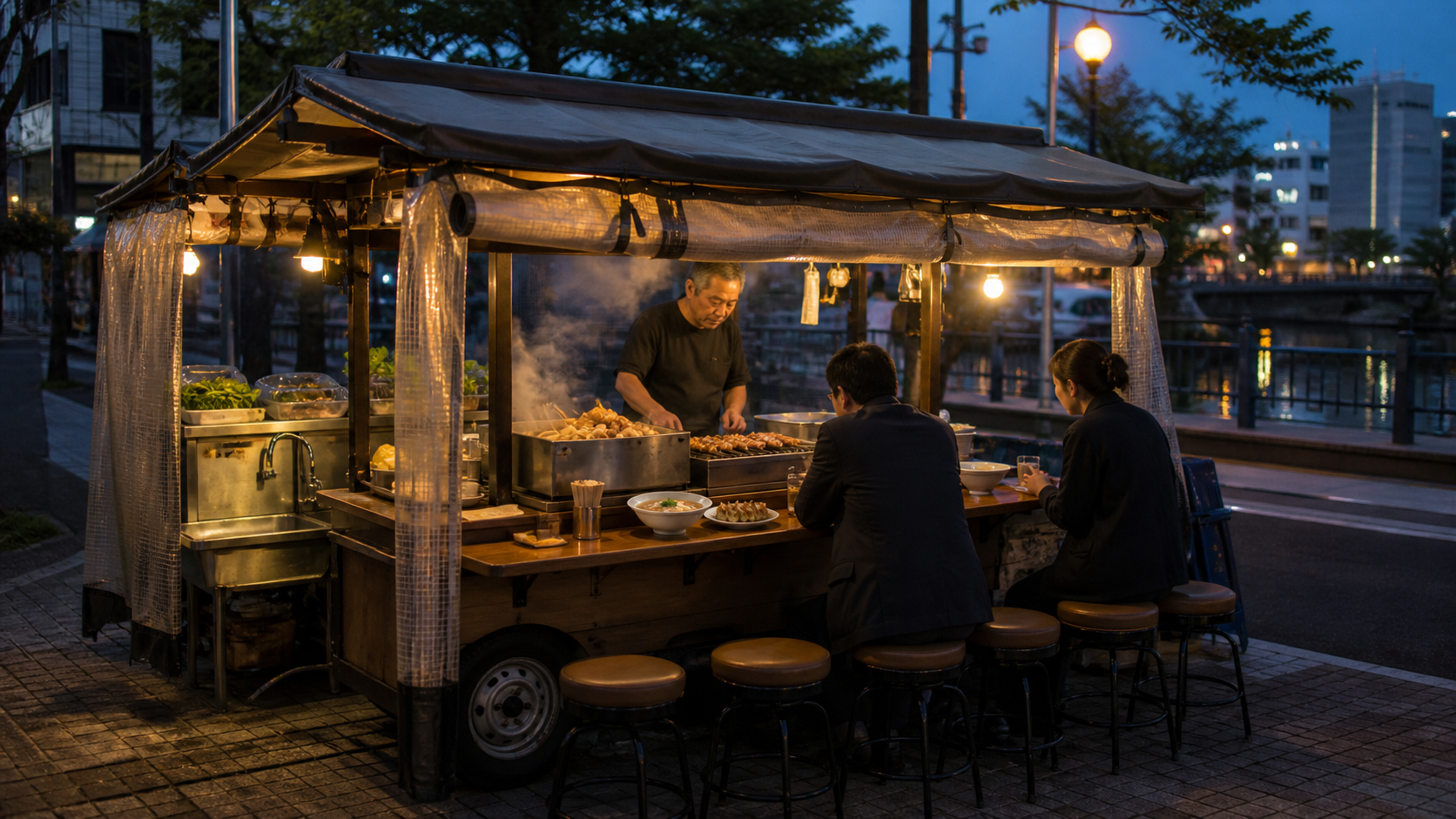
Information checked: August 26, 2026. Fukuoka’s yatai are compact mobile food stalls assembled on public roads for the evening and removed after service. They are not ordinary outdoor tables or permanent izakaya. More than 100 operate around the city under municipal rules, preserving a postwar street-food tradition while meeting modern requirements for water, hygiene and neighbourhood use.
A working urban system, not a festival booth
The modern yatai expanded after World War II, but many Japanese cities later restricted street stalls. Fukuoka retained the culture and now uses municipal licensing and public-space rules to keep it viable. Each owner transports, assembles and removes a tiny kitchen; the close counter lets diners watch food being cooked and creates conversation without making conversation compulsory.
Do not confuse a yatai with a kitchen car. Official Fukuoka guidance says yatai food is eaten at the stall and takeout is prohibited for hygiene and quality control. Raw dishes are not served.
Choose Tenjin, Nakasu or Nagahama by your route
| Area | Access and character | Best for |
|---|---|---|
| Tenjin | Stalls line parts of Watanabe-dori and Showa-dori, near Tenjin and Nishitetsu Fukuoka (Tenjin) stations | After shopping; broad choice and easy onward transport |
| Nakasu | The riverside/Neo-Nakasu cluster is roughly a 5-minute walk from Nakasu-Kawabata subway station | Night scenery and a compact first visit; queues can be conspicuous |
| Nagahama | Near the fish-market district; many stalls are reached from Akasaka Station, with exact walks varying | Ramen history and a calmer, more dispersed atmosphere |
Use the current official yatai map, then open the individual stall page for address, access, menu, closed days and payment. “Nakasu yatai” is not a synonym for every yatai in Fukuoka.
Opening hours are rebuilt every evening
Some stalls start around 18:00, but most open about 18:30–19:00 and many close around midnight. These are general patterns, not guaranteed hours. Each owner has different holidays; rain, storms, illness, maintenance or private circumstances can prevent opening.
- Check the official yatai search or official LINE information on the same day.
- Choose a first and backup stall within the same area.
- Arrive around 18:30–19:00 for an early seat, or expect a queue at famous stalls.
- Keep the last subway/train in mind; do not assume a listed late closing means transport still runs.
The Yatai Concierge at Fukuoka Airport International Terminal 1F is currently listed as 08:00–21:30, but verify airport service information before relying on it.
From ramen and oden to modern specialties
| Dish | What it is | Check before ordering |
|---|---|---|
| Tonkotsu ramen | Thin noodles in pork-bone broth | One bowl can end the meal; pork, wheat, egg possible |
| Yaki-ramen | Stir-fried ramen noodles with sauce/broth | Not soup ramen; pork, seafood, wheat, soy |
| Oden | Daikon, egg, fish cakes and other items simmered in broth | Usually priced per item; fish stock common |
| Yakitori | Grilled skewers; menus may include chicken, pork or vegetables | Per-skewer or set price; salt/tare; cook poultry fully |
| Hitokuchi gyoza | Small pan-fried dumplings associated with Hakata | Pork, wheat, sesame and shared cooking surfaces |
| Mentaiko dish | Spicy seasoned pollock roe used in omelettes or grilled dishes | Fish, chilli, egg/dairy depending on dish |
Menus are no longer limited to classics: some stalls specialize in tempura, French-inspired plates, coffee or cocktails. Pick by the official menu rather than assuming every stall sells ramen.
Check prices first and order lightly
Ask the staff before taking an empty stool. If there is a queue, join the end and wait to be seated. Official guidance considers at least one drink and one dish per person polite; a soft drink such as oolong tea is acceptable. At most yatai there is no mandatory appetizer or cover charge, but some bar-style stalls do charge one—check the menu.
| Plan | Approximate budget per person |
|---|---|
| One stall: drink + two small dishes | ¥1,500–¥3,000 |
| One fuller meal with ramen | ¥2,500–¥4,500 |
| Two-stall tasting | ¥3,000–¥6,000 plus transport |
These are planning ranges, not current stall prices. Verify the posted, tax-inclusive total. Official guidance says only about 10% accept credit cards, so bring enough cash and small notes even when one listing shows cashless payment. Pay before leaving and request a receipt if needed.
Small-space rules that protect the culture
- Go alone or in a group of two or three; a typical stall may seat only about ten people.
- Leave suitcases at the hotel or a locker. Bags cannot occupy stools or block the road.
- There is no toilet inside. Check the official map for nearby public or partner facilities before sitting.
- Reservations are uncommon; never assume a social-media message guarantees a seat.
- Do not linger after finishing when people are waiting. One or two stalls are enough; “three-stall hopping” is a suggestion, not an obligation.
- Ask before photographing the owner, cooking area or other diners. Keep voices considerate of nearby residents.
- Do not request takeout or raw food, and dispose of nothing on the street.
Allergies, dietary needs and physical access
Broth, sauces and shared equipment make severe allergies difficult. Tonkotsu is pork; oden and ochazuke often use fish stock; gyoza and noodles contain wheat; mentaiko is fish roe. A vegetable skewer cooked on a shared grill is not automatically vegan, halal or allergen-free. Show a Japanese allergy card before ordering; if the owner cannot confirm safety in the tiny kitchen, choose another restaurant.
Yatai usually have backless stools, narrow gaps, a curb or uneven pavement and no accessible toilet. Wheelchair transfer and space vary by stall. Use the official individual listing and contact the tourism desk for a suitable location rather than arriving with a large mobility device unannounced. Families should confirm child seating, smoke exposure and late-night suitability.
A realistic yatai evening and FAQ
| Time | Plan |
|---|---|
| 17:30 | Check weather, live opening information, last transport and cash |
| 18:15 | Store luggage and use a restroom |
| 18:30 | Walk to the selected area and confirm posted prices |
| 18:45–19:45 | One drink plus two dishes; add ramen only if wanted |
| 20:00 | Optional second stall or end the meal without over-ordering |
| 21:00 | Return by public transport |
Are yatai open every night?
No. Holidays are stall-specific and bad weather can cancel service. Check on the day.
Is ramen always the cheapest choice?
No. Prices and portions differ. Ramen is filling, so order it last if you want to taste several dishes.
Can non-drinkers go?
Yes. Order a soft drink and food. Japan’s legal drinking age is 20.
Is chatting with strangers required?
No. The close seating can make conversation natural, but quiet, respectful dining is equally valid. Do not treat owners or neighbours as performers.
Official references: Fukuoka City Official Yatai Guide / How to Enjoy Yatai / Yatai operations and hygiene / Fukuoka City Yokanavi yatai search