



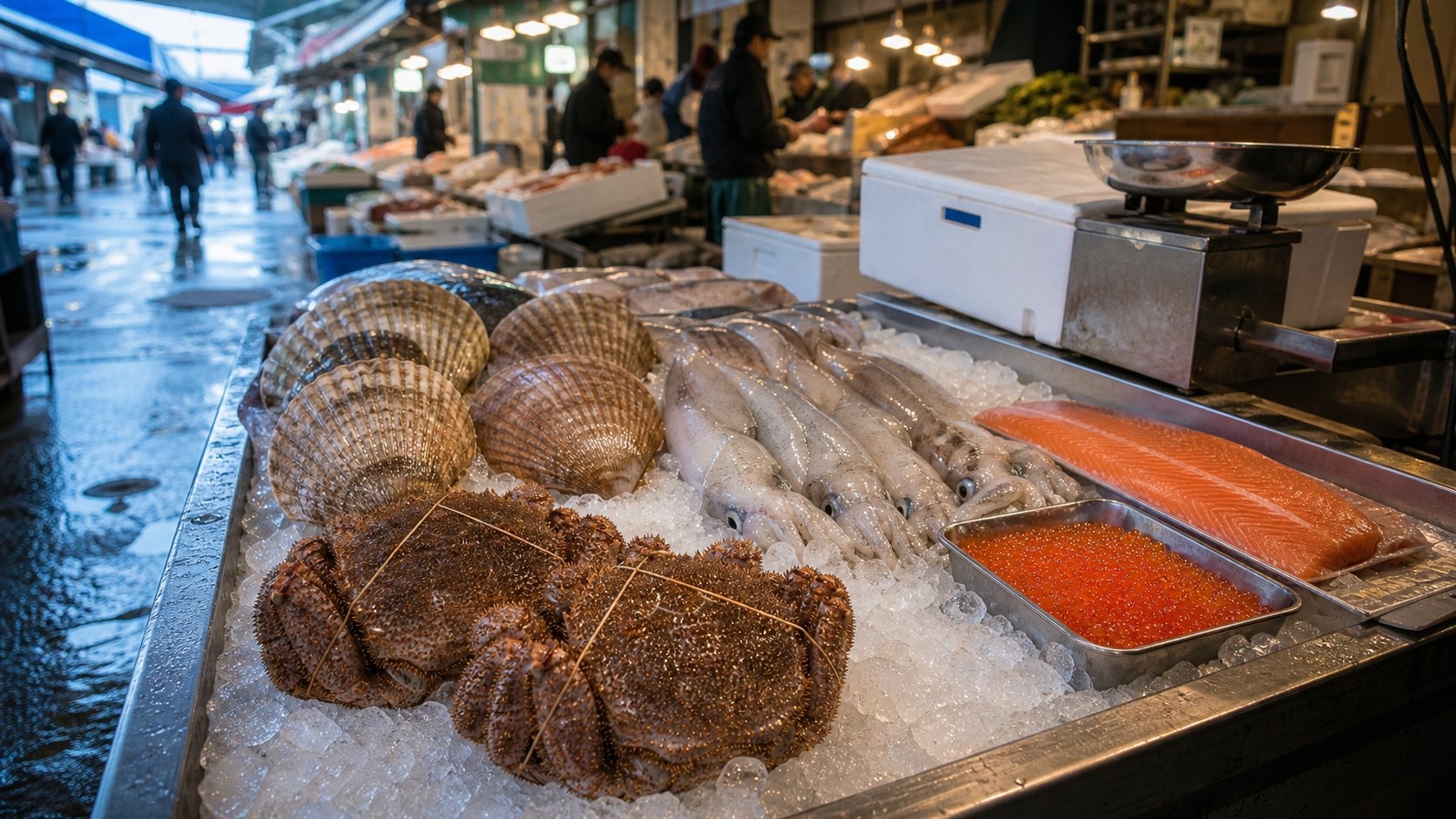
Information checked: August 26, 2026. Hokkaido seafood is not one permanent “best season.” Squid, salmon, scallops, sea urchin and crab follow different fisheries, regions and weather, while a Sapporo market may sell products gathered from across the island or beyond. This guide shows how to plan Hakodate Morning Market and Sapporo’s Nijo Market, ask what is local and seasonal, and buy or eat seafood without losing sight of price, cold chain and sustainability.
“Hokkaido seafood” changes by coast and month
Hokkaido faces the Sea of Japan, Pacific and Sea of Okhotsk, so the same species can have different seasons by fishing area. The official Hokkaido tourism calendar lists Hakodate spear squid around March–May and Japanese flying squid around June–December; autumn salmon around September–October; and scallop examples from the Okhotsk coast in June–October and the Sea of Japan or Funka Bay in December–March. Crab availability is broad, but species, landing area and condition still matter.
These are planning windows, not catch guarantees. Storms, quotas and landing conditions change menus. Ask three separate questions: Where was it landed? Is it fresh, frozen or thawed? Is this the shop’s recommended season? Frozen seafood can be excellent; vague “fresh Hokkaido” language is not proof of origin.
Choose by experience, not a checklist
| Seafood | Useful forms | What to confirm |
|---|---|---|
| Squid | Sashimi, grilled or rice bowl | Species, landing date and whether it is raw; colour alone does not prove freshness |
| Scallop | Raw, grilled or butter-sautéed | Origin and whether the quoted price is per piece |
| Salmon / roe | Grilled salmon, sashimi where appropriate, ikura bowl | Wild or farmed, seasoning and serving size; “salmon” is not always local autumn salmon |
| Sea urchin | Small bowl or sushi | Origin, tray grade and current market price; colour varies naturally |
| Crab | Boiled whole, legs or prepared meat | Species, live/cooked/frozen state, weight, cooking loss, packing and final total |
Hair crab (kegani), red king crab and snow crab differ in body shape, meat and price. Do not buy simply because a tank animal is large. A smaller crab with good weight and clear provenance may be the better meal.
Hakodate Morning Market or Nijo Market?
| Hakodate Morning Market | Nijo Market, Sapporo | |
|---|---|---|
| Best fit | Breakfast immediately beside JR Hakodate Station; southern Hokkaido context | Easy central-Sapporo stop combined with Odori, Soseigawa and Tanukikoji |
| Scale / form | About 250 businesses across a large market district; seafood, produce, sweets and restaurants | Compact historic market with street-facing and indoor shops plus restaurants |
| Timing | Earliest start; many shops finish by afternoon | Shops mainly daytime; some restaurants continue later |
| Do not assume | Every item was landed in Hakodate that morning | Everything sold in Sapporo was caught near Sapporo |
A market is both a working retail area and a visitor destination. Compare labels and staff explanations rather than treating every stall as one operator with identical prices.
Hakodate Morning Market: practical information
| Address | 9-19 Wakamatsu-cho, Hakodate, Hokkaido 040-0063 |
|---|---|
| Access | About 1 minute on foot from JR Hakodate Station |
| Hours | Official tourism information gives 6:00–14:00 from January to April and 5:00–14:00 from May to December; each shop varies |
| Closed | Market listed as open year-round, but individual shop holidays and New Year hours vary |
| Admission | Free to walk through; food, shopping and activities cost extra |
| Payment | Some cards and QR payments are accepted; carry another method because acceptance varies |
| Recommended time | 60–90 minutes before 9:00 for a walk, comparison and breakfast without trying to cover every stall |
Donburi Yokocho contains multiple seafood restaurants, and cooked fish sets provide an alternative to raw bowls. Store-by-store hours take precedence over the district-wide reference.
Nijo Market: practical information
| Address | Minami 3-jo Higashi 1–2-chome, Chuo-ku, Sapporo |
|---|---|
| Access | Walk from Bus Center-mae Station on the Subway Tozai Line; also reachable on foot from Odori |
| Hours | Sapporo’s current listing gives shops around 7:00–17:00 and restaurants around 7:00–21:00; individual hours vary |
| Closed | Varies by shop |
| Admission | No admission fee; pay the individual business |
| Recommended time | 45–75 minutes; go earlier for selection, or use a restaurant’s own published hours for dinner |
Nijo Market’s downtown convenience is its strength. It is not the Sapporo Central Wholesale Market Curb Market, which is a separate destination near Nijuyon-ken Station. Check the exact market before routing.
Price, weight, preparation and shipping
- Ask the species and origin: Kore wa doko-san desu ka? (Where is this from?)
- Confirm whether the displayed price is per 100 grams, per crab, per tray or per meal.
- For crab, have the selected animal weighed and ask for the final tax-inclusive total before cooking.
- Confirm whether boiling, cutting, ice packs, box and domestic shipping cost extra.
- State when and where you will eat it; ask how long the cold pack is effective.
- Keep the receipt and shipping slip, and verify the delivery date and refrigerated/frozen service.
International shipping of raw seafood is rarely a simple shop service. Destination-country quarantine, airline and customs rules apply; do not assume vacuum packing makes an item legal to import. For gifts, shelf-stable canned or processed seafood may be more practical, subject to the same import checks.
Raw seafood, allergens and market hygiene
Raw seafood carries risks including bacteria and parasites. The Ministry of Health, Labour and Welfare warns that Anisakis can cause acute abdominal symptoms; vinegar, salt, soy sauce and wasabi do not reliably kill it. Eat raw dishes promptly at a reputable business, keep takeaway cold and do not leave it in a warm car, locker or suitcase.
Fish, crab, shrimp, molluscs, salmon roe, soy, wheat, egg, milk and sesame are common concerns. A seafood bowl may use sauces or stock containing ingredients not visible. Shared knives, grills and fryers create cross-contact. For a serious allergy, show the Consumer Affairs Agency sheet and do not rely on “seafood” as one broad category.
Ask before touching, photographing close to staff or filming tanks. Samples are offered by invitation; use the provided pick. Do not eat while blocking narrow aisles, and dispose of shells and packaging where instructed.
A responsible two-city plan and FAQ
- Hakodate morning: arrive after checking store hours, compare one circuit, then choose a modest breakfast with either raw or cooked seafood.
- Hakodate day: continue to the port district rather than buying perishables before hours of sightseeing.
- Travel day: do not treat Hakodate–Sapporo as a quick local hop; check current rail or flight schedules and allow a separate day.
- Sapporo morning: visit Nijo Market, ask origin and weight, and share one seasonal item rather than repeating a huge bowl.
- Afterward: walk Soseigawa and Odori; collect chilled purchases only near the end of the day.
Is early morning always cheaper?
No. Early arrival improves selection, not guaranteed discounts. Market prices and shop policies differ.
Is every kaisendon made with Hokkaido seafood?
No. Read the menu and ask origin; a bowl assembled in Hokkaido may use seafood from elsewhere.
Can I eat live squid?
Some Hakodate businesses offer squid experiences, subject to catch and operating conditions. It is still raw seafood and not suitable for everyone.
What is the most sustainable choice?
There is no universal species answer. Ask origin and fishing information, choose an appropriate portion, avoid waste and prefer transparent sellers.
Official references: Travel Hakodate: Morning Market / Welcome to Sapporo: Nijo Market / Hokkaido Tourism: gourmet calendar / MHLW: Anisakis