


Information checked: August 26, 2026. An izakaya is a casual place for drinks and food, closer to a gastropub or tapas bar than a bar that serves alcohol alone. Small independent counters, neighborhood dining rooms and large chains can have very different menus, charges and payment systems. This guide helps first-time visitors ask before assuming.
Choose by menu, seating and access—not by lanterns alone
For a first visit, check the official listing or storefront for current opening days, last order, reservation rules, menu language, payment methods and smoking status. A red lantern or noren does not prove that walk-ins, children, large luggage or credit cards are accepted. Small yokocho counters may have fewer than ten seats; do not split a group across neighboring businesses without asking.
Record the exact address, nearest staffed station and exit, walking route, telephone number and route back. Tokyo stations can have distant exits, and a venue “near Shinjuku” may still be far from the platform you need. If step-free access matters, ask about entrance steps, aisle width, counter height, toilets and shoe-removal seating before booking.
Pause at the entrance and confirm the essentials
Say how many people are in your party and wait to be shown a seat. Staff may ask whether you have a reservation, whether smoking or non-smoking seating is acceptable, or whether you can finish before a set time. At tatami or some private rooms, remove shoes only when directed and store them neatly.
Before ordering, confirm any minimum order, time limit, table charge, otoshi, late-night surcharge and whether prices include tax. Do not bring outside food or drink unless the venue has explicitly agreed. Keep luggage out of aisles, exits and staff routes.
Otoshi is usually a charged small dish, not a free sample
Many izakaya automatically serve each guest an otoshi, a small appetizer associated with a seating or cover charge. The dish and price vary by venue, and not every izakaya uses the same system. GO TOKYO describes it as commonly charged; therefore, do not publish one nationwide fixed price or promise that it can always be refused.
If a food allergy, religious restriction or vegan requirement makes the dish unsafe, explain this before it is served and ask what the venue can do. Removing the dish does not necessarily remove a disclosed seating charge. If the system or price does not suit you, decide politely before taking the seat rather than arguing after eating.
Order in small rounds and check portion size
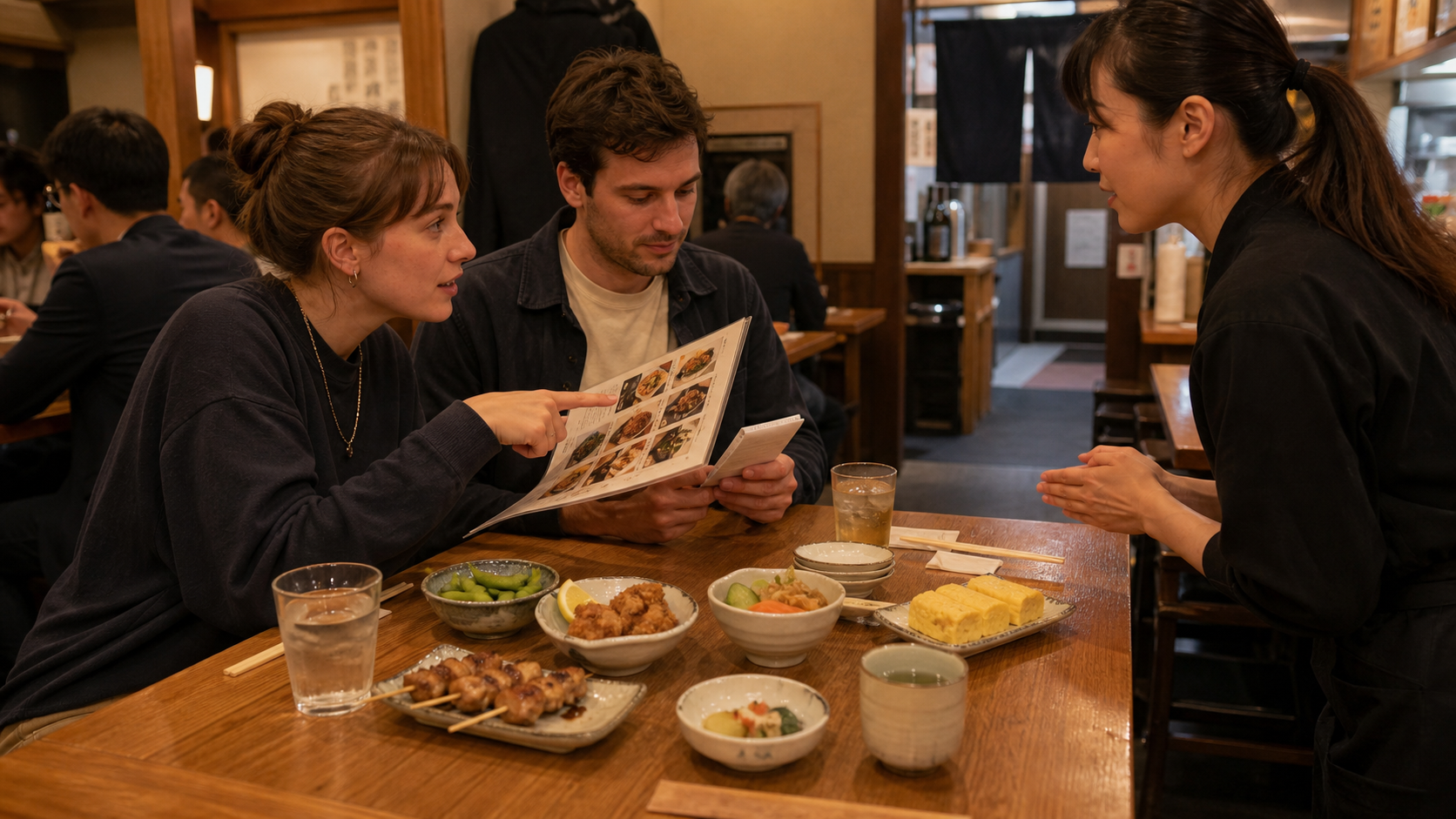
It is common to order a drink—water, tea and soft drinks are valid choices—then a few dishes and add more later. A balanced first round might include a cold item, a vegetable, one grilled or fried dish and a rice or noodle dish later. Edamame, yakitori, karaage, tamagoyaki, grilled fish, tofu and pickles are common examples, not promises that every shop serves them.
Ask how many skewers or pieces come in one order and whether dishes are designed for one person or sharing. Use the tablet, QR menu, paper menu or call button provided; do not assume every small shop has pictures or English. Daily specials may appear only on a board.
An ingredient list is not the same as cross-contact safety
State the exact ingredient and severity before ordering. Dashi may contain fish, sauces may contain wheat or alcohol-derived seasonings, salads may include meat or dairy, and shared grills, fryers and utensils can cause cross-contact. “Vegetable dish” does not automatically mean vegetarian, vegan, halal or allergy-safe.
Ask whether the kitchen can avoid the ingredient and cross-contact; if staff cannot confirm, choose another item or venue. For severe allergies, contact the restaurant before travel and carry the emergency medication prescribed for you. Translation cards help communication but do not guarantee safe preparation.
Alcohol is optional; Japan’s drinking age is 20
You do not need beer to participate. Oolong tea, sparkling water, juice and alcohol-free drinks may be available, but check the menu rather than assuming. Japan’s alcohol age remains 20 even though the civil age of adulthood became 18; bring identification and never pressure another guest to drink.
Set your own limit, drink water, eat food and stop if unwell. Do not plan to cycle or drive after drinking. Indoor smoking is generally restricted, but qualifying venues or designated smoking rooms can exist, so confirm the actual shop if smoke is a concern.
Ask where to pay and protect the last journey home
Say “Okaikei onegaishimasu” when ready. The bill may come to the table while payment happens at the register, or payment may be completed at the table. Check the item total, otoshi or table charge, tax, discounts and payment method calmly. Tipping is not customary; do not leave coins behind as an assumed tip.
Some shops accept only cash or specific cards and QR services. Groups should decide how to split the bill before reaching a narrow register. Check the actual last train for your destination and allow time to reach the correct platform; late opening hours do not guarantee transport home.
Useful Japanese and first-visit FAQ
| Japanese | Meaning |
|---|---|
| 2人です (Futari desu) | Two people. |
| お通しと席料はいくらですか? | How much are the otoshi and seating charge? |
| おすすめは何ですか? | What do you recommend? |
| これは何人前ですか? | How many people is this portion for? |
| お酒は飲みません | I do not drink alcohol. |
| お会計をお願いします | The bill, please. |
Must everyone order alcohol?
No. Ask for an available soft or alcohol-free drink and respect any minimum-order policy disclosed by the venue.
Can I photograph the food and interior?
Ask first, especially at small counters. Do not include staff or guests without consent, use flash, film handwritten recipes or block service.
Can I arrive with a suitcase?
Ask in advance. Tiny counters may have no safe storage; station lockers or hotel storage are often better.
Official references: GO TOKYO izakaya guide / GO TOKYO dining etiquette / National Tax Agency: under-20 drinking prevention