



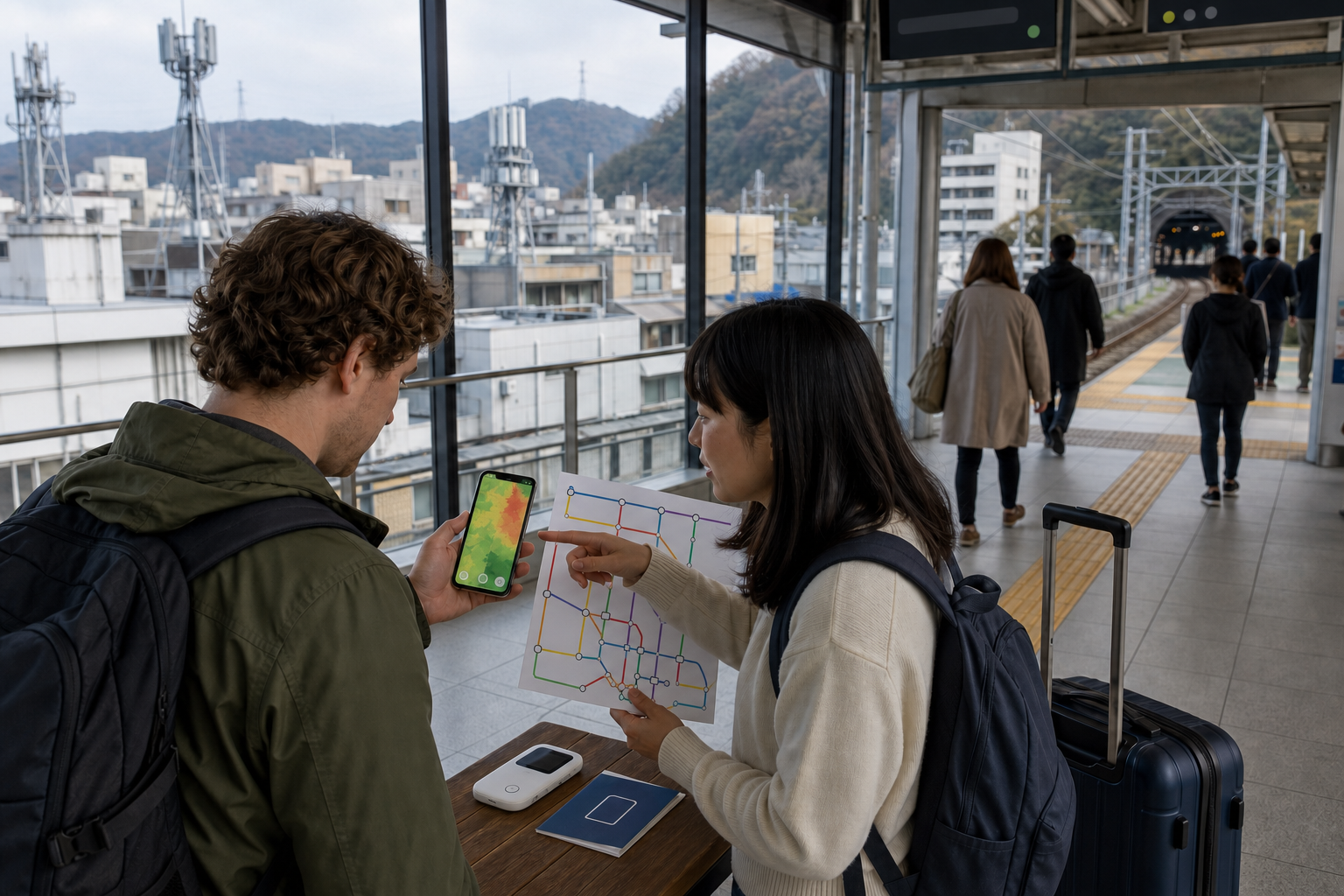
Information checked: August 26, 2026. Japan has commercial 5G, but no honest guide can promise nationwide 5G at every station, mountain, tunnel or building. “6G” remains research, proof-of-concept and standardisation work aimed largely at the 2030s—not a tourist mobile service. This guide separates cellular generations from Wi-Fi, explains why a 5G icon does not guarantee speed, and gives one real Tokyo media-technology visit.
Japan’s 5G rollout is real, but “complete nationwide coverage” is not
Japanese operators launched commercial 5G in 2020 and continue expanding and changing areas. Coverage maps are updated as networks change; indoor walls, underground space, terrain, congestion, maintenance and device bands affect service. Operators may use new 5G spectrum such as sub-6 GHz and millimetre wave, or repurpose spectrum formerly used for 4G. These do not provide the same bandwidth or reach. Never convert one operator’s population metric into a promise for one address.
A 5G icon describes a connection state, not the whole experience
| Layer | What to verify |
|---|---|
| Device | Supported Japanese frequency bands, eSIM/SIM, software and carrier profile |
| Plan | 5G entitlement, data allowance, tethering, throttling and fair-use rules |
| Radio | Sub-6, millimetre wave or converted spectrum; indoor/terrain signal |
| Core network | Non-standalone or 5G SA support; device and SIM requirements differ |
| Application/server | Remote server, VPN, app design and congestion can be the bottleneck |
NTT Docomo explicitly distinguishes ordinary 5G areas from 5G SA areas and notes software, device and SIM requirements. The same principle applies across carriers: check the chosen provider’s current terms, not a generic “Japan 5G” claim. Docomo official area information
“5G Wi-Fi” mixes two different systems
5G usually means a mobile carrier’s fifth-generation cellular network. Wi-Fi connects a device to a local access point, which then uses some backhaul connection. “5 GHz Wi-Fi” describes a Wi-Fi frequency band and is not 5G cellular. Airport free Wi-Fi can be useful without being 5G, and a phone can show 5G while its hotspot creates Wi-Fi for a laptop. Judge each service by operator, terms, security and measured performance.
Choose roaming, eSIM, SIM or pocket Wi-Fi by the trip
| Option | Good fit | Check before paying |
|---|---|---|
| Home-carrier roaming | Short trip and same phone number | Daily cap, 5G partner access, calls/SMS, bill ceiling |
| Travel eSIM | Unlocked compatible phone | Data-only status, APN, activation time, tethering, support |
| Physical visitor SIM | Compatible unlocked device with SIM tray | Band support, identity/activation, size, voice availability |
| Pocket Wi-Fi | Several devices or incompatible phones | Battery, return deadline/location, loss fee, fair use |
“Unlimited” may include fair-use or high-usage controls. Download the eSIM QR and instructions before travel, but do not activate early if validity starts at installation. Keep the original SIM secure and preserve a route for bank or account verification messages.
Check an exact route, then keep an offline fallback
Use the provider’s official current map for accommodation, rail corridor and rural destination—not only Tokyo Station. Maps are predictions, not indoor guarantees. Save hotel address, tickets, translation phrases and critical maps offline. Rural valleys, islands, mountain trails, tunnels and disaster conditions can lose service; connectivity is not a substitute for trail preparation or local safety instructions.
A speed test should not harm the network or your data plan
Tests consume real data and vary with server, time, location and device. Do not run repeated large tests on a crowded platform, hospital, aircraft, quiet gallery or emergency scene. Record provider, plan, device, approximate place, date/time, radio state and test server if publishing a result. One fast screenshot does not establish nationwide quality, and one poor indoor result does not prove a national failure.
6G is a research direction, not a service travelers can book
NICT’s Beyond 5G/6G White Paper works backward from scenarios after 2030 to identify architectures and technologies. Research includes terrestrial and non-terrestrial networks, optical and terahertz links, sensing, timing, digital twins, resilience and orchestration. Demonstrations test parts under controlled conditions; they do not prove a commercial hologram, remote-surgery or universal satellite service exists. Standards, spectrum, safety, energy, cost, privacy and deployment remain separate questions. NICT official white paper
NTT InterCommunication Center: experience media technology, not “6G service”
Address: Tokyo Opera City Tower 4F, 3-20-2 Nishi-Shinjuku, Shinjuku, Tokyo 163-1404. Access: directly connected to Hatsudai Station East Exit on the Keio New Line; roughly two minutes. Hours: 11:00–18:00. Closed: Mondays (Tuesday when Monday is a holiday), year-end/New Year, the first Sunday of August, second Sunday of February and exhibition changeovers. Admission: depends on the exhibition; the 5F lobby Art & Science Chronology and HIVE corners are free. Check the current exhibition rather than relying on an old general fee. Official visit information
ICC is a media-art and science venue, not an Otemachi “NTT technology museum” offering a permanent 6G demonstration. Use artworks to ask how interfaces, networks, embodiment, surveillance and participation change culture. Follow work-specific photography and interaction rules.
Public Wi-Fi, privacy and emergency boundaries
Confirm the official SSID, avoid sensitive transactions on unknown networks, prefer encrypted sites, update devices and use a trusted VPN if appropriate. Disable automatic joining and sharing after use. Never upload identifiable strangers, private screens or location-sensitive research data just because the connection is fast. In an emergency, voice/data networks may congest; follow authorities, use available disaster-message systems and conserve battery.
A practical arrival checklist
- Confirm the phone is unlocked and supports the provider’s relevant bands.
- Save eSIM/SIM instructions, customer support and APN offline.
- Check exact-route coverage and download essential maps and tickets.
- Set data-use alerts, disable unwanted cloud backup and test tethering once.
- Separate cellular 5G, 5 GHz Wi-Fi and speculative 6G claims whenever explaining the experience.
Japan’s communications culture is visible not only in headline speed, but in reliability engineering, dense infrastructure, disaster resilience, standards work and the social rules that let shared networks remain useful.