


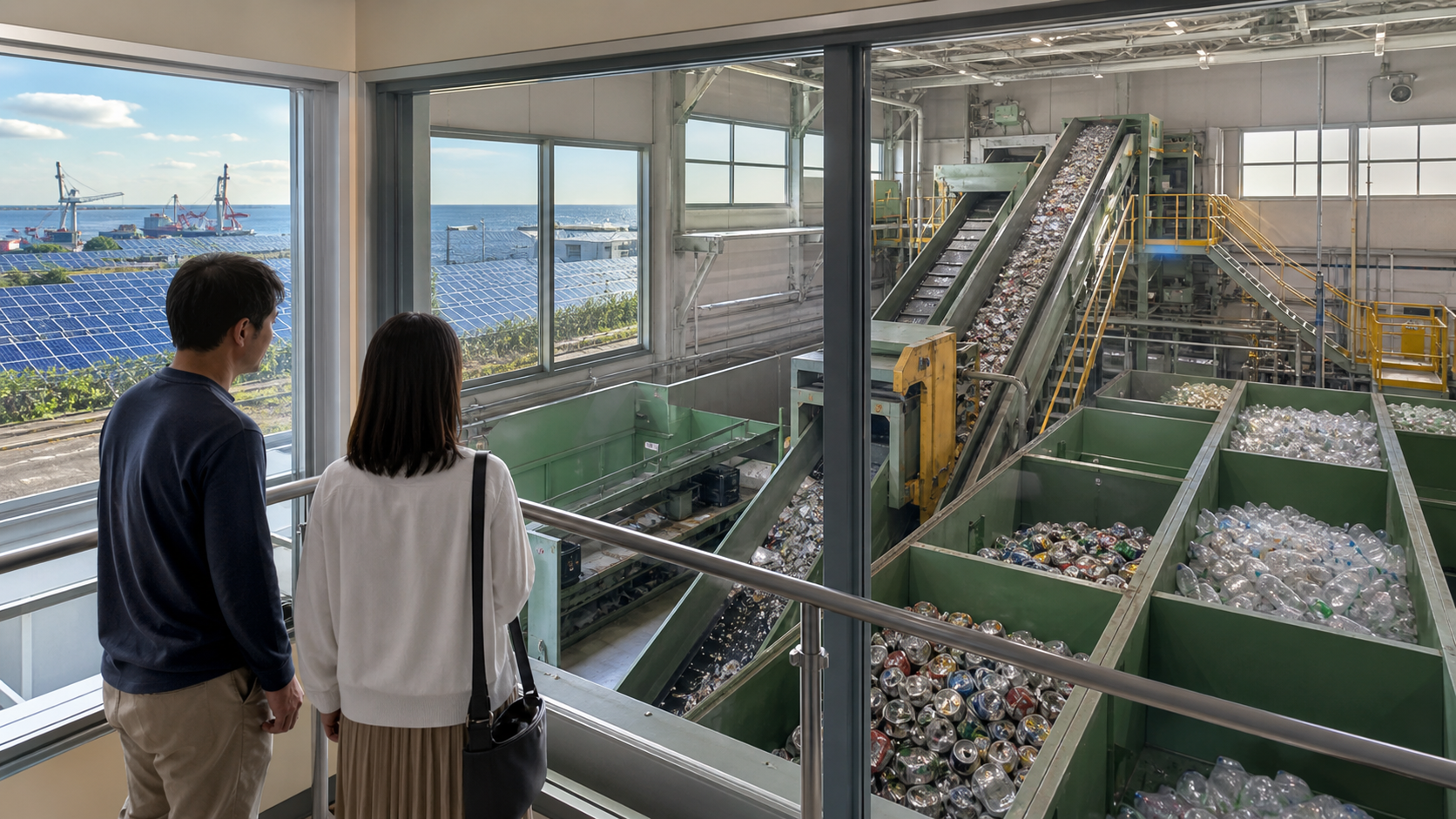
Japan’s environmental technology is easiest to understand away from futuristic slogans. Around Tokyo Bay, visitors can see what happens after a city discards materials, how incineration heat can be reused, and how solar generation is explained beside real infrastructure. These sites reveal engineering choices—and their limits—rather than proving that a city is automatically “zero waste.”
Circular economy is a system, not one impressive machine
Tokyo’s Super Eco Town project placed private waste-treatment and recycling facilities on metropolitan land in the waterfront area to address waste and promote environmental industries. The important questions are not simply “Is it high-tech?” but: What material enters? How much becomes a usable secondary resource? Where does the residue go? How much energy and transport are required?
Material recycling, thermal recovery and disposal are different outcomes. Heat from waste incineration can replace another heat source, as at Yumenoshima, but combustion still creates emissions and ash. Solar panels generate electricity without fuel combustion during operation, but output varies and panels have manufacturing and end-of-life impacts. A responsible visit compares the whole chain instead of treating any single display as proof of sustainability.
Compare the three visitor options
| Place | What you can learn | Booking / language | Cost |
|---|---|---|---|
| Tokyo Super Eco Town tour | Commercial waste treatment and material recovery | Advance application; scheduled dates; tour is in Japanese | Free |
| Yumenoshima Tropical Greenhouse | Use of high-temperature water supplied by a nearby incineration plant | Walk-in; normal museum visit | Adult ¥250 |
| Kawasaki Eco Gurashi Miraikan | Climate, renewable energy and resource-circulation exhibits; view toward mega-solar infrastructure | Walk-in individual visit; multilingual leaflets | Free |
Details checked 26 August 2026. Tours, closures and transport can change, so verify the linked official notices before departure.
Tokyo Super Eco Town: see industrial recycling by scheduled tour
The project is not a single museum called the “Tokyo Waste Management Center.” Participating plants process different streams in waterfront districts, and the Tokyo Environmental Public Service Corporation runs bus tours on announced dates. In the 2026 public schedule, routes varied by day and could include construction material, electronic equipment, food waste or landfill-related facilities.
- Meeting / access: the published tour uses Tokyo Teleport Station on the Rinkai Line as its meeting and return point; follow the confirmation email for the exact exit and time.
- Eligibility: age 16 or older; up to five applicants per group; capacity 36.
- Reservation: apply through the official page by seven days before the visit; first come, first served.
- Fee: free.
- Language: regular public tours are entirely in Japanese. The organizer says groups bringing an interpreter should use the separate inquiry route; this is not the same as an English guide being provided.
- Operating days: no daily opening schedule for casual visitors. Attend only a confirmed tour date.
- Recommended use: choose this only if you can follow technical Japanese or bring an approved interpreter and can commit most of a day.
Yumenoshima: incineration heat made visible through a greenhouse
The tropical greenhouse is a visitor-friendly example of energy cascading: high-temperature water from the adjacent Shin-Koto incineration plant normally supplies energy for greenhouse heating. During the plant’s 2026 periodic shutdown, the museum publicly explained that air conditioners and coolers would substitute—a useful reminder that infrastructure depends on operating conditions.
- Address: 2-1-2 Yumenoshima, Koto City, Tokyo.
- Access: 13 minutes on foot from Shin-Kiba Station (JR Keiyo, Tokyo Metro Yurakucho and Rinkai lines), or 5 minutes from Yumenoshima bus stop.
- Hours: 9:30–17:00; last admission 16:00.
- Admission: adults ¥250; age 65+ ¥120; non-Tokyo junior-high students ¥100; Tokyo resident/student junior-high students and elementary-age children or younger free. Eligibility proof may be required.
- Closed: Monday (open on a public-holiday Monday and closed the following Tuesday), plus December 29–January 3.
- Recommended visit: allow 60–90 minutes. Read the heat-use explanation, then ask what happens during incinerator maintenance rather than assuming the greenhouse is always heated the same way.
Kawasaki Eco Gurashi Miraikan: solar and resource circulation in one visit
This municipal learning facility covers climate change, photovoltaic power and resource circulation through hands-on exhibits. Its observation area looks toward large-scale solar infrastructure and the industrial landscape near Haneda Airport. Individual visitors may tour freely; official leaflets are available in Japanese, English, Chinese and Korean.
- Address: inside Ukishima Processing Center, 509-1 Ukishimacho, Kawasaki Ward, Kawasaki.
- Access: from JR Kawasaki Station East Exit bus stand 16, take route 川03 toward Ukishima Bus Terminal (roughly 40 minutes), then walk about 10 minutes. Confirm the current timetable and last return bus.
- Hours: 9:00–16:30.
- Admission: free; individuals may visit without a group reservation.
- Closed: the current Kawasaki City page lists Sunday, Monday and the year-end/New Year period; holiday arrangements and temporary closures are announced separately.
- Guided solar visit: availability and times vary; ask reception on the day or contact the facility. Do not build the trip around an old timetable.
- Recommended visit: allow 90 minutes, or about 2 hours if a confirmed guided element is included. Because the site is remote, plan the return bus first.
Five questions that turn a display into useful learning
- Boundary: Does the stated reduction cover the facility, the city, transport or the full product life cycle?
- Input: Is the feedstock clean and separated, or contaminated mixed material?
- Output: Does it become a product of equal quality, a lower-grade material, fuel, ash or landfill residue?
- Energy: Is recovered heat replacing fossil fuel, and what happens during maintenance or low demand?
- Evidence: Is the claim supported by measured annual data and a defined baseline, or only by a model display?
Also distinguish reuse, material recycling, thermal recovery and disposal. Japanese labels may group these in a broader resource-circulation story, but they are not environmentally identical.
Two realistic half-day plans
Easy Tokyo plan
Travel to Shin-Kiba, visit Yumenoshima Tropical Greenhouse for 60–90 minutes, then walk in the public park if weather permits. This is the best choice for families, short visits and travelers who do not speak technical Japanese. It does not include entry to the incineration plant.
Deeper Kawasaki plan
Check both outbound and return bus times before leaving Kawasaki Station. Spend 90–120 minutes at Eco Gurashi Miraikan and, if available, join only the guided component confirmed by reception. Bring water and food as appropriate for a remote industrial area, but consume them only in designated spaces.
Do not attempt to combine all three sites in one day: Super Eco Town requires its own scheduled bus tour, while Ukishima is far from central rail stations.
Industrial-site safety, privacy and photography
- Wear closed shoes and follow helmets, eyewear, clothing and route instructions when a tour requires them.
- Never cross barriers, touch samples or collect discarded material.
- Ask before photographing machinery, control screens, workers or company information. Photography rules can differ by plant.
- Do not photograph workers as anonymous “technology scenery”; obtain permission for identifiable people.
- Keep groups together, arrive on time and disclose accessibility or interpreter needs before an industrial tour.
- Do not publish a facility’s promotional claim as an independently verified environmental fact.
Frequently asked questions
Can I tour Tokyo Super Eco Town in English for free?
Do not assume so. The regular tour is free but officially described as Japanese-only. Interpreter-accompanied groups use a separate application route and require coordination.
Is waste-to-energy the same as recycling?
No. Energy recovery uses heat from combustion; material recycling attempts to retain material value. Both also produce impacts and residues that should be disclosed.
Does a solar panel mean the facility is carbon neutral?
No. A credible claim needs a defined boundary, generation and consumption data, other energy sources, and life-cycle assumptions.
Official sources: Tokyo Super Eco Town tours, Tokyo Metropolitan Government project outline, Yumenoshima visitor information, and Kawasaki Eco Gurashi Miraikan. Checked 26 August 2026.