


Information checked: August 26, 2026. Dining alone at an izakaya is common enough to have its own phrase, hitori-nomi, but not every izakaya is equally convenient for one guest. This guide shows how to identify a solo-friendly place, ask for a counter seat, order portions without waste, understand cover charges, enjoy a meal without alcohol, and return safely after an evening out.
Solo-friendly signs—and warning signs
| Helpful sign | Why it helps |
|---|---|
| Counter seats visible | Efficient use of one seat and easier staff contact |
| Prices and portion units shown | You can distinguish one skewer, one plate and a set |
| Small dishes or half portions | More variety without waste |
| Call button or tablet | Less pressure to catch a busy server |
| Soft drinks listed | Clear non-alcoholic option |
A group banquet specialist, hot-pot restaurant with a two-person minimum, standing bar with nowhere for luggage, or shop showing “reservation only” may be inconvenient. A chain can be a good first experience because menus and charges are often clearer; a tiny independent shop can be rewarding, but one empty stool does not guarantee capacity.
Entering alone without a script
At the door say hitori desu (one person) or answer hai, hitori desu when asked o-hitori-sama desu ka? If you have no reservation, add yoyaku shite imasen. Staff may decline because of bookings, kitchen capacity or a group-only format; it is not necessarily hostility toward foreigners or solo guests.
| Useful phrase | Meaning |
|---|---|
| Kauntā-seki wa arimasu ka? | Is a counter seat available? |
| Kin’en-seki o onegai shimasu. | A non-smoking seat, please. |
| Nijikan gurai desu ka? | Is the limit about two hours? |
| Nanji ga rasuto ōdā desu ka? | What time is last order? |
How to use a counter seat comfortably
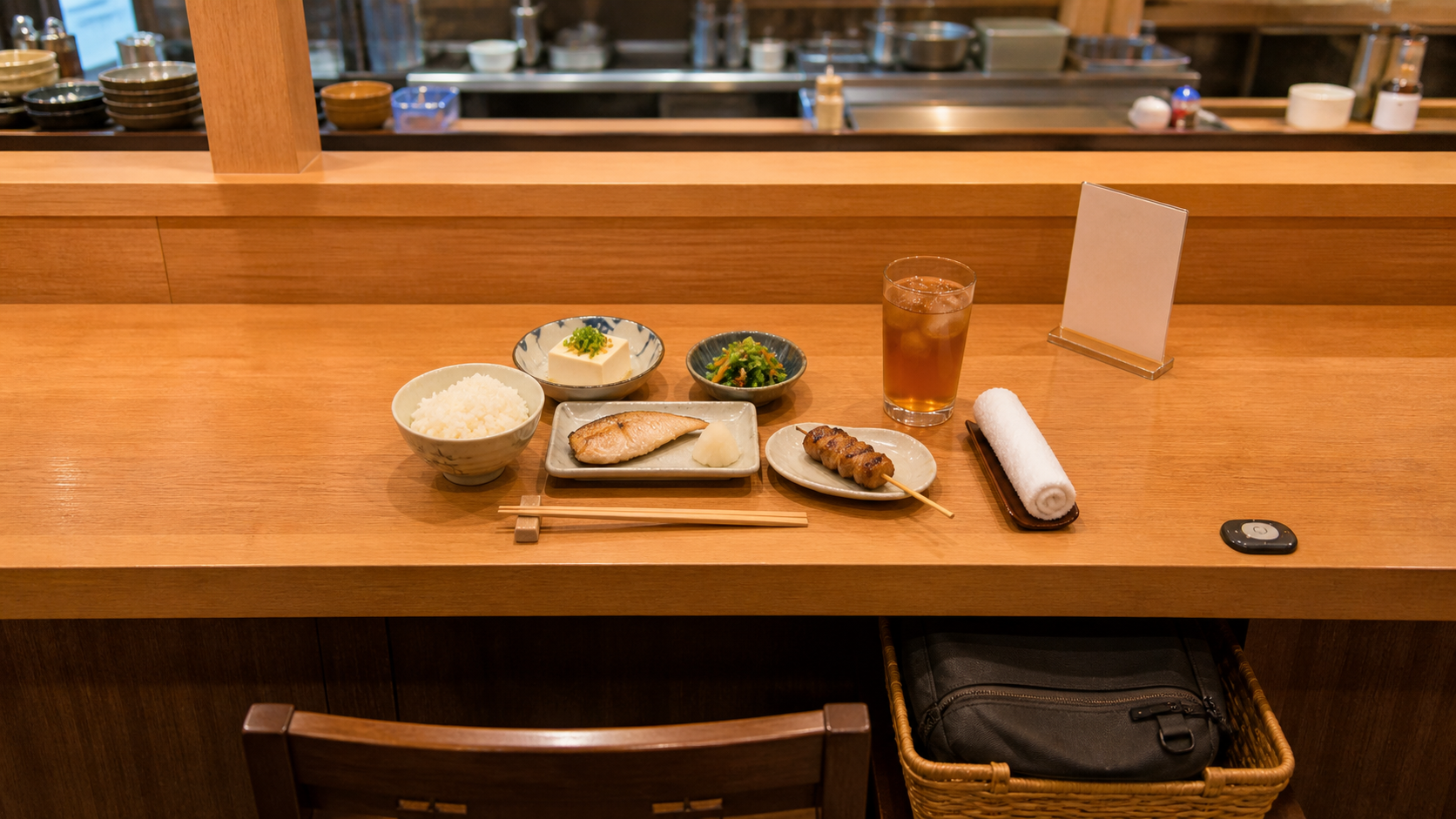
Place a compact bag in a provided basket or under your chair, never in the service aisle or on a neighbouring stool. The wet towel (oshibori) is for hands, not the counter or your face. A call button means you may press once and wait; otherwise say sumimasen when staff are not carrying hot dishes.
A counter is not an invitation to interview the chef. Brief conversation is fine when staff initiate it, but they may be busy. Do not photograph people, the open kitchen or other guests without permission. Keep phone audio off and avoid video calls.
A balanced order for one
JNTO explains that izakaya dishes are often shared, so some portions are too large for one. Start with one drink and two dishes, then add one item at a time. A practical pattern is one protein, one vegetable and rice or noodles at the end.
| Stage | Examples | Question |
|---|---|---|
| First | Tofu, edamame, pickles, small sashimi | Hitori de tabekireru ryō desu ka? Is it manageable for one? |
| Hot dish | Two yakitori skewers, grilled fish, dashimaki egg | Is the displayed price per skewer or per plate? |
| Vegetable | Seasonal greens, tomato, mushroom | Does the dressing or dashi contain fish? |
| Finish | Rice ball, ochazuke, small noodles | How large is the serving? |
“Set meals” are not universal at night; do not choose a shop on that assumption. Happy hour is also a shop-specific promotion, not a standard 17:00–19:00 rule.
Otoshi, cover charges and a realistic budget
JNTO notes that an automatic small appetizer called otoshi often represents part of an izakaya table charge rather than a free gift. Ask before sitting: seki-ryō ya otōshi wa arimasu ka? (Is there a seat charge or otoshi?) A late-night surcharge, mandatory drink or service format may also apply.
| Plan | Typical budget range |
|---|---|
| Light meal, soft drink | About ¥2,000–¥3,500 |
| Several dishes and one or two drinks | About ¥3,000–¥5,000 |
| Specialist seafood/sake shop | Can exceed ¥5,000 |
These are planning ranges, not guaranteed prices. Confirm tax, cover, item units and payment method. Many places settle at a register near the exit; take the bill slip with you. Tipping is not customary.
You never need to start with beer
“First, beer” is a familiar phrase, not an obligation. Order oolong tea, sparkling water or a zero-alcohol drink. Say arukōru wa nomimasen (I do not drink alcohol). If there is a one-drink rule, a soft drink is normally valid unless the shop clearly states otherwise.
Japan prohibits alcohol consumption under age 20. Know the last train, do not accept an unattended drink, and do not drive or cycle after drinking. If you feel unwell, tell staff and use a licensed taxi or public transport. Drinking alone does not mean drinking quickly; alternate water and food.
Allergens are harder to spot in small dishes
Dashi may contain bonito or other fish; tare may contain soy and wheat; mayonnaise and batter can contain egg; shared fryers cause cross-contact with seafood, meat and dairy. An otoshi arrives before the main order, so state a serious allergy before sitting down.
Use the Consumer Affairs Agency multilingual Food Allergy Communication Sheet. Ask separately about ingredients and shared equipment. A visible ingredient being removed is not the same as safe preparation. “Vegetable” does not automatically mean vegan, halal or allergen-free.
Choose a non-smoking seat if needed; smoking rooms and permitted establishments still exist under defined rules. If smoke exposure is medically important, confirm the whole venue rather than relying only on a table sign.
A low-stress solo evening and FAQ
- 17:30: choose a place near your hotel or a direct train line, before the main group rush.
- 17:35: confirm solo seating, smoking, charge, time limit and payment.
- 17:45: order one drink and two small dishes.
- 18:15: add one hot dish only if still hungry.
- 19:00: ask for the bill and leave before the last-train calculation becomes stressful.
Will staff think eating alone is strange?
No. Solo customers are normal, especially at counters. Capacity and shop format still determine admission.
Should I talk to the person next to me?
A greeting is fine, but respect signals that someone wants privacy. Do not treat local guests as free tour guides.
Can I use a translation app?
Yes. Prepare short text, keep screen brightness moderate and do not record voices without consent.
Can I work on a laptop?
Usually not ideal at a small evening counter. Eat, free the seat in reasonable time and use a café or coworking space for work.
What if the shop refuses one person?
Thank them and leave. Choose a counter-oriented place; do not argue or assume discrimination without evidence.
Official references: JNTO izakaya guide / JNTO customs and etiquette / Consumer Affairs Agency allergy sheet / National Tax Agency: drinking age