



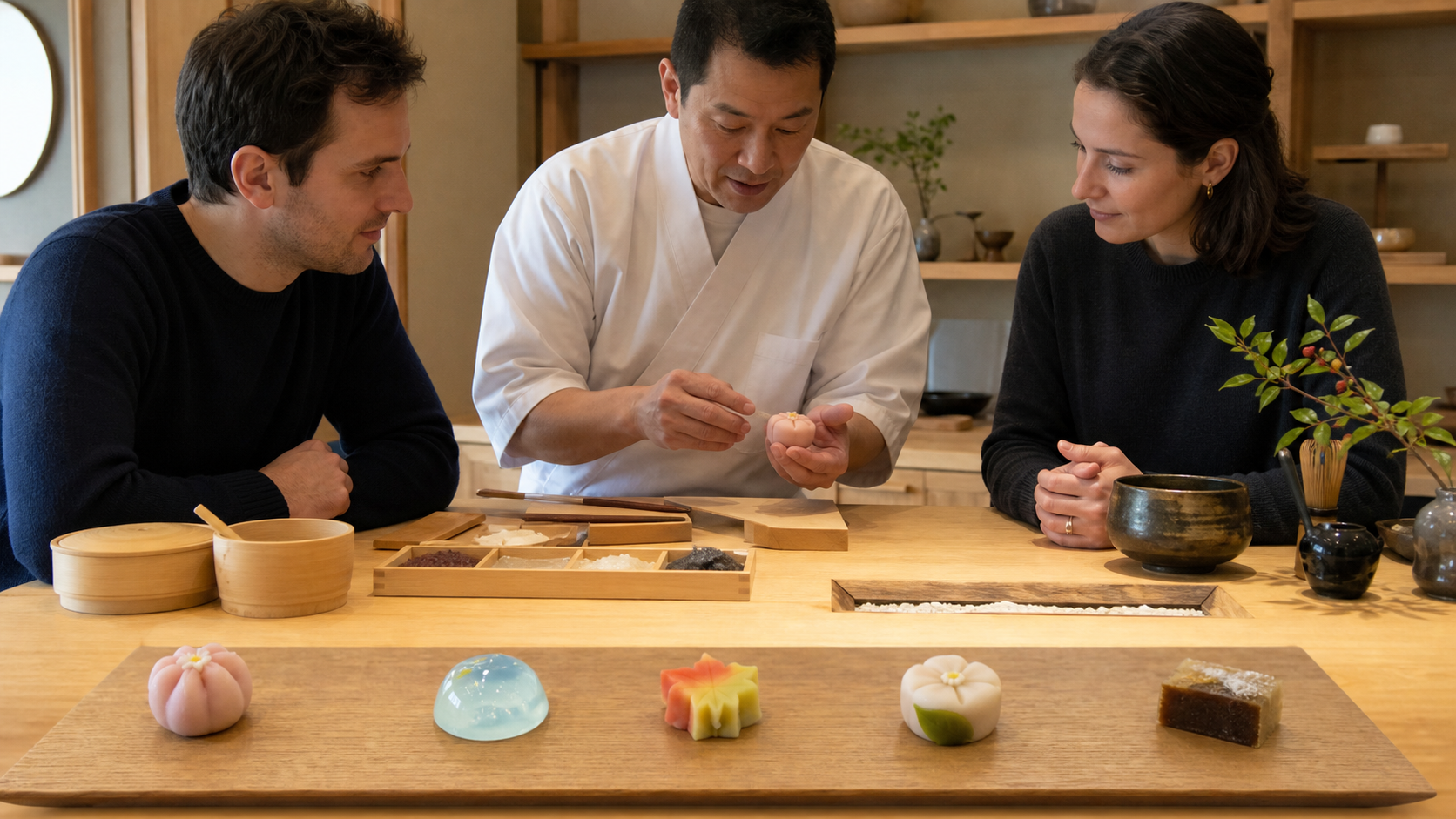
Information checked: August 26, 2026. Wagashi are not simply “Japanese desserts” or four fixed flavours. A confectioner may express rain, a first blossom, moonlight or snow through colour, texture, shape and a poetic name even when the bean-paste base is similar. This guide helps travelers recognize types, read seasonality, order with tea, check allergens and carry sweets safely.
A small sweet can carry a season before it arrives
MAFF describes wagashi as traditional confections shaped by exchange with continental Asia, tea culture, changing sugar supply, regional ingredients and modern production. There is no single legal recipe. The Edo period helped refine named designs and specialist craft, while ordinary mochi, dango and local festival sweets remained part of daily life.
A seasonal motif is often anticipatory: a plum blossom may appear before full bloom. The kamei, or poetic confection name, can refer to literature, weather or a landscape rather than list ingredients. Ask both “What does the name mean?” and “What is it made from?”
Classify by moisture and method, not appearance alone
| Type | Examples | Travel implication |
|---|---|---|
| Namagashi / fresh | Nerikiri, daifuku, some sakuramochi | Short life; may need same-day eating or refrigeration |
| Han-namagashi / semi-dry | Some monaka fillings, sweetened beans, soft confections | Varies greatly; follow the label |
| Higashi / dry | Rakugan and pressed sugar sweets | Often easier to carry, but fragile and humidity-sensitive |
| Mochimono | Daifuku, ohagi, kashiwamochi | Texture hardens or changes; leaves may be wrappers, not always edible |
| Mushimono / yakimono | Steamed manju, dorayaki, castella | Wheat, egg or alcohol may appear |
| Nagashimono / nerimono | Yokan, mizuyokan, nerikiri | Ingredient and moisture vary despite similar names |
“Mochi” is not one product, and a translucent summer sweet is not necessarily gelatin: agar or kudzu may be used. Confirm the exact shop recipe.
Seasonality joins ingredients, motifs and annual events
| Moment | Examples | Important nuance |
|---|---|---|
| New Year | Hanabiramochi, celebratory motifs | Availability and meaning vary by school and region |
| Spring | Uguisumochi, kusamochi, sakuramochi, hanami dango | Kanto and Kansai sakuramochi styles differ; preserved leaf practice varies |
| Early summer | Kashiwamochi, chimaki, wakaayu | Connected with annual customs; wrapper leaves are not automatically food |
| High summer | Mizuyokan, kuzuzakura, clear-stream motifs | Visual coolness is cultural expression, not proof of refrigeration |
| Autumn | Ohagi, chestnut sweets, moon and maple motifs | Harvest timing differs by region and year |
| Winter | Yuzu, camellia, snow and warm zenzai | Zenzai and oshiruko terminology varies regionally |
Do not expect every listed sweet in every city. The best question is “What represents the season here today?”
At tea, the sweet is normally eaten before matcha
JNTO explains that a seasonal wagashi is eaten before matcha to prepare the palate, unlike serving cake and tea simultaneously. MAFF notes that substantial fresh omogashi commonly accompany thick koicha, while dry higashi accompany thin usucha. Procedures vary by tea school and host, so follow the demonstration rather than imitating a video.
In a café, use the provided pick to divide the sweet into manageable pieces. Admire the front if the host indicates it, then eat quietly before the tea. You do not need to finish an item that conflicts with a medical restriction.
Ask shelf life before choosing a gift
- State when and where the sweet will be eaten.
- Ask whether it requires refrigeration, freezing or room-temperature storage.
- Check the unopened best-before/use-by date and instructions after opening.
- Keep namagashi level; protect higashi and monaka from crushing and humidity.
- For a flight, check destination customs and choose sealed, clearly labelled products.
A decorative box is not evidence of long shelf life. Hotel minibars may not maintain food-safe temperatures, and vacuum packaging does not prove room-temperature stability. Prices vary by maker, ingredients, exhibition-style craftsmanship and packaging; confirm per piece or per box before payment.
Bean paste does not make every wagashi vegan or allergy-safe
Possible ingredients include rice, wheat, egg, milk, soy, sesame, nuts, yam, gelatin, honey, alcohol, miso and fruit. Sakura leaves may be salted; manju skin can contain wheat; castella commonly contains egg; shop tools and display cases may create cross-contact. Animal ingredients are less common in traditional recipes, not impossible.
Packaged products follow labelling rules, but items sold loose and food-service information require staff confirmation. For severe allergy, identify the exact allergen, recipe, shared equipment and cross-contact before purchase. “Plant-shaped,” “matcha” and “gluten-free rice flour” do not prove vegan, halal or allergen safety.
Choose a workshop for technique, not costume
Confirm the exact address, station exit, duration, price, booking/cancellation, language, minimum age, standing time, hand strength, take-home quantity, refrigeration and photography. Ask whether participants shape prepared paste or also cook and colour it; both can be worthwhile but are different experiences.
Food hygiene comes before the photo: wash hands, tie hair, remove jewellery if instructed and do not touch shared ingredients after using a phone. A good teacher explains the motif, confection name, tool marks and why colour gradients stay restrained.
A useful first tasting
- Choose one fresh seasonal sweet and one durable type such as yokan or higashi.
- Ask for the Japanese name, motif, ingredients and same-day storage.
- Try plain tea or matcha without assuming a sweetened drink is traditional.
- Compare texture and bean paste before buying a large gift box.
- Photograph only with permission and keep other customers out of frame.
Is wagashi always very sweet?
No. Sweetness and portion vary; salt, roasted grain, citrus, miso and tea may change the balance.
Can I eat the leaf?
It depends. Sakura leaves are sometimes eaten according to preference, while kashiwa leaves usually function as wrappers. Ask the shop.
Where should I go?
Rather than a universal best shop, choose a maker near your itinerary with an official current calendar, ingredient answers and storage instructions.
Official references: MAFF Japanese sweets / MAFF washoku and wagashi / JNTO tea experience / Consumer Affairs Agency food labels / CAA dining allergy guidance