



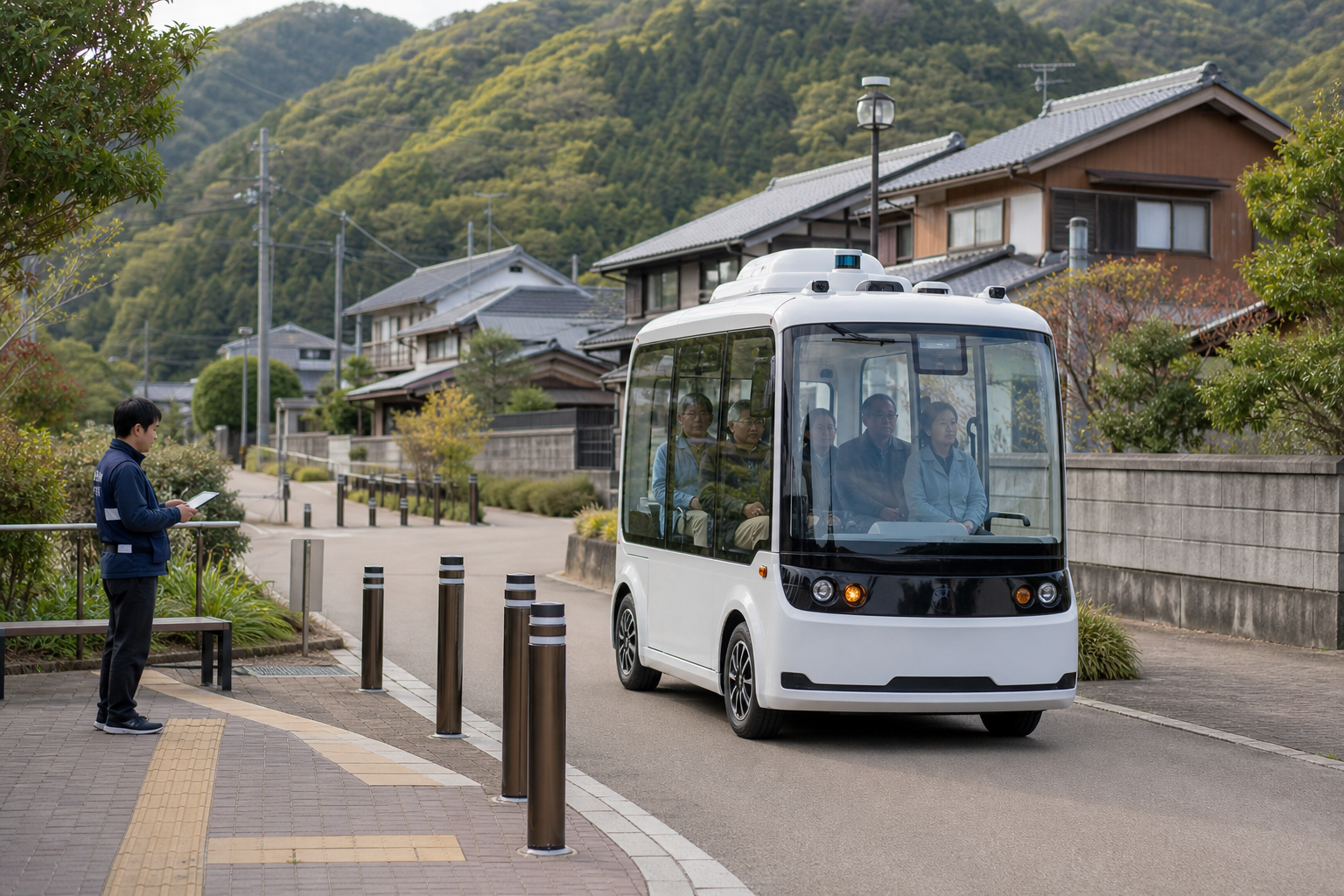
Japan’s automated vehicles are often presented as a glimpse of the future, but the most interesting story is already grounded in everyday problems: an ageing population, fewer professional drivers and communities that still need a dependable way to reach stations, hospitals and shops. For a visitor, however, “Level 4,” “demonstration” and “public service” do not mean the same thing. This guide explains the difference and shows how to check whether a ride is genuinely available.
What Levels 0–5 actually mean
The level describes who performs the driving task and under what conditions; it is not a score for how futuristic a vehicle looks.
| Level | Who drives? | What a traveller should understand |
|---|---|---|
| 0–1 | Human driver | Warnings or one limited assistance function do not make the vehicle self-driving. |
| 2 | Human driver | The system can control speed and steering together, but the driver remains responsible and must supervise continuously. |
| 3 | System within defined conditions | The system drives while its conditions are met, but a human must respond when a takeover is requested. Japan’s 2026 ISO work on motorway traffic-jam systems focuses partly on this safe handover. |
| 4 | System within a defined operating domain | No human driver is required for the driving task inside a specified route, speed, weather and infrastructure envelope. It does not mean the vehicle can drive anywhere. |
| 5 | System everywhere | Full automation without a restricted operating domain remains a concept, not an ordinary visitor service in Japan. |
The key term is the operational design domain (ODD). A Level 4 shuttle may be authorised only on one mapped section, at low speed, in suitable weather and under remote monitoring. Leaving that domain changes the technical and legal situation.
Service, trial and test ride are different
Japanese announcements use several terms that translation can blur. Jisshō jikken (実証実験) is a demonstration or field trial. Shijōkai (試乗会) is a test-ride event, usually on specified dates. Honkaku unkō (本格運行) means a regular operational phase, but eligibility and service days may still be limited.
- A project being selected or subsidised does not prove that passengers can board.
- A vehicle running on a road does not prove that the general public is eligible.
- A fare shown in an older release does not prove that the service is operating today.
- “Driverless” may still involve remote supervisors and on-site safety staff.
Eiheiji: a milestone, currently suspended
ZEN drive in Eiheiji, Fukui Prefecture, began Japan’s first full Level 4 remote-monitored mobility service in May 2023. Its approximately 2-kilometre route used part of the former Keifuku railway alignment, now the Eiheiji Mairōdo path, between Aratani and Shihi near the gate town of Eiheiji Temple. That setting matters: automation was adapted to a carefully controlled local corridor rather than dropped into unrestricted traffic.
- Current status: suspended from 1 April 2026 until further notice because the warranty and maintenance period for the vehicles and system expired.
- Public test rides/inspection visits: not currently accepted.
- Former service pattern: weekends and public holidays, about 10 minutes, adult ¥100, junior-high-school age and under ¥50, preschool children free. These are historical details, not a current timetable or fare offer.
- Official status check: ZEN Connect operating page and Eiheiji Town transport page.
You can still visit Eiheiji Temple and the surrounding gate town by ordinary public transport. Treat ZEN drive as an important chapter in Japan’s mobility history, not as transport guaranteed for your present trip.
Kashiwa: operating, but access is restricted
On 13 January 2026, a Level 4 medium-sized bus entered service on a roughly 700-metre public-road section of the University of Tokyo Kashiwa Campus route. It is significant because it moves beyond a small cart, but the intended users are university students, faculty and staff, and people visiting the campus.
- Area: University of Tokyo Kashiwa Campus, Kashiwa, Chiba.
- Access condition: campus-related eligibility applies; it is not advertised as a walk-up tourist attraction.
- Before visiting: confirm both your reason for campus access and the day’s shuttle arrangements with the host department. Do not enter solely to seek a ride.
- Primary source: Ministry of Economy, Trade and Industry announcement.
Why Japan is developing local shuttles
The cultural value lies less in the gadget than in the social design around it. Rural rail closures, shrinking bus networks, driver shortages and residents giving up driving all affect how a community remains connected. Japan’s national RoAD to the L4 programme therefore combines vehicles with remote monitoring, infrastructure, regulation, local consent and sustainable operation.
This is also why many Japanese projects look modest: a station connector, hospital loop or former railway path may create more public value than a dramatic robotaxi demonstration. The quiet question is whether technology can preserve daily independence without weakening safety or excluding people who do not use smartphones.
Seven checks before you travel
- Official operator: use the municipality, transport operator or host institution—not a reposted video.
- Current status: look for 運行中 (operating), 運休 (suspended) or 実証実験 (trial), plus the update date.
- Eligibility: check whether service is public, resident-only, campus-only, invitation-only or advance-registration only.
- Exact date and hours: weekend, seasonal and one-day test rides are common.
- Route and boarding point: a project name may cover several sections operating at different automation levels.
- Fare and booking: confirm payment method, age rules, reservation deadline and capacity.
- Disruption and fallback: rain, snow, wind, maintenance or system checks can stop service; keep a bus, taxi or walking alternative.
Safety and etiquette on board
- Follow staff instructions and fasten the provided restraint. Low speed does not remove sudden-stop risk.
- Keep bags, children and mobility aids secure; never touch sensors, emergency equipment or doors.
- Ask before photographing staff, other passengers or monitoring screens. Technical displays may contain operational or personal information.
- Tell the operator about wheelchair dimensions or assistance needs in advance. “Barrier-free” access varies by vehicle and temporary platform.
- If you feel unwell, hear an alarm or notice an obstruction, use the stated call button or alert staff. Do not attempt to intervene outside the procedure.
A realistic way to include mobility in a trip
Make the destination—not the experimental vehicle—the reason for your journey. Visit a temple town, science district or local museum that remains worthwhile if the shuttle is cancelled. Recheck the official Japanese page 48–72 hours before departure and again that morning. Screenshot the boarding instructions, but regard the live notice as authoritative.
For technology-focused travellers, compare three layers: the vehicle, the operating domain and the community problem it addresses. That turns a ten-minute ride from novelty into a useful lesson about how Japan negotiates safety, ageing and public space.
FAQ
Can tourists currently ride a Level 4 vehicle in Eiheiji?
No. The operator states that ZEN drive has been suspended since 1 April 2026 until further notice.
Is the Kashiwa Level 4 bus a tourist attraction?
No. It serves eligible University of Tokyo campus users and visitors. Campus access and shuttle use should be confirmed through your host.
Does Level 4 mean the vehicle can drive anywhere?
No. It operates without a human driver only inside its authorised ODD, such as a fixed route, speed and weather range.
Are autonomous rides always free?
No. Trials may be free, regular services may charge a fare, and some projects do not accept public passengers at all.
Official references: MLIT: first Level 4 service in Eiheiji; RoAD to the L4; METI automated-driving policy. Operating details can change without notice; verify the operator immediately before travel.