



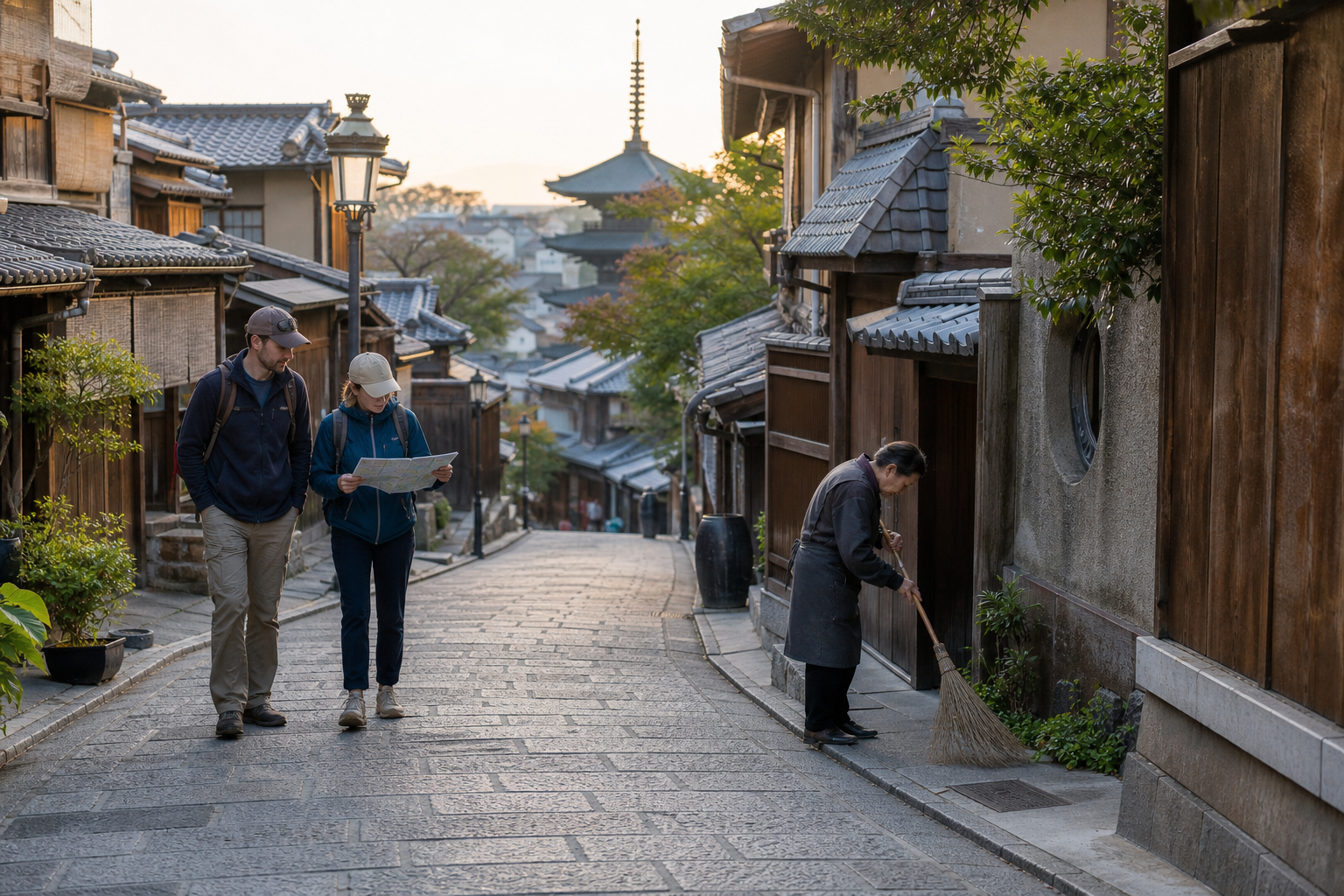
An early Kyoto walk is not simply a quest for photographs without people. It is a chance to pray quietly, share residential streets responsibly and notice the city before shops and tour groups set its daytime rhythm. This 2.5–3 km route runs from Kiyomizu-dera through Sannenzaka, Ninenzaka, Yasaka Shrine and Maruyama Park to Chion-in in about three to four hours.
Route and timing
| Time | Place | Purpose |
|---|---|---|
| 05:45–06:00 | Top of Kiyomizu slope | Check the safe entrance |
| 06:00–07:15 | Kiyomizu-dera | Quiet main-hall visit |
| 07:15–08:00 | Sannenzaka/Ninenzaka | Keep moving through lived-in streets |
| 08:00–08:35 | Yasaka Shrine | Worship in the precinct |
| 08:35–09:30 | Maruyama Park/Chion-in | Park passage and temple visit |
| After 09:30 | Gion/Higashiyama | Breakfast at a verified open business |
The schedule allows time for worship and safe walking, not queues for an empty photo. Start earlier in summer; in winter, delay for daylight and inspect ice. There is no reason to enter dark lanes before dawn merely because they appear quiet.
Getting to Kiyomizu-dera
- Address: 1-294 Kiyomizu, Higashiyama Ward, Kyoto
- Bus: from Kyoto Station direction, routes including City Bus 206 serve Gojozaka; walk uphill about 10 minutes. Confirm the early timetable and disruption status.
- Rail: approximately 25 minutes on foot from Keihan Kiyomizu-Gojo Station, ending uphill.
- Car: no temple car park. Prefer public transport; ask a taxi driver for a legal, safe drop-off that respects current traffic controls.
Mapping apps can suggest a rear shortcut that does not enter the temple. The official guidance identifies approaches from the top of Kiyomizu-zaka at Nio-mon Gate or the top of Chawan-zaka. Never turn private property or a narrow service path into a shortcut. If public transport from your accommodation does not suit 06:00, arrive later rather than sacrificing safety.
Kiyomizu-dera: meet a living Kannon tradition at 6:00
- Opens: 06:00; closing varies by season and special evening programme
- Regular admission: adult ¥500; primary/junior-high student ¥200
- Closure: normally open daily; verify event, disaster and works notices
- Allow: 60–75 minutes
Traditionally founded in 778, Kiyomizu-dera is a Kita-Hosso Buddhist temple centred on devotion to Kannon. Look beyond the view from the famous stage: Nio-mon, the main hall and the approach toward Otowa Waterfall form a continuing sacred landscape. Do not cross directly in front of worshippers; follow hat, voice and photography notices inside buildings.
Practice, cleaning and deliveries still happen early. Do not occupy a passage with a tripod, lean over railings or spread a queue before opening. Check seasonal closing and special access on the official visitor page.
Sannenzaka, Ninenzaka and Yasaka Pagoda: scenery where people live
Descend Kiyomizu-zaka into Sannenzaka and Ninenzaka, then view Hokan-ji’s five-storey pagoda—popularly called Yasaka Pagoda—from the public road. Stone steps and paving become slippery when wet and are unsuitable for rolling suitcases. Many businesses are closed early, so do not rely on a shop for toilets, breakfast or shelter.
Interior opening at Hokan-ji is irregular. Seeing the exterior does not promise entry; if the gate is closed, leave it out. Machiya doors, entrances and small gardens are not a set. Stay out of private lanes and property, do not stage prolonged portraits in front of a home, and safely yield to residents, deliveries, bicycles and cars.
Yasaka Shrine: 24-hour access still requires quiet
- Address: 625 Gionmachi Kitagawa, Higashiyama Ward, Kyoto
- Precinct: open for worship 24 hours; no general admission fee
- Office: normally 09:00–17:00
- Access: about 5 minutes from Keihan Gion-shijo; 8 minutes from Hankyu Kyoto-kawaramachi
- Allow: 25–35 minutes
Yasaka Shrine is deeply connected with the Gion Festival. Rather than treating its West Gate as a backdrop, bow at the threshold, use the purification basin when available, and generally worship with two bows, two claps and one bow. A ceremony or posted instruction always takes priority.
Open all day does not mean conversations, lighting equipment or souvenir counters are available at any hour. See the official shrine information.
Maruyama Park to Chion-in: public park and Pure Land Buddhism
Leave the shrine’s east side, cross Maruyama Park northward and enter Chion-in. The municipal park is free, but blossom-season facilities, circulation and food rules can change. Do not interfere with morning maintenance or local use by playing music, drinking or spreading luggage.
- Chion-in address: 400 Rinka-cho, Higashiyama Ward, Kyoto
- Gates: normally 06:00–16:00; ceremony dates can differ
- Precinct: free
- Garden reception: Yuzen-en 09:00–16:00; Hojo Garden 09:00–15:50
- Garden fees: high-school age+ ¥300 Yuzen-en, ¥400 Hojo, ¥500 combination; primary/junior-high ¥150, ¥200 or ¥250 combination
- Exit: about 8 minutes to Subway Higashiyama or 10 minutes to Keihan Gion-shijo
Chion-in is the head temple of the Jodo school founded by Honen. Its enormous Sanmon is a religious threshold before it is a photograph. Some precinct steps are steep; check the signed detour and current support. Gardens begin at 09:00, so do not wait in a doorway if you arrive early—finishing with the free precinct is a valid plan. Reconfirm on the official visit page.
Do not reduce a temple and shrine to the same “photo spot”
Kiyomizu-dera and Chion-in are Buddhist temples; Yasaka is a Shinto shrine. Their customs differ, but all remain places of faith. A goshuin is evidence of a visit and devotion, not a stamp-rally prize to demand before the office opens. There is no prescribed offering amount, and coins need not be thrown from a distance.
If a ritual is unfamiliar, read the notice, bow quietly and avoid the paths of priests, shrine staff and ceremonies. Building-specific bans on indoor photography, particular angles or tripods always override a general assumption.
Residential, photography and food etiquette
- Voices and suitcase wheels carry especially far in the morning. Do not use speakerphone or conduct a group lecture in a lane.
- Gion and Higashiyama are not theme parks. Never enter private property, a restricted alley, doorway or garden.
- Do not stop, follow, touch or photograph geiko and maiko without permission. Do not step into traffic or block a pavement for a picture.
- Do not promise yourself a business whose morning hours you have not verified. Carry water and a small snack if needed, eat only where permitted and take rubbish away.
- Give commuting, delivery, cleaning and worship priority over a composition; move on when people gather.
Read the official Gion resident guidance before walking.
Season, safety and accessibility
| Condition | Decision |
|---|---|
| Summer | Heat builds soon after sunrise; hydrate, rest in shade and stop with symptoms |
| Winter | Check darkness and ice; safe light matters more than being first |
| Rain | Slow on stone steps, wear grippy shoes and do not fill the lane with umbrellas |
| Typhoon/heavy-rain warning | Cancel the walk and follow accommodation and transport guidance |
The route has long gradients, steps and uneven paving. Wheelchair, mobility-aid and stroller users should not choose it merely because early hours are quieter. Check Kiyomizu-dera’s official wheelchair map, support available after gates open, and Chion-in’s detours or shuttle hours. Never force an unassisted descent on stone stairs.
Short options, budget and FAQ
90-minute version: Kiyomizu-dera at 06:00, Sannenzaka/Ninenzaka, finish before 08:00. Fewer-gradient version: start at Yasaka Shrine and use the accessible portions of Maruyama Park and Chion-in, omitting the Kiyomizu slopes. Reference budget: ¥500 Kiyomizu-dera; Chion-in precinct free, or up to ¥500 for both gardens; plus transport and breakfast. Recheck prices.
What time guarantees empty streets?
None. The 06:00 Kiyomizu opening is a useful anchor, but holidays, seasons, ceremonies and photographers change demand. Courtesy and safety matter more than emptiness.
Can I wear a rental kimono?
Yes, but there are long slopes and stone steps. Verify rental opening/return times, footwear and rain, and never rush in unfamiliar sandals.
Will breakfast be open?
Some businesses open early, but days and hours change. Check the business’s own listing and keep a fallback near a station rather than building the route around an unverified café.
Official references: Kiyomizu-dera; Yasaka Shrine; Chion-in. Reconfirm transport, weather and special access on the visit date.