



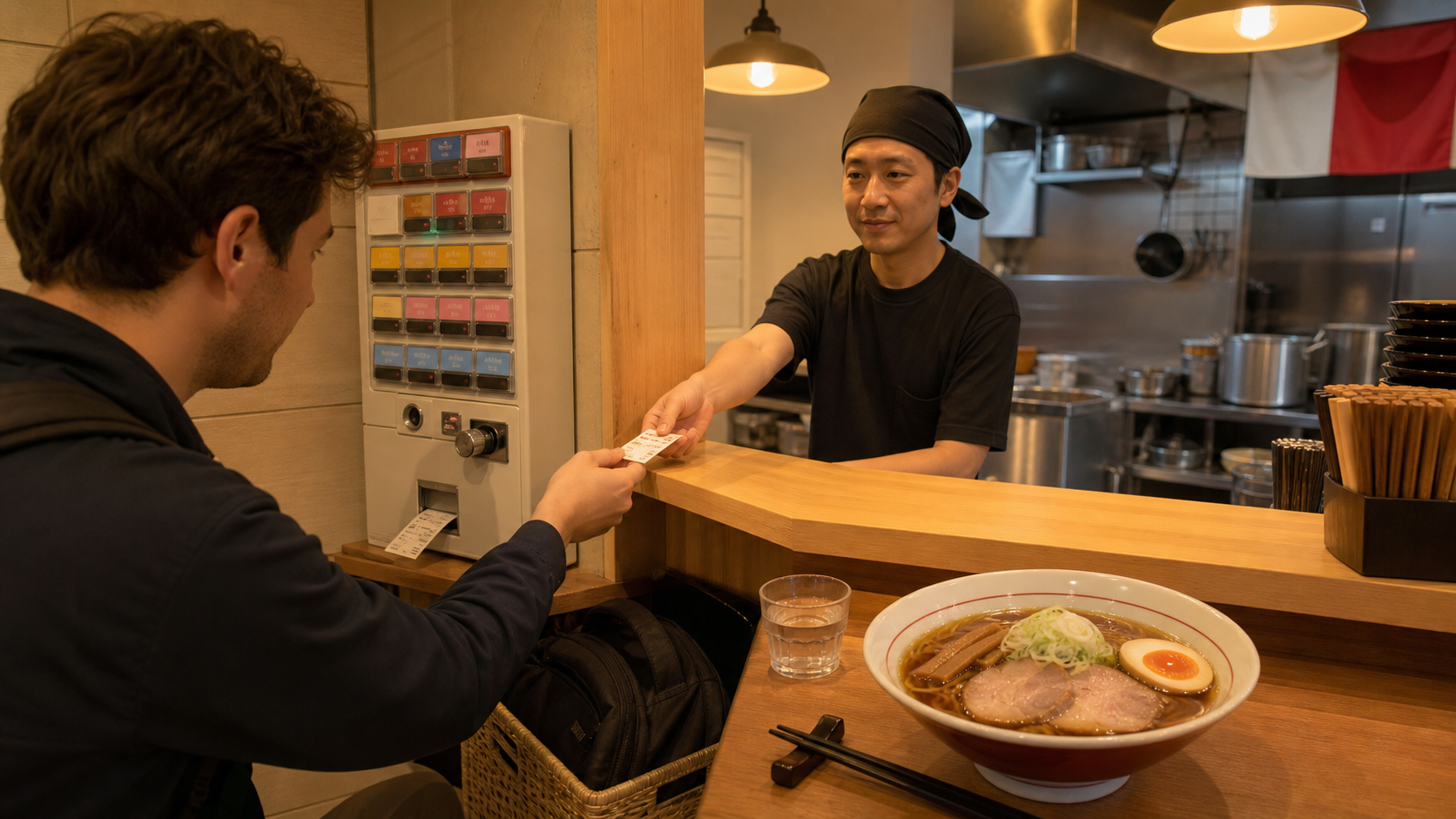
Information checked: August 26, 2026. A ramen shop can look intimidating when the menu is outside, the queue moves quickly and a ticket machine has no obvious language switch. The process becomes simple once you separate broth, seasoning, noodles and toppings. This guide explains how to choose a bowl, buy a ticket, request only the options a shop offers and eat without copying myths.
Ramen is broth, tare, aroma oil, noodles and toppings
Modern Japanese ramen developed from Chinese-influenced noodle dishes, then individual cooks refined soup specifically for each bowl. The result is not one national recipe. A cook may combine animal bones, chicken, dried fish, shellfish, vegetables or kombu, then add concentrated seasoning called tare and aromatic oil.
This explains why “shoyu, shio, miso and tonkotsu” are not four perfectly parallel categories. Shoyu, shio and miso usually describe seasoning; tonkotsu describes a pork-bone broth. A bowl can therefore be tonkotsu-shoyu. Noodle thickness, hydration, curl and toppings are further choices, not quality rankings.
Choose by flavour structure, not a universal best list
| Style clue | Likely character | Check before ordering |
|---|---|---|
| Shoyu | Soy-sauce seasoning; can be clear or rich, with chicken, pork or seafood stock | Not automatically vegetarian or gluten-free |
| Shio | Salt-forward tare that may make the stock more visible | “Salt” does not mean low sodium |
| Miso | Fermented soybean seasoning, often robust; strongly associated with Sapporo | Soy; butter, pork or seafood may appear |
| Tonkotsu | Emulsified pork-bone broth, often paired with thin noodles in Kyushu styles | Pork aroma, noodle-firmness options, kaedama |
| Tsukemen | Separate noodles dipped into concentrated soup | Cold/warm noodles, portion size, soup-wari |
| Abura soba / mazesoba | Brothless or low-broth noodles mixed with tare and oil | Mix thoroughly; egg, pork, fish powder possible |
Regional names are useful starting points, not fixed formulas. MAFF notes Sapporo miso, Hakodate shio and Asahikawa shoyu within Hokkaido alone, while Kyushu contains multiple pork-bone traditions. Try the house specialty before adding every topping.
A ticket machine is prepayment, not a test
- Read the outside menu and photograph the bowl name before joining the line.
- Check whether the machine accepts cash, new banknotes, coins or cashless payment. Prepare payment without blocking the entrance.
- Insert money first unless the screen instructs otherwise. Select the base ramen, then size, toppings and side dishes.
- A lit “sold out” indication means that item cannot be ordered; choose another bowl rather than repeatedly pressing it.
- Take every ticket and your change. Hand the tickets to staff and wait for seat instructions.
- If staff ask a question, they may be confirming noodle firmness, rice size or a topping—not requesting payment again.
Some shops take orders and payment at the counter or table; others sell tickets before or after queueing. Follow the signs and staff rather than assuming every shop uses the same sequence.
Customize only where the shop offers choices
| Term | Meaning | Useful response |
|---|---|---|
| 麺の硬さ | Noodle firmness, common at some thin-noodle tonkotsu shops | 普通 futsu (regular) is safest for a first bowl |
| 味の濃さ | Seasoning strength | 普通 unless the shop explicitly offers lighter/stronger |
| 脂の量 | Amount of fat or aromatic oil | 少なめ / 普通 / 多め only when listed |
| 替え玉 | Extra noodles added to remaining soup | Order before the soup is gone; usually paid separately |
| スープ割り | Hot stock added to leftover tsukemen dipping soup | Available at some tsukemen shops, not a universal service |
Extreme firmness words such as barikata belong mainly to particular Kyushu-style shops. They are not a nationwide badge of expertise. Taste before adding garlic, chili oil, vinegar or sesame; condiments can be powerful and the cook designed the first balance.
Slurping is accepted, never compulsory
JNTO’s current manners guidance says many people slurp noodles and the practice is generally accepted, but visitors should not feel obliged. Slurping can help move hot noodles and air together; deliberately making the loudest possible noise is not a sign of respect. Eat safely at your own pace.
Use chopsticks for noodles and toppings and the spoon for soup. Lifting the bowl is acceptable in a casual shop. You may finish the soup, but leaving it is also a complete meal. Do not return used toppings or condiments, occupy a seat while companions who are not ordering wait inside, or linger after finishing when people are queued. Calls, video and flash photography disrupt a compact counter; ask before filming the kitchen or staff.
Ramen has more hidden allergens than the visible toppings
Most ramen noodles contain wheat and may contain egg. Broth or tare may contain pork, chicken, beef, fish, shellfish, soy, wheat, sesame, milk or alcohol; chashu sauce and seasoned eggs add further soy, wheat and egg. Removing visible pork does not remove pork broth, and a vegetable topping does not make a bowl vegetarian, vegan, halal or kosher.
Japan’s Consumer Affairs Agency warns that restaurant allergen information is voluntary and unintended cross-contact can occur. For a severe allergy, show the exact allergen before buying a non-refundable ticket and ask whether stock, tare, noodles and shared utensils are safe. If staff cannot confirm, choose a specialist shop with documented procedures. “Gluten-free noodles” do not prove the soup and kitchen are gluten-free.
Budget, address and access checks before travelling
| Order | Planning range per person |
|---|---|
| Basic bowl | Often about ¥800–¥1,500 |
| Special bowl / extra toppings | Often about ¥1,200–¥2,200 |
| Premium ingredients or large tourist-area bowl | May exceed ¥2,000–¥3,000 |
| Gyoza, rice, drink or kaedama | Add roughly ¥150–¥800 per item |
These are planning ranges, not current prices for a named shop. Verify the exact branch address, station exit, queue location, opening hours, last order, irregular closures, soup sell-out policy and payment on the official channel. Small shops may close once soup runs out.
Also check stairs, door width, counter height, movable chairs, wheelchair turning space, accessible toilet, child seating and stroller storage. A ground-floor address does not prove step-free access. For families, confirm whether every seat holder must order and whether hot bowls can be safely placed away from children.
A low-stress first visit and FAQ
| When | Action |
|---|---|
| Before arrival | Save the bowl photo/name, price, cash rule and allergen question |
| At the entrance | Join the correct line; do not block neighbours or the pavement |
| At the machine | Buy the house specialty in regular size; collect ticket and change |
| At the counter | Hand over ticket, answer “futsu” if unsure, put luggage in the provided place |
| After serving | Taste first, adjust condiments gradually, leave after finishing |
What if I press the wrong button?
Do not buy a second ticket immediately. Show the ticket to staff and ask whether they can exchange or refund it; the policy varies.
Must I order rice or gyoza?
No. A bowl alone is normal unless a set is the only product offered.
Can two people share one bowl?
Some shops require one bowl or item per seat and may not allow sharing during busy periods. Ask before buying.
Is the longest queue the best ramen?
No. A queue can reflect seating capacity, publicity and service speed as well as demand. A well-chosen local shop without a famous ranking may suit your taste better.
Useful phrases?
Osusume wa dore desu ka? (Which do you recommend?), Futsu de onegaishimasu (Regular, please), and Arerugī ga arimasu (I have an allergy). For a medical restriction, use a written allergy card rather than pronunciation alone.
Official references: JNTO ramen guide / JNTO manners guidance / MAFF: ramen diversity / MAFF: Hokkaido regional ramen / Consumer Affairs Agency: dining out with food allergies