



Japan’s convenience stores—konbini—are useful when you arrive late, leave early or need a meal between trains. They are not all open 24 hours, do not all have eat-in seats, and should complement rather than replace local restaurants. This guide shows how to choose food safely and confidently without relying on one chain or short-lived promotional products.
1. When a konbini is useful
A branch near a station or hotel can cover breakfast before cafés open, a quick lunch during a transfer, or a light supper after restaurant last orders. Opening hours, toilets, seating, hot water, ATMs and payment methods differ by branch, so check the exact store on a map and confirm signs at the entrance. In smaller towns, the nearest branch may be a walk or drive away.
For a better trip, use convenience food strategically: breakfast on an early travel day, then a market, family restaurant or neighborhood shop later. That combination gives you both reliability and Japan’s regional food culture.
2. Build a practical meal
A simple formula is staple + protein + vegetables or fruit + drink. For example, pair one onigiri with a boiled egg or tofu side, salad, and water or unsweetened tea. A sandwich can be paired with soup and fruit; a bento often already contains rice and protein, so add vegetables rather than another large main.
- Early breakfast: onigiri, egg, yogurt or fruit, and a drink.
- Transfer lunch: sandwich or rice dish, vegetable side, and tea.
- Late arrival: a smaller hot meal or soup; avoid buying more than you can refrigerate safely.
3. What to buy—and what to check
| Section | Good use | Check first |
|---|---|---|
| Onigiri | Portable staple | Filling, allergens and wrapper arrows |
| Sandwiches | Fast breakfast/lunch | Egg, milk and wheat; keep chilled |
| Bento, pasta, rice bowls | Fuller hot meal | Heating instructions and use-by time |
| Salads and side dishes | Add vegetables or protein | Dressing packet and refrigeration |
| Hot counter/frozen food | Freshly hot or late-night option | Preparation, shared equipment and eating time |
| Dessert, yogurt, fruit | Small finish or breakfast add-on | Cold storage and spoon |
Indicative prices vary by city, branch and product. Instead of chasing a “famous” item, compare the shelf label, package size and whether utensils or heating are actually needed.
4. Read dates, storage and allergens
消費期限 (shōhi kigen) is the safety-oriented use-by deadline under the stated storage conditions; 賞味期限 (shōmi kigen) indicates the period of best quality. Also look for 保存方法 (storage method) and 要冷蔵 (keep refrigerated). Some labels include an exact hour, not only a date.
Japan requires packaged foods to declare specified allergens. As of 1 April 2026, the mandatory list includes shrimp, crab, walnut, wheat, buckwheat, egg, milk, peanut and cashew nut. Recommended allergen items may not always appear, and restaurant-style hot food or shared fryers need separate confirmation. A product that looks vegetarian can still contain fish stock, egg, dairy or meat extract.
Nutrition panels normally list energy, protein, fat, carbohydrate and salt-equivalent information. If you have a serious allergy, do not depend on a translation app alone: show a written allergy card and ask staff or choose a clearly labelled alternative.
5. Heating and preparation at checkout
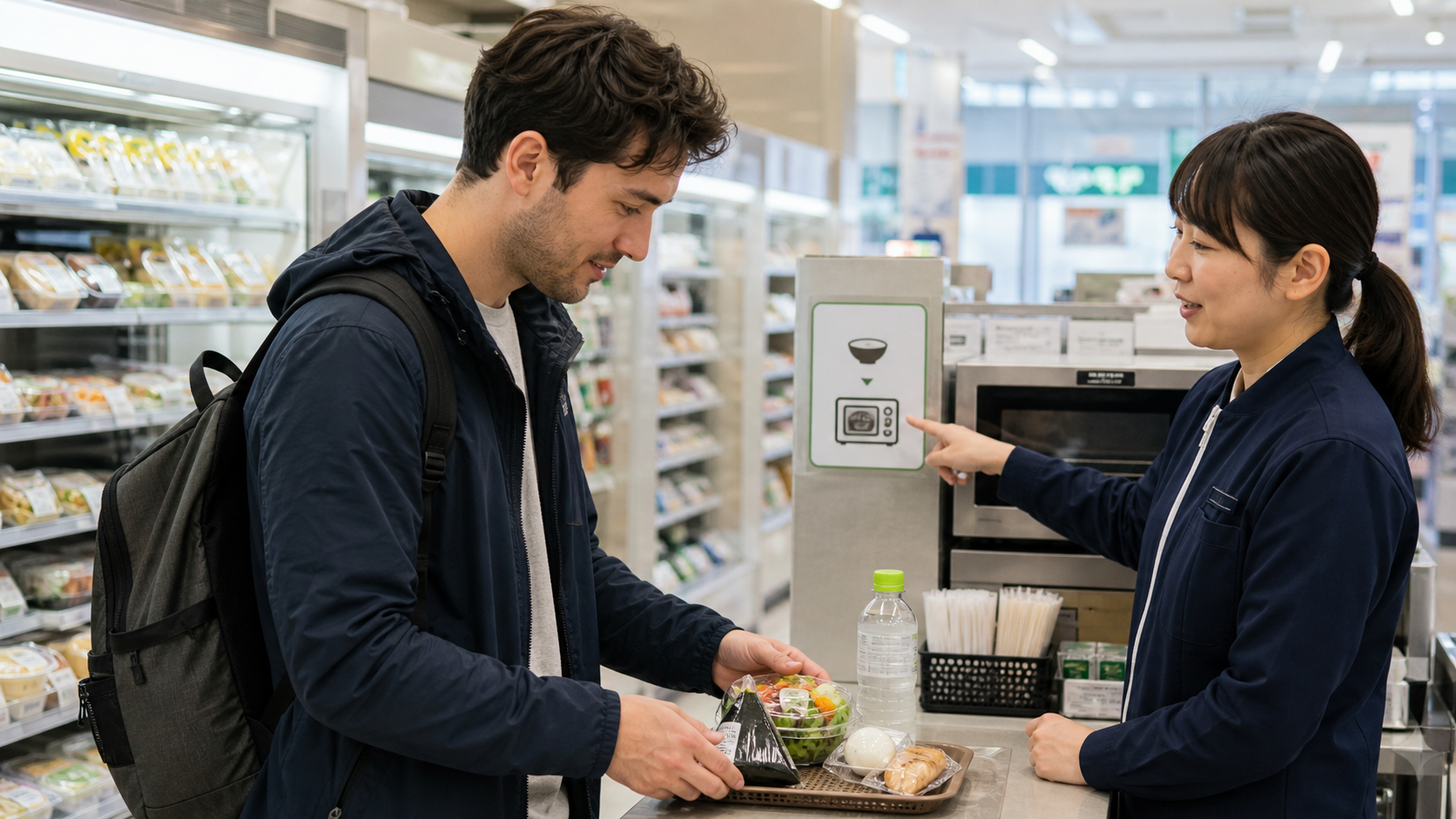
Staff may ask 温めますか? (atatamemasu ka?, “Would you like it heated?”). Reply はい、お願いします (“Yes, please”) or そのままで大丈夫です (“No heating is fine”). Some branches have staff-operated microwaves; others use self-service equipment. Tell the cashier before payment if you intend to use an eat-in space, because the tax treatment or store procedure can differ.
- Check the package for microwave time and whether a lid, sauce packet or film must be removed.
- Ask before heating anything uncertain; never microwave metal, unsuitable packaging or a sealed boiled egg.
- Request chopsticks (hashi) or a spoon (supūn) only when needed.
- For cup noodles or frozen food, confirm that hot water or the correct appliance is available before buying.
6. Eat-in, walking and rubbish etiquette
Use marked eat-in seats only when available and follow time limits or local signs. Do not open food in the sales aisle, block the entrance, or bring outside food into the store. Eating while walking can spill on others; a designated seat, hotel room or permitted park bench is usually calmer.
Store bins are not universal and may be limited to items bought there. Sort packaging exactly as labelled and never carry hotel rubbish into a branch. If you will eat an item soon, Japan’s temae-dori campaign encourages choosing a suitable item from the front of the shelf to help reduce food waste.
7. Budget and dietary needs
As a planning range—not a guaranteed price—allow roughly ¥400–900 for a simple breakfast, ¥700–1,300 for a light lunch, ¥900–1,800 for a fuller meal, and ¥200–700 for a drink or snack. Tourist districts, premium lines and delivery-style branches may cost more.
Halal, vegan and gluten-free needs require more than visual inspection. Check every sauce, stock and seasoning; fried food may share oil, and rice dishes can contain hidden animal ingredients. When uncertainty would be dangerous, buy factory-sealed food with a label you can verify or use a specialist restaurant.
8. First-visit workflow, access and FAQ
- Find the exact branch and confirm opening hours and walking route.
- Choose a meal using the four-part formula.
- Read the date, storage, allergens and heating line.
- At checkout, say whether to heat it and take only needed utensils.
- Eat in a permitted place, then sort waste according to the branch or accommodation rules.
Accessibility: station branches can be narrow, with high shelves and crowded self-checkouts. Look for a step-free entrance and wider suburban branch, or ask 手伝っていただけますか? (“Could you help me?”). Accessible toilets and seating are not guaranteed.
Are all konbini open 24 hours? No. Confirm the individual branch. Can I use an overseas card or ATM? Acceptance varies by terminal, issuer and branch; carry a backup payment method. Can I eat every meal there? You can, but mixing konbini convenience with local restaurants gives better variety and cultural value.
Official references: Japan Consumer Affairs Agency, Food Labelling and allergen information; Ministry of Agriculture, Forestry and Fisheries, Temae-dori and food-loss reduction; Japan National Tourism Organization, customs and etiquette. Details and prices may change; verify the package and branch on the day.