

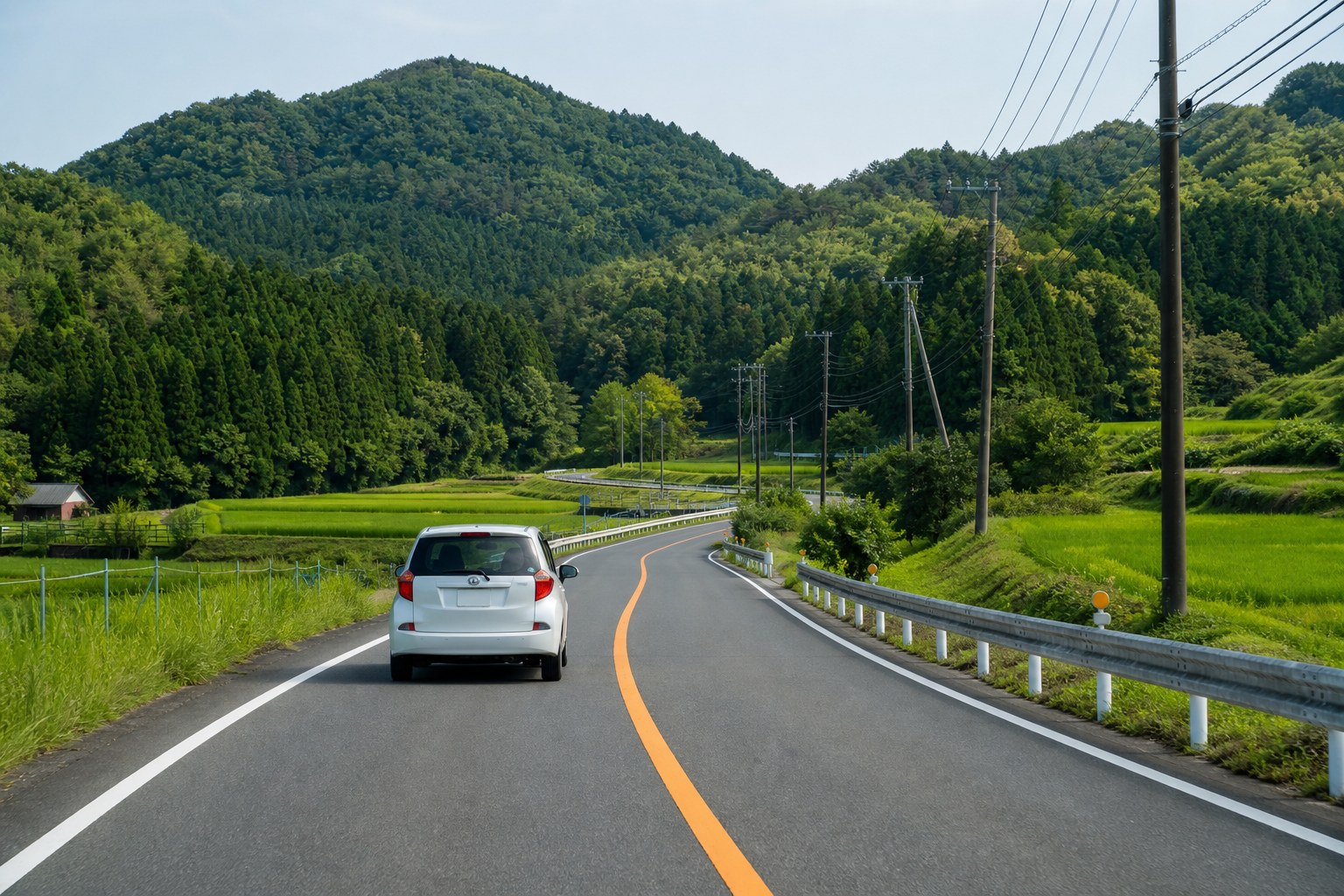
Driving in Japan
Licenses · Traffic Rules · Road Signs
Japan drives on the left — with strict, uniquely Japanese rules. This guide covers everything from license eligibility to road etiquette.
Which Licenses Are Valid in Japan?
Japan recognises foreign licences under two frameworks: the 1949 Geneva Convention on Road Traffic and bilateral agreements. Whether you can legally drive depends entirely on the country that issued your licence.
The following countries have signed special agreements with Japan. Holders of a valid national licence together with an official certified Japanese translation (issued by the Japanese Automobile Federation / JAF or each country’s designated authority) may drive in Japan. No IDP is required.
Holders of an International Driving Permit (IDP) issued under the 1949 Geneva Convention, plus the original national licence, may drive in Japan. The IDP is issued in your home country before travel. The following countries are signatories:
Countries that signed only the 1968 Vienna Convention — not the 1949 Geneva Convention — issue IDPs that are not legally recognised in Japan. Attempting to drive with such a permit constitutes unlicensed driving.
The People’s Republic of China is not a signatory to the 1949 Geneva Road Convention, and there is no bilateral licence-recognition agreement between Japan and China. A PRC driving licence and any so-called ‘international driving licence’ issued in mainland China have absolutely no legal validity in Japan. Driving on one will be treated as unlicensed driving, resulting in severe penalties and possible voiding of accident insurance. To drive in Japan, you must obtain a Japanese licence.
Japan’s Unique Traffic Rules
Even with a valid licence, Japan’s road rules differ significantly from most countries. These eight points are the most important to know.
Vehicles drive on the left side of the road and the steering wheel is on the right. Drivers from right-hand-traffic countries must pay careful attention after turning at intersections — right turns require a wider sweep while left turns stay in the near lane, the opposite of what most people are used to.
Japanese law requires all vehicles to come to a complete stop before crossing any railway level crossing — regardless of whether the barrier is down. After stopping, look left and right to confirm no train is approaching before proceeding. Violations carry heavy fines, and accidents are catastrophic.
Japan’s legal BAC limit is just 0.03% (‘Alcohol-Influenced Driving’). In practice, even a small drink can put you over the limit. Penalties reach 5 years imprisonment or a ¥1,000,000 fine. Do not drink a single drop before driving.
Using a handheld phone while driving — calling, viewing, or operating — is a serious offence, punishable by up to 6 months imprisonment or a ¥100,000 fine. Operating a device at a red light is also illegal. Always pull over completely, or use a Bluetooth hands-free device.
Vehicles must unconditionally yield to pedestrians at all zebra crossings. Even if a pedestrian has only stepped onto the kerb to cross, you must stop. Failing to yield can result in a fine of up to ¥20,000 and may void your insurance if an accident occurs.
Virtually no legal roadside parking exists in Japanese cities, and enforcement is relentless. Always use a coin parking lot (コインパーキング) or multi-storey car park. Illegal parking results in an immediate ticket (from ¥15,000) and towing fees exceeding ¥30,000.
Roads marked with a ‘Zone 30‘ sign have a maximum speed of 30 km/h. Slow down proactively near schools and during school hours — Japanese primary school pupils typically walk in groups and may step out suddenly.
Most Japanese expressways are toll roads. When renting a car, we recommend also renting an ETC transponder (approx. ¥500/day) for automatic toll payment without stopping. Standard speed limit is 100 km/h; some sections (e.g. Neo Tomei) allow 120 km/h. Seat belts are mandatory for all occupants, including rear passengers.
Japan Speed Limits at a Glance
| Road Type | Speed Limit | Note |
|---|---|---|
| Zone 30 / Residential | 30 km/h | Strictly enforced in residential areas |
| General Residential | 40 km/h | Default when no sign posted |
| National / Prefectural Road | 50–60 km/h | Follow roadside signs |
| Expressway (Standard) | 80–100 km/h | Minimum 50 km/h |
| Neo Tomei and Designated Sections | 110–120 km/h | Indicated by special signs |
Essential Japanese Road Signs Illustrated
Japanese road signs are divided into three categories: Regulatory signs (prohibitions/restrictions), Warning signs (hazard alerts), and Guide signs (directional information). Colours and shapes carry specific legal meanings.
Road Etiquette & Safety Tips
Most rental companies require you to return the car with the same amount of fuel as when you picked it up (usually full). Refuel before returning to avoid a hefty surcharge. Look for self-service stations (セルフ) for the best prices.
Service areas (SA) and parking areas (PA) on Japanese expressways are excellent — they have clean toilets, food stalls, shops, and regional specialities. Don’t miss them on long drives.
In Japan, call 110 for police (accidents, crimes) and 119 for ambulance / fire. For non-emergency police consultations, dial #9110. Some rental car companies also offer 24-hour road-side assistance.
Many rural Japanese roads are extremely narrow — mirrors protruding from buildings and convex safety mirrors at blind corners are common. Drive slowly and use your horn gently when approaching blind corners on mountain roads.
Frequently Asked Questions
Australia is a signatory to the 1949 Geneva Convention, so an IDP (issued in Australia before departure) together with your original Australian licence allows you to drive in Japan.
An IDP is valid for one year from the date of issue. The one-year limit starts from the date of issue — not from when you arrive in Japan. For visits of up to one year, the IDP remains valid for the duration of your stay.
Yes. Under the Japan–Taiwan bilateral agreement, a valid Taiwanese driving licence together with an official Japanese translation (available from the Japan-Taiwan Exchange Association) allows you to drive in Japan without an IDP.
Driving without a valid licence in Japan (‘unlicensed driving’) carries a maximum penalty of 3 years imprisonment or a ¥500,000 fine. Your rental car insurance will also be voided, meaning you are personally liable for all damage.